

The Wild Ride EP suggests a restless mix of self-confrontation, power, and conflict, themes echoed in titles such as “Break the Mirror,” “Super Power,” and “War Machine.” Its tracks also feature in the 2014 Lifetime movie Don’t Look Back. Together, those details offer a starting point for understanding the sound and visual reach of Taylor McCluskey’s music.
A track title can hint at a song’s mood, but you have to hear the songs together to understand the full picture. This guide explores the themes of Taylor McCluskey’s music without treating titles as a substitute for listening. It also looks at his career, a musical influence he has named, and artists listeners may enjoy alongside his work.
From the energy of Wild Ride to later releases and live performances, McCluskey’s work spans music, film, and the stage. Read on for a closer look at the EP’s themes, key career milestones, and the sounds that help put his music in context.
Key Takeaways
- Explore the themes suggested by Wild Ride and see how its tracks connect with the film Don’t Look Back.
- Trace key career milestones, from releases such as Reckless and War Machine to live performances.
- Consider how Mazzy Star’s So Tonight That I Might See offers a glimpse into McCluskey’s listening influences.
- Use the guide to compare musical textures and find artists whose sound may appeal to you.
- Learn how to think about genre through the music itself, rather than relying on labels alone.
The Wild Ride EP and music placements
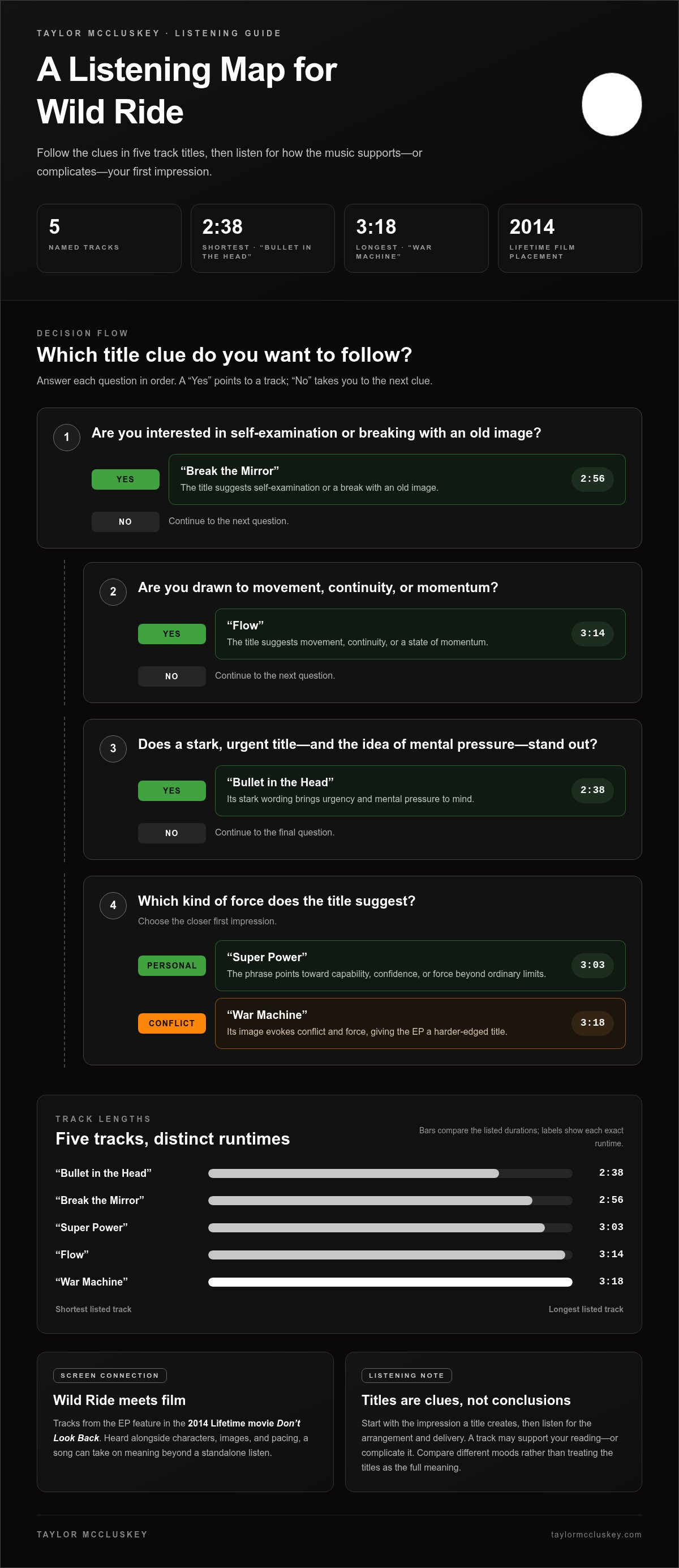
The Wild Ride EP connects Taylor McCluskey’s songs with screen storytelling. Tracks from the EP feature in the 2014 Lifetime movie Don’t Look Back. That placement gives the release a cinematic context, while the song titles invite listeners to consider themes of identity, strength, conflict, and movement. The titles offer clues, not a complete account of each song’s meaning.
Track lengths offer a practical way into the EP. They show how each song occupies its own space, from the shortest listed track to the longest. Use the titles as prompts, then listen for how the music develops the ideas they suggest.
- “Break the Mirror” runs 2:56. Its title suggests self-examination or a break with an old image.
- “Super Power” runs 3:03. The phrase points toward capability, confidence, or a force beyond ordinary limits.
- “Bullet in the Head” runs 2:38. Its stark wording brings urgency and mental pressure to mind.
- “Flow” runs 3:14. The title suggests movement, continuity, or a state of momentum.
- “War Machine” runs 3:18. Its image evokes conflict and force, giving the EP a harder-edged title.
Compare the titles before listening, then notice whether the performance supports or complicates your first impression. For example, “Flow” may suggest ease, while “Bullet in the Head” signals a sharper emotional frame. That contrast can help you hear the EP as a collection of distinct moods rather than one uninterrupted idea.
The Don’t Look Back placement adds another layer. A song heard within a film can take on meaning through its relationship to characters, images, and pacing. The EP tracks featured in the 2014 Lifetime movie therefore reach beyond a standalone listening context. The placement also links McCluskey’s musical work with screen production, without requiring listeners to treat the songs as film scores.
For a focused listen, start with one title and consider the impression it creates. Then compare it with another track. “Super Power” and “War Machine,” for instance, both imply force, but suggest different kinds: one personal, the other mechanical or collective. The arrangement and delivery shape whether those readings hold.
Wild Ride is useful to explore through both its five named tracks and its film connection. The listed durations range from “Bullet in the Head” at 2:38 to “War Machine” at 3:18. Listen for contrasts in mood, then consider how a track’s meaning might shift when paired with a film scene. Those two angles provide a grounded entry point into the EP.
Musical career
Taylor McCluskey’s career spans studio releases and live performance. He has headlined at The Whisky, The Viper, and HOB, bringing his recorded work to established stages. His discography also traces a continuing release history, with albums and singles spanning multiple years. Together, these milestones offer a way to follow his development through recordings and performances.
Several releases mark distinct points in that timeline. Reckless is listed as a 2017 album, followed by the single “Super Power” in 2023 and the album War Machine in 2024. In 2026, McCluskey’s releases include the single “Break the Mirror” and a live EP recorded at Piccolo Studios. The dates make it easier to explore his catalogue chronologically.
- 2017: Reckless, an album.
- 2023: “Super Power,” a single.
- 2024: War Machine, an album.
- 2026: “Break the Mirror” and a live EP from Piccolo Studios.
Star God marks another major album milestone. It is McCluskey’s fourth full-length studio album, which he described as a work in progress for two years. He also framed the record as a forty-seven-minute listening experience. That approach suggests a deliberate sequence, where the full runtime matters as much as the individual songs.
McCluskey has described a hands-on writing and recording process. He usually begins songs in his home studio by playing a 1983 Les Paul Custom. For Star God, he and Glen Robinson sent tracked music files to Zak St. John to record live drums. The music was mixed and mastered as separate production stages. Those details map a collaborative process from initial writing to finished recordings.
The work continues with 24 hrs., a new 10-track record McCluskey is developing with Glen Robinson. That project adds a forward-looking chapter to a career already marked by albums, singles, and live recording. McCluskey also has 12 composer credits listed, reflecting work beyond the identity of a performing artist. The arc of Taylor McCluskey’s music is best followed through its releases, collaborations, and live-stage history.
Explore the catalogue by release type as well as chronology. Start with an album to hear a longer sequence, then compare it with a single such as “Super Power” or “Break the Mirror.” A live EP offers another perspective on performance. Moving between formats makes it easier to notice how a track changes in context and how each release contributes to McCluskey’s career.
Play counts offer another snapshot of how listeners encounter the catalogue. “Break the Mirror” is shown with 8,314 plays, while “Super Power” is shown with 106,837 plays. The contrast gives readers a simple way to compare the visibility of these tracks without treating plays as a measure of artistic value.
Other listed tracks broaden that picture: “Bullet in the Head” is shown with 4,925 plays, “Flow” is shown with 25,681 plays, and “War Machine” is shown with 18,850 plays. Read alongside the albums, singles, and live recording, these figures provide a further point of entry into McCluskey’s recorded work. They also make it possible to move from a track’s place in the release timeline to its recorded audience activity, while keeping the focus on the music and the different forms in which it appears.
Musical influences
Taylor McCluskey has named Mazzy Star’s So Tonight That I Might See as a favorite album. That detail offers a useful point of reference, but it doesn’t define his entire sound. An artist’s listening choices can reveal moods and textures they value without proving direct imitation. Treat the album as a listening clue, then compare its atmosphere with McCluskey’s recordings.
Mazzy Star’s record gives you a way to focus on space, guitar tone, vocal delivery, and pacing. Listen for how a song’s atmosphere develops, rather than looking only for similar riffs or lyrics. Then bring that same attention to McCluskey’s songs. The comparison works best as a listening exercise, not as a claim that the artists share an identical style.
- Start with the full album. Listen to So Tonight That I Might See in sequence and notice its overall mood.
- Choose one detail. Focus on guitar texture, vocal presence, or the pace of a song.
- Compare with McCluskey. Listen for a related quality, or for a clear contrast.
- Keep the distinction clear. A shared mood doesn’t establish a direct musical influence.
That distinction matters because a favorite album can shape how listeners interpret an artist, even when the artist hasn’t described a specific song as inspired by it. McCluskey’s named reference is So Tonight That I Might See. It provides a concrete starting point, while his songs remain the best evidence of what his music sounds like.
Try comparing contrasting examples from McCluskey’s catalogue. “Flow” and “War Machine” suggest different imagery, which can prompt separate expectations before you listen. Notice whether each track feels spacious or direct, restrained or forceful. These are observations about your listening experience, not proof that either song borrows from Mazzy Star.
For a closer study, write down one impression after each listen. Note the feature you noticed, such as guitar atmosphere or vocal intensity, and the track that prompted it. Then revisit So Tonight That I Might See and ask whether the same feature stands out. This simple comparison keeps the discussion grounded in sound while distinguishing a stated favorite from a confirmed source for a particular song.
Similar artists
Mazzy Star is a clear starting point for listeners exploring artists connected to Taylor McCluskey. He has named the band’s So Tonight That I Might See as a favorite album. That makes Mazzy Star a relevant listening reference, not proof that the artists sound alike. Use the album to identify qualities you enjoy, then compare them with McCluskey’s recordings.
“Similar” can mean shared mood, guitar character, vocal approach, songwriting, or production. A useful comparison separates those elements instead of relying on a broad genre label. For example, you might connect with one recording’s atmosphere but prefer another artist’s vocal delivery. Naming the specific quality makes recommendations more personal and easier to follow.
- Begin with Mazzy Star. Listen to So Tonight That I Might See and note the musical qualities that hold your attention.
- Choose one comparison point. Focus on atmosphere, guitar texture, vocal style, or the way a song builds.
- Test the connection. Play a Taylor McCluskey track and listen for that same feature, or a contrast.
- Refine your search. Describe the quality you liked, rather than searching only for artists that sound “similar.”
This approach avoids turning a favorite album into an unsupported claim about direct influence. McCluskey’s stated appreciation for Mazzy Star supports a thoughtful comparison, while each artist’s work remains distinct. A shared listening reference can open a path between catalogues without suggesting that one artist copies another.
For a more precise match, consider what you want from your next listen. If you value atmosphere, choose recordings where mood and space draw your attention. If performance matters more, compare vocal presence and phrasing. If composition stands out, focus on how melodies and arrangements develop. These criteria help you find meaningful connections beyond surface resemblance.
Keep a short note after each comparison. Write “Mazzy Star, atmospheric guitar” or “McCluskey, stronger contrast,” based on what you hear. Then use that description to guide your next discovery. This method is more useful than treating an artist comparison as a fixed label. It also leaves room for contrast: sometimes a different sound is what makes a recommendation rewarding.
For a named listening reference, Mazzy Star is a grounded place to begin. Explore So Tonight That I Might See, identify the sound or mood you enjoy, and compare it with McCluskey’s recordings. You’ll get a clearer sense of your own taste without overstating how closely the artists resemble each other.
Sound and genre
Genre labels can orient you, but they rarely explain every choice in a song. When listening to Taylor McCluskey’s music, start with specific elements before settling on a category. Compare the writing, instrumentation, vocal delivery, and production across tracks. Those details help describe what you hear without forcing every release into one fixed label.
Begin with the arrangement. Notice which musical parts lead, how the rhythm supports them, and whether the song builds or stays steady. In “Break the Mirror,” for example, listen to the relationship between the vocal line and instrumental backing. Then compare it with “Flow.” This reveals differences in energy and movement without assuming either song belongs to a particular genre.
Next, consider the recording context. A studio release and a live recording can present the same artist differently. McCluskey’s live EP from Piccolo Studios offers a useful comparison with his studio material. Listen for how performance dynamics, ensemble interplay, and room sound affect your impression. These qualities can shape perceived genre as much as a song’s basic instrumentation.
Production also influences how listeners describe a sound. Pay attention to the balance between vocals and instruments, the clarity of individual parts, and the overall density of the arrangement. Choose a track and note whether its sound feels open or layered, then compare it with another recording. Treat these as descriptions, not definitive genre classifications.
- Rhythm: Listen for a steady pulse, a changing groove, or a more spacious pace.
- Arrangement: Identify the part that draws attention first, such as voice, guitar, or drums.
- Delivery: Notice whether the vocal performance sounds restrained, forceful, or conversational.
- Production: Compare the clarity, density, and balance of the recorded parts.
McCluskey’s named listening reference, Mazzy Star’s So Tonight That I Might See, can also frame a comparison. Focus on one audible quality at a time, such as atmosphere or guitar texture, then decide whether you hear a connection in his recordings. A shared quality doesn’t make two artists interchangeable. It gives you a precise way to explain your response.
To map your own genre impression, select one studio track and one live performance. Write down three observations about rhythm, arrangement, and vocal delivery. Then compare those notes with your first impression. For a direct listen across releases and performances, explore Taylor McCluskey’s music and make your own sound profile from the recordings.
Taylor McCluskey: Music Albums and Singles
Taylor McCluskey offers music albums and singles for listeners ready to explore his recordings. After comparing the tracks, influences, and career milestones discussed above, start with a single, then move between albums to hear how the sound shifts. Releases such as War Machine, “Break the Mirror,” and “Super Power” offer distinct entry points into the catalogue. A live recording adds the energy of performance. McCluskey’s music sits alongside his film projects and live appearances, connecting his recordings to a wider creative output. Visit taylormccluskey.com to explore Taylor McCluskey’s work.
Take the Next Step in Your Listening
Let curiosity guide your next listen. Choose a track that catches your attention, then follow the sound into another release or a live performance. Listening closely to Taylor McCluskey’s music can reveal details a quick first impression misses, from changes in arrangement to the way a song’s mood develops. Your own response is a useful guide to what to explore next.
For listeners ready to go beyond discovery, Taylor McCluskey offers music albums and singles, film production services, and concert tickets. These offerings connect recorded music with screen projects and live performance, giving fans different ways to engage with his work.
Contact Taylor McCluskey to continue the conversation or explore what’s next. Let the next song open a new direction.
Frequently Asked Questions
What are some themes that are explored on this new album?
A grounded reading of Star God can explore scale, identity, and transformation, starting with its title rather than assuming a fixed story. The title invites a cosmic perspective, while listening to the record as a complete sequence can reveal whether its songs form a shared arc. Notice recurring images, shifts in mood, and how the closing moments reshape earlier impressions. This keeps interpretation tied to what you hear.
What do you hope listeners take away from listening to your new album as a whole?
The album invites listeners to give it focused attention and form their own interpretation. Rather than looking for one prescribed message, notice which moments stay with you and why. You might connect with a lyric, a change in arrangement, or a contrast between songs. Those personal connections make listening active while leaving room for different interpretations.
Who are some of your musical influences?
Mazzy Star is a named listening influence. Taylor McCluskey has identified the band’s So Tonight That I Might See as a favorite album. Use that reference as a starting point, not a complete map of his sound. Listen to the album, choose a quality that stands out, then consider how it shapes your expectations when you hear his work.


