

A filmmaker’s website can do more than archive finished work: it can present an independent career on its own terms. A strong independent filmmaker portfolio brings a focused reel, selected projects, festival recognition, awards, career background, and a clear contact route together in one place. Let the work lead, with concise context that shows the filmmaker’s creative direction and role in each project.
Choosing what to show matters as much as the design. A carefully selected body of work helps visitors understand a filmmaker’s perspective, range, and development without searching through every credit. This article explores how independent directors use websites to present their work, with examples of projects, festival and award recognition, and career paths. Each element can make a portfolio more useful to collaborators and audiences while keeping the focus on the films and the vision behind them.
Key Takeaways
- Choose a focused reel and selected projects that show your creative perspective, role, and range.
- Build a filmmaker website that presents your work clearly and gives collaborators a direct way to reach you.
- Place festival selections and awards alongside the projects they recognize, with concise context about each achievement.
- Use education and career milestones to show how your background informs your filmmaking practice.
- Follow a practical sequence to shape your site, organize its content, and keep your portfolio current.
Filmmaking portfolio and selected projects
A strong independent filmmaker portfolio gives visitors three clear signals: what you make, what you contributed, and how to reach you. Start with a concise reel, then select projects that demonstrate your strongest work. Each project entry should identify the title, format, your role, and a brief creative or production note. Finish with a clear contact route.
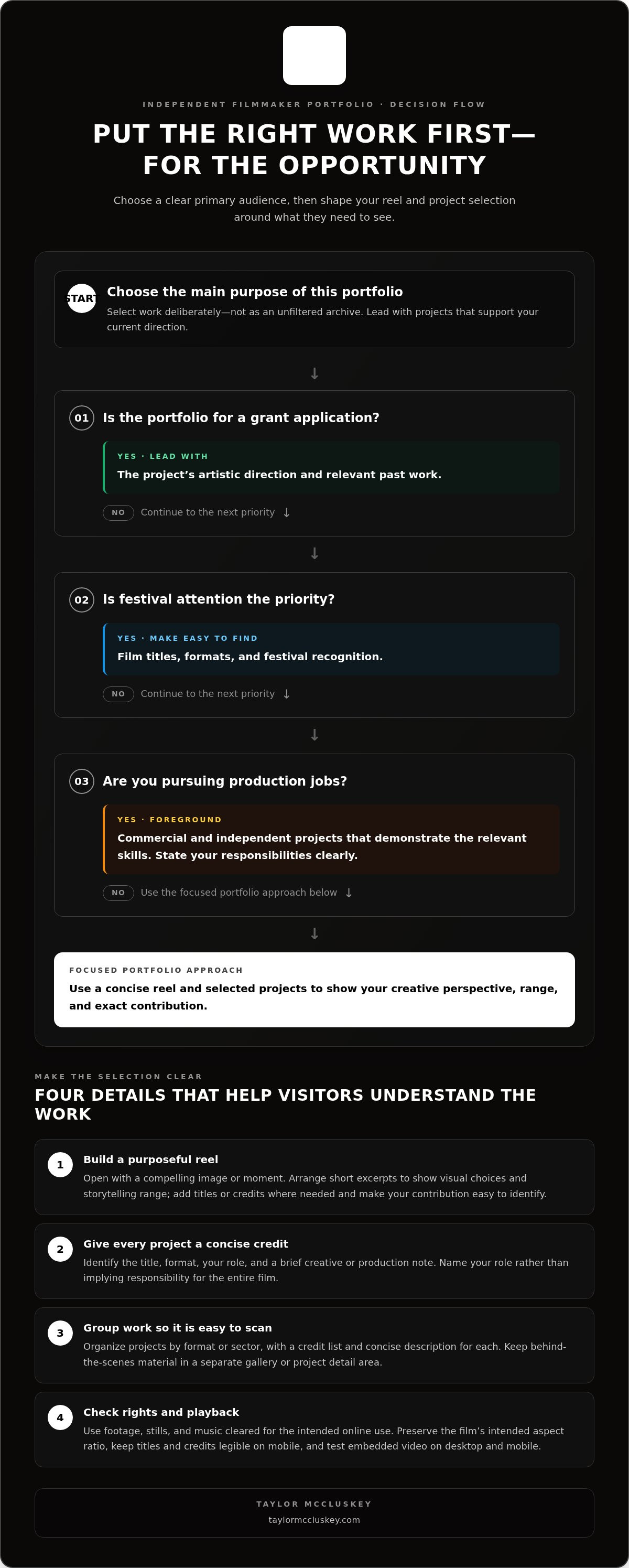
Build a past-project gallery through deliberate selection, not an unfiltered archive. Include completed films, commercial work, and independent projects when they support your current direction. For example, a director seeking production jobs can foreground campaign films and describe their responsibilities; a filmmaker pursuing festivals can lead with narrative shorts and festival milestones. Separate project categories so visitors can quickly find relevant work.
Use concise case notes to explain a project. Situation: Sam Icklow’s portfolio includes the sixth episode of While The Men Are Away. Action: He crafted the episode. Result: This specific production credit gives visitors a project to explore. Keep your own entries just as precise: name your role rather than implying responsibility for the entire film.
Copyright and music licensing rules for films in a portfolio: Use footage, stills, and music that you are cleared to display in your portfolio. Check that music rights cover the intended online use: a track cleared for one context may not cover another.
How to build a reel: Open with a compelling image or moment, then arrange short excerpts to show your visual choices and storytelling range. Add clear project titles or credits where needed, and make your contribution easy to identify. A cinematographer, for instance, can foreground camera work, while a director can emphasize performance and scene construction.
How to organize films, credits, and behind-the-scenes work: Group projects by format or sector, then give each its own credit list and concise description. Put behind-the-scenes material in a separate gallery or project detail area, such as production stills for a short film. Maurine Pagani’s use of Super 8 film offers a concrete example of a distinctive format that can be identified in project context.
Video specifications: Preserve each film’s intended aspect ratio and provide a clean, legible playback version. Keep titles, captions, and credits readable on mobile screens, and avoid compression that obscures image detail. Test every embedded video on desktop and mobile before publishing so viewing is straightforward.
Tailor the selection: For grants, foreground the project’s artistic direction and relevant past work. For festivals, make film titles, formats, and recognition easy to find. For production jobs, emphasize commercial and independent projects that demonstrate the required skills. Andrew Cussens says he is personally responsible for every project he produces and serves as the client’s main contact, showing how a clear role statement can sharpen a portfolio credit.
Filmmaker websites for independent directors
A director’s website can function as a creative platform, not merely an online résumé. It should make the filmmaker’s perspective visible, guide visitors through selected work, and provide a direct contact route. Independent filmmakers can build platforms where they are instead of waiting for Hollywood’s permission. A focused site can connect local projects, collaborators, and audiences around a distinct body of work.
Best platforms for hosting filmmaker reels and film projects: Choose a video-hosting platform with reliable playback and embed its player on your own website. This combines the control of a personal portfolio with dedicated video delivery. Keep project pages consistent, and test playback on phones and computers before sharing the site.
How much does a filmmaker portfolio website cost? Cost depends on the project’s scope, and a quote follows a quote request. Design, hosting, video delivery, custom features, and ongoing maintenance all shape the work involved. A simple site with a reel and project pages has different needs from one with frequent updates or extensive video content.
How to optimize a filmmaker portfolio for search engines and clients: Give every project a descriptive title and a short, original summary. State the director’s role and the film’s format in visible page text. Use clear headings, descriptive page titles, and meaningful image descriptions. Make contact information easy to find, and organize projects by genre, format, or sector. These details help visitors understand the work and give search engines useful context.
Build the site in a deliberate order. First, choose the audience and the projects they should see. Next, create a homepage, project pages, a biography, and a contact page. Add a reel and selected stills, with concise credits beside each film. Finally, review every page on mobile and desktop. A director seeking festival attention can lead with narrative work; one pursuing production roles can foreground relevant commercial projects.
Keep the site active as the work evolves. Replace outdated lead projects, add new credits, and remove pages that no longer reflect the director’s practice. For an example of film work presented within a broader creative practice, explore film production services.
Awards and festival recognition
Festival recognition adds useful context to a filmmaker’s project history. A selection, nomination, semifinalist result, or award shows how a film or script has been presented to audiences and juries. Label each distinction accurately. Include the project title, festival name, recognition type, and year when available. Precise wording helps visitors distinguish a screening from a win, or a script result from a film award.
Case: Greenback$. The situation was an award-winning short film with a performance credit worth highlighting. Taylor McCluskey received Best Actor at the Independent Filmmakers Showcase Film Festival in 2017 for Greenback$. On a project page, connect the recognition directly to the film and identify the category. The result is a specific achievement that gives readers context about the film’s reception and McCluskey’s role.
Case: Youngblood. An original script entered a festival recognition process and became a semifinalist at Flickers’ Rhode Island International Film Festival. Present this as a script distinction, not a film award or completed-film screening. The credit shows development work alongside produced projects. Keep the festival name and recognition status together so the achievement is clear.
Use one consistent format for every entry. State the project first, then the event and the exact result. Add the year when it’s available, and distinguish awards from selections, nominations, and semifinalist placements. For example, write “Best Actor, Independent Filmmakers Showcase Film Festival, 2017” for Greenback$. Give Youngblood its own entry, identifying it as an original script and its semifinalist recognition.
Recognition works best when visitors can connect it to the work itself. Place the festival credit near the relevant project description, synopsis, and credits. For Greenback$, specify the acting category alongside McCluskey’s role. For Youngblood, make clear that the recognition applies to the script. This prevents a festival result or award from appearing to cover unrelated projects.
- Prioritize relevance: Feature distinctions connected to the projects you want readers to explore.
- Use exact labels: Keep awards, selections, nominations, and semifinalist results distinct.
- Add project context: Connect each recognition to the film or script it concerns.
- Update with care: Add new milestones while preserving accurate earlier credits.
The Greenback$ acting award and Youngblood script recognition illustrate different forms of festival acknowledgment. Both can strengthen a professional profile when described precisely. Keep the project at the center, use the festival’s full name, and let the recognition support the story of the work rather than replace it.
Guillaume Collin's film Babatoura was released in 2021 and won the Best International Short Film Award at the Torino Film Festival. Record the release year alongside the exact award title, keeping the distinction attached to the film rather than a general career summary. This gives visitors a clear account of when the work appeared and how it was recognized.
Hans Vercauter's short film Wolf's Milk won the Jury Prize at the Montreal World Film Festival. No year is supplied, so leave it out rather than infer one. Keeping the festival and prize together makes the credit clear and avoids implying another form of recognition. Precise wording lets readers compare achievements without confusing awards or project formats.
Education and career backgrounds
An education and career section should explain how a filmmaker developed their practice without reading like a full résumé. Connect each credential or milestone to the work shown elsewhere on the site. Wyatt Maw’s graduation from the American Film Institute Conservatory as a directing student gives visitors a specific training background. Pair the detail with relevant directing credits, not an unfiltered list.
Case: Wyatt Maw. Maw graduated from the American Film Institute Conservatory as a directing student. State the credential precisely and connect it with selected work. This gives visitors a clear account of his educational background without suggesting that the credential alone defines his filmmaking.
Case: Sam Icklow. Icklow has an MFA from UCLA, a concise educational milestone to place beside his project credits. His portfolio can connect the degree with work he has crafted, including the sixth episode of While The Men Are Away. Together, these details show both his educational background and a specific production contribution.
Case: Guillaume Collin. Collin is a Berlinale Talents alumnus. The situation is a filmmaker documenting professional development beyond a degree. The action is to identify the program accurately and place it beside selected projects. The result is a career profile that shows another kind of development milestone. His award-winning film Babatoura provides a related project reference, rather than leaving the credential without creative context.
Career changes can be just as revealing as formal study. Des Mulland switched to directing full time in 1998. Present that transition as a dated milestone, then show the directing work that followed. The result is a readable career timeline, not an unsupported claim about what caused later success. Keep transitions factual and let project credits illustrate the practice.
Leadership credits also clarify a filmmaker’s professional path. Jose Betancourt has been an executive producer at Habitant Productions since 2019. A portfolio can state the role and organization, then connect that experience to relevant projects. This gives visitors a concrete view of his production background. Distinguish executive producing from directing, writing, or other credits so each contribution remains clear.
Use a consistent structure for each biography entry:
- Background: Name the school, program, organization, or career milestone.
- Action: State the degree, role, or transition accurately.
- Context: Connect it to a relevant project or credit.
These examples show several paths: Maw’s directing studies, Icklow’s MFA, Collin’s Berlinale Talents experience, Mulland’s career shift, and Betancourt’s producing role. An edited biography makes those differences clear. Select details that help readers understand a filmmaker’s route into the work, and keep every title, date, and credit consistent across the site.
Career paths need not begin in established centres. Independent filmmakers can build momentum in emerging markets before moving to traditional industry hubs. Keep this context distinct from education credentials.
How to create a filmmaker portfolio website step by step
Build the site around the work you want people to discover. An independent director seeking festival audiences needs a different front page from a filmmaker pursuing production jobs. Use these steps to make the site clear, useful, and easy to maintain.
- Set the purpose. Choose the primary audience first: collaborators, festival programmers, clients, or viewers. A director pursuing narrative projects might lead with a short film. Someone seeking commercial work could foreground relevant campaigns. This decision guides the site’s structure and the projects visitors see first.
- Choose a domain and platform. Select a domain that’s easy to remember and closely tied to your professional identity. Pick a website platform that supports project pages, embedded video, and readable mobile layouts. Before committing, build a sample page for one film. Check that its title, synopsis, credits, and video display clearly.
- Plan the pages. Create a homepage, selected-work page, biography, and contact page. Add separate project pages when a film needs more context. For example, a documentary page can include its subject, your role, a trailer, and production stills. Keep navigation labels direct so visitors can find films without guessing.
- Prepare project materials. Gather each film’s title, format, release details, synopsis, credits, and approved stills. Check spelling and role descriptions against your film credits. Add a short note that explains your creative contribution. A director’s project page might describe a visual approach, while an editor’s page can clarify editing responsibilities.
- Add the reel and test playback. Choose a representative reel that reflects your current direction. Embed it on the homepage or selected-work page, then test playback on mobile and desktop. Check the image, sound, captions, and surrounding text. If a video loads slowly or appears cropped, adjust its display before sharing the site.
- Make contact simple. Place a clear contact route in the site navigation and near relevant project details. Include a concise invitation for collaborators or production inquiries. Test the contact form or email link yourself. A visitor who has just watched a film should be able to find the next step easily.
Before launch, review every page as a first-time visitor. Can they identify the filmmaker, understand each role, and reach the work without unnecessary clicks? Fix broken media, inconsistent credits, and vague page titles. Then share the site with a trusted collaborator and use their feedback to clarify anything that is hard to follow.
Keep the portfolio current as projects develop. Replace an outdated featured film when new work better represents your direction. Update festival credits and biographies as milestones change. For a practical look at work spanning film and music, explore Taylor McCluskey’s creative projects.
Taylor McCluskey: Music Albums and Singles
Taylor McCluskey’s music albums and singles offer another way to explore a multidisciplinary creative practice. After reviewing filmmaker portfolios, consider how music and film can sit within one artistic identity. His film production services can support projects that call for film production. The wider site also features concert tickets and artist merchandise, giving fans ways to follow his work beyond the screen.
Turn to Taylor McCluskey when you want to explore his music releases or film work in one place. For project inquiries or to discover more, visit taylormccluskey.com.
Put Your Next Creative Step in Motion
Your portfolio can evolve with your work. Treat it as a living creative statement, and revisit it whenever a new project changes the story you want to tell. The next step might be refining a project page, shaping a new film, or finding collaborators who understand your vision. Let each update reflect where your filmmaking is headed, not just where it has been.
An independent filmmaker portfolio works best when it opens a door to the next meaningful conversation. If you’re developing a film project and want to connect with Taylor McCluskey, get in touch about your project. Bring a clear sense of the work you want to make and the creative direction you want to pursue. The conversation can begin with the project itself, its purpose, and the kind of production support it needs. Keep moving forward with intention. Your next chapter starts with the work you choose to make.
Frequently Asked Questions
What should an independent filmmaker include in a portfolio?
An independent filmmaker portfolio should help viewers understand the filmmaker’s creative identity and assess their work. Alongside selected films, add a concise director’s statement about recurring themes or influences. A project page can credit key collaborators, such as the cinematographer or editor, and state whether the film is completed, in production, or seeking support. This context helps visitors understand the project’s stage and how they might engage.
Best portfolio websites for independent filmmakers
A personal website with a focused reel, selected project pages, and an easy-to-find contact route is a strong foundation. Embed a video-hosting platform with reliable playback, then test it on phones and computers.


