

A strong film starts with a crew plan that serves the story and the budget. Hiring an indie film production company means aligning the production scope, crew roles, schedule, and budget before filming begins. A production partner can map the work, identify the freelancers and key crew members needed, and organize budget categories around the project’s demands.
It’s reasonable to want creative ambition without losing control of production decisions. Start by understanding what the company will handle, how crew needs are determined, and which choices could affect the budget as the plan develops.
This guide explains how to assess production services, build a crew plan, and approach budgeting for an independent film. You’ll also learn what to clarify in the working relationship and how Taylor McCluskey’s film production services can support a project moving from planning toward production.
Key Takeaways
- Build the budget around the script, schedule, locations, crew needs, and production scope so creative priorities guide spending.
- Compare production companies by how clearly they explain their process, crew planning, and approach to your project’s needs.
- Read portfolios and credits for relevant experience, consistent craft, and evidence of work that fits your film’s scale and vision.
- Put responsibilities, deliverables, payment terms, schedule, and change procedures in the production agreement.
- Define ownership, copyright, and distribution rights in writing so everyone understands how the finished work can be used.
Production budgeting
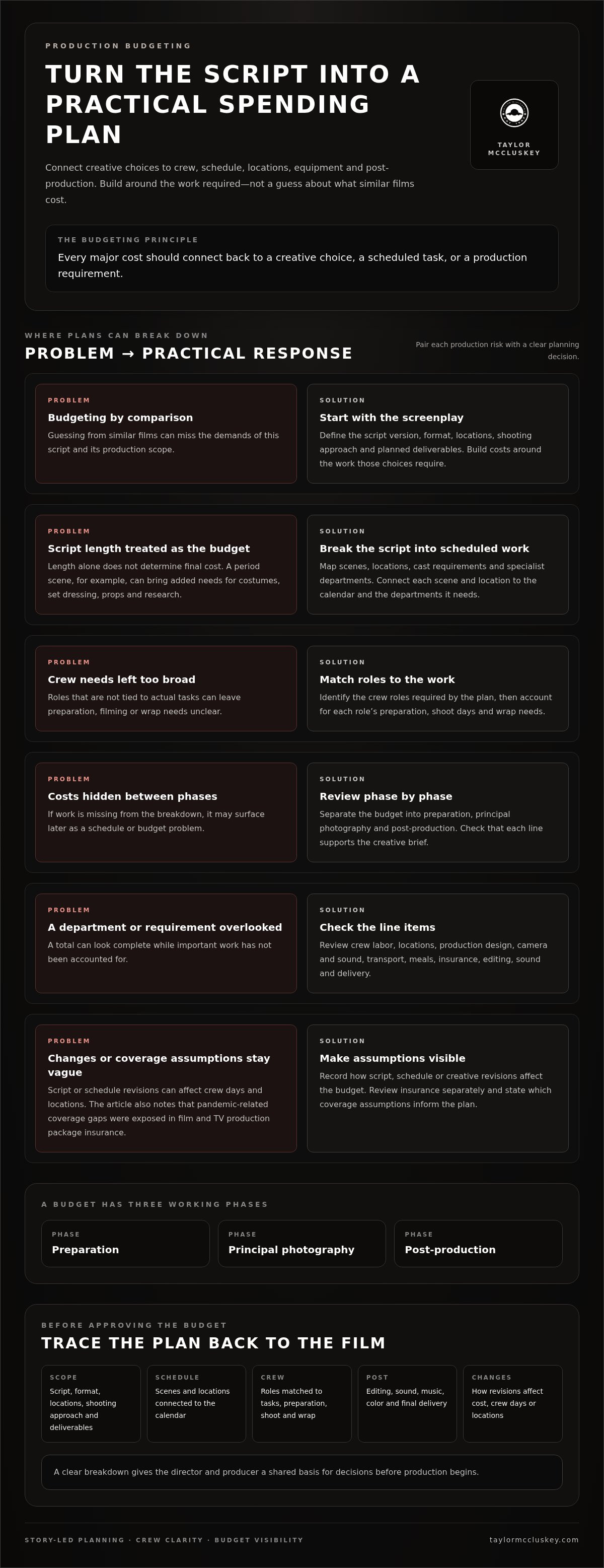
A useful production budget turns the script into a practical spending plan. It connects creative choices to crew, schedule, locations, equipment, and post-production needs. Start with the screenplay and a clear production scope. Build the budget around the work required, rather than guessing what similar films cost.
A freelance line producer consulting listing dated Oct 5, 2026, described a short-term, pre-production engagement. Treat that as one project example, not a standard for other films. Its period setting may shape locations, costume design, props, and research. Its script length alone does not determine the final budget.
Ask the production team to break the script down into scheduled work. Scenes, locations, cast requirements, and specialist departments all shape the plan. The company can map those needs into budget line items and flag where the schedule may create cost pressure. For example, a period scene may require coordinated costumes, set dressing, and props. A location change can add transport and setup needs. Each choice has practical production consequences.
Review the budget by phase and department. A working breakdown commonly separates preparation, principal photography, and post-production. Within each phase, examine crew labor, locations, production design, camera and sound needs, transport, meals, insurance, editing, sound, and delivery. Check that every line supports the creative brief. Missing work does not disappear, it can surface later as a schedule or budget problem.
- Scope: Define the script version, format, locations, shooting approach, and planned deliverables.
- Schedule: Connect each scene and location to the production calendar and required departments.
- Crew: Match roles to actual tasks, then account for preparation, shoot days, and wrap needs.
- Post-production: Include editing, sound, music, color, and final delivery requirements.
- Changes: Record how script, schedule, or creative revisions affect the budget.
Review insurance separately. According to the U.S. Government Publishing Office, the pandemic exposed coverage gaps in film and TV production package insurance. Treat coverage as a production risk alongside the schedule, locations, and planned activities. The budget should make clear which coverage assumptions inform the plan.
Before approving a budget, trace major totals back to the schedule and creative choices. Ask which assumptions could change and how revisions would affect crew days or locations. Hiring an indie film production company is most useful when the budget process makes those connections visible. A clear breakdown gives the director and producer a shared basis for decisions before production begins.
How do I find and vet indie film production companies near me?
Start with your film’s actual production needs, not a broad search alone. A feature shooting across several locations needs different coordination from a contained drama. Write a short brief covering genre, script status, locations, schedule, crew needs, and intended deliverables. Use it to compare companies on relevant experience and practical fit.
Search local film commission directories, regional film offices, production communities, and referrals from filmmakers. Add the city or region where you expect to shoot, then review company websites and project credits. A nearby office can simplify location coordination, but proximity matters less than the company’s ability to manage your production’s scope and workflow.
Move from search results to direct evidence. Look for a consistent company identity across its website, portfolio, and project credits. Check whether its credited work resembles your film in format, tone, production demands, or intended audience. A dialogue-driven drama and a location-heavy period film, for example, require different planning strengths.
- Send a focused brief. Share the same project summary with each shortlisted company. Include the script stage, intended locations, schedule expectations, and the areas where you need production support.
- Compare the response. Notice whether the company asks relevant questions about the script, production scope, and priorities. A useful response should address your project, not rely on generic claims.
- Discuss crew planning. Ask how the company approaches department needs, freelancer coordination, and communication during preparation and filming. Clear roles help prevent gaps between creative decisions and production logistics.
- Request relevant references. Speak with filmmakers whose projects resemble yours. Ask about communication, planning, problem-solving, and how changes were handled during production.
Use the conversation to assess working compatibility. Explain a real constraint, such as a limited location window or a demanding scene, and listen for a practical response. The company should explain its reasoning and identify which decisions affect the plan. Don’t judge fit solely by polished language or a dramatic showreel.
Before deciding, compare each company’s proposed role, communication process, and project-specific approach in writing. Note who would lead production discussions and how crew coordination would work. This gives you a clear basis for evaluating options, rather than treating the lowest estimate or closest office as the automatic choice.
As you assess creative fit and production approach, you can also explore film production work for a sense of how a project’s story can shape its execution.
What should I look for in an indie film production company's portfolio and credits?
A portfolio shows finished images; credits reveal who did the work. Read them together. For each project, identify the company’s specific role, such as production, co-production, or a service contribution. A company credited for production may have handled different responsibilities from one providing a limited production service. That distinction helps you compare relevant experience with your film’s actual needs.
Choose examples that resemble your project in format, tone, and production demands. A contained drama, for instance, may demonstrate performance-led storytelling and controlled locations. A period piece may show experience coordinating design details and visual continuity. The story doesn’t need to be identical. Look for comparable challenges and visible solutions.
Review each available film from opening to end credits, rather than judging only its trailer or showreel. A polished montage can demonstrate visual taste, but may leave out pacing, sound, performance, or scene transitions. Note what works for your project and where the company’s contribution appears. If a project credit is unclear, ask what the company handled during preparation, filming, and post-production.
Use this checklist to assess each relevant credit:
- Role: Separate the company’s responsibilities from those of the director, producer, and other production partners.
- Format: Compare features, shorts, documentaries, or other work with your intended format.
- Craft: Look at image, sound, editing, production design, and consistency across scenes.
- Scope: Consider whether the project’s locations, cast, and visual approach resemble your production needs.
- Recency: Note when a project was completed and whether the credited team reflects the people who would work with you.
Credits also help you prepare focused questions. If a company lists a film with several production partners, ask which departments it coordinated. If its portfolio features strong location work, ask how location decisions shaped the finished scenes. Specific questions reveal more than simply asking whether the company can make a good film.
Look for evidence of judgment, not just scale. A restrained scene can demonstrate precise blocking, controlled lighting, and careful sound. A larger-looking sequence may depend on visual effects or extensive design. Ask how creative choices served the story and whether they fit your priorities. The strongest reference is work you can discuss in practical terms.
Finally, compare portfolio evidence with the proposed working relationship. Confirm who would lead production discussions and how the team’s past strengths apply to your project. When hiring an indie film production company, use credits to clarify capabilities, responsibilities, and creative fit, rather than treating them as a list of titles.
What should an indie film production agreement include?
A production agreement should translate the project plan into clear responsibilities. It should identify the parties, their roles, the services covered, and how decisions will be made. For example, distinguish production management from creative approvals. Name the person authorized to approve schedule changes, script revisions, and additional work. Clear wording helps the director, producer, and production company share the same expectations.
Describe the work in practical terms. Attach or identify the relevant script version, production schedule, budget assumptions, and agreed deliverables. If the company is coordinating crew, specify which departments and production phases that responsibility covers. If the arrangement is limited to preparation, define where that phase ends. Avoid broad language such as “manage production” without spelling out the expected tasks.
Review these core clauses before signing:
- Scope and deliverables: List the services, production phases, materials, and final items the company will provide.
- Roles and approvals: Identify decision-makers, communication channels, and who can authorize changes.
- Schedule: Record key preparation, filming, review, and delivery milestones. Explain how schedule revisions are documented.
- Payment terms: Set out the payment schedule, invoicing process, and how approved additional work is handled.
- Expenses: State which project expenses require approval and how receipts or records are submitted.
- Changes and delays: Describe how script revisions, location changes, or postponed filming affect responsibilities and timing.
- Insurance and risk: Clarify the coverage responsibilities and production assumptions relevant to the work.
- Termination and handover: Explain how either party ends the arrangement and what project materials transfer afterward.
Make the change process specific. If a scene moves to another location, the agreement should show who records the revision and who approves its production impact. A written change record can identify the affected task, schedule, expense, and revised deliverable. That creates a traceable decision instead of relying on an informal conversation.
Payment terms should connect invoices to defined work or milestones. For example, an installment might be tied to completion of a preparation deliverable. Define how the parties will handle disputed invoices and approved expenses. Don’t leave payment timing or approval authority to assumptions that may differ between the producer and company.
Address creative materials and rights in coordinated terms. The agreement should identify the materials involved, permitted uses, and any separate rights documents required for the project. Ownership and distribution provisions deserve careful attention because production services alone don’t establish who controls every element. The following rights section examines those distinctions in detail.
Before signing, compare the agreement with the latest project plan. Check that the named parties, script version, schedule, scope, and approval process match. For complex rights or liability language, an entertainment attorney can explain how the wording affects your production. Keep the signed agreement and approved changes together as the project’s working record.
How are ownership, copyright, and distribution rights handled when hiring a production company
Separate three questions in the agreement: who owns project materials, who may use them, and who controls distribution decisions. A production company’s role in making a film does not, by itself, explain every party’s rights. The signed documents should set out the arrangement. For example, distinguish ownership of the finished film from permission to use a clip in a company portfolio.
Start with a rights schedule covering the screenplay, footage, recorded performances, music, artwork, and other materials. For each item, identify its creator or rights holder, intended project use, and any limits or permissions. A composer’s music, for example, may have terms separate from the film’s picture. Clear records help the producer understand what can be included in the final work.
Ask the production company to state its role in writing. Does it provide production services, contribute creative materials, or receive a defined interest in the project? These are different arrangements. Name the work the company will create and explain how the agreement treats it. Avoid relying on phrases such as “all rights included” without specifying which rights and materials they cover.
Distribution terms need the same precision. Identify who can negotiate or approve distribution, which platforms or territories are covered, and whether permissions are exclusive or limited. If a producer plans festival screenings before a streaming release, record how those windows fit the distribution plan. Define who can approve edits, trailers, stills, and promotional excerpts, and how those approvals work.
Use a rights checklist during contract review:
- Materials: List the screenplay, footage, music, artwork, and other project assets.
- Ownership: State who owns each item and the completed film under the agreed arrangement.
- Permissions: Describe allowed uses, restrictions, credit language, and any relevant term or territory.
- Distribution: Assign negotiation and approval responsibilities, including promotional use.
- Records: Keep signed releases, licenses, and amendments with the production documents.
Track changes as production develops. If a scene adds a recognizable song, for example, update the rights records before treating the track as cleared for the film. If new artwork appears onscreen, record its source and applicable permission. A rights log helps the producer connect each final asset to its supporting document.
Before signing, compare the production agreement with any separate writer, performer, composer, or distributor documents. Resolve inconsistent terms before they shape delivery or release plans. Rights language can affect future use, so an entertainment attorney can review complex ownership or licensing clauses. To align production planning with your film’s creative goals, explore film production services.
Taylor McCluskey: Music Albums and Singles
Taylor McCluskey offers film production services for filmmakers moving from planning toward production. As a musician, actor, and filmmaker, he brings a multidisciplinary creative perspective to his film work. Turn to his production services when your project needs a partner to help advance its development and execution.
Taylor McCluskey’s music albums and singles offer another way to explore his creative work. This guide has focused on practical decisions: crew planning, budgets, portfolios, agreements, and rights. Those decisions create a foundation for moving a film forward with clarity and intent.
To discuss your project or learn more, visit taylormccluskey.com.
Give Your Film a Clear Next Move
The next step is to turn your project’s creative direction into a focused production conversation. Before hiring an indie film production company, identify the decision that most needs momentum: shaping the production plan, aligning collaborators, or moving the project toward its next phase. A clear starting point makes it easier to discuss how your vision can take form.
Taylor McCluskey offers film production services, alongside music albums and singles and concert tickets. Explore his work when you’re ready to connect your film ambitions with a multidisciplinary creative practice. Each project begins with its own priorities, voice, and path forward.
Contact Taylor McCluskey about your film to begin a conversation about your project. Your story has its own direction. Take the next step with purpose.
Frequently Asked Questions
What does an indie film production company do?
An indie film production company helps organize the work required to make an independent film. Its role can include developing a production approach, coordinating departments, managing production logistics, and supporting delivery. For example, if a director has a finished script but no crew plan, a production company can help turn the creative requirements into an actionable workflow. Responsibilities vary by project, so define the company’s role before work begins.
How much does it cost to hire an independent film production company?
The price depends on the project and is provided after a quote request. Scope, schedule, locations, crew requirements, production phases, and deliverables all influence the estimate. A short production with few locations has different needs from a feature with complex logistics. Share the script stage and intended work so the proposed scope and estimate reflect the project rather than an assumed standard.
What factors affect indie film production company rates?
Rates reflect the assigned work, production schedule, and project demands. A tightly packed shoot may require more coordination than a flexible schedule. Multiple location moves, specialist departments, night work, or extensive preparation can also affect staffing and logistics. Post-production responsibilities matter too. Compare estimates by checking the tasks, phases, and deliverables each covers, rather than comparing totals without their underlying scope.
What questions should I ask before hiring a film production company?
Ask who will lead day-to-day communication, how production decisions are documented, and how the team responds when plans change. You might ask, “Who approves a revised shooting plan?” or “How will I receive progress updates?” Also clarify what materials the company needs to begin and what format it uses for production documents. Specific questions help reveal whether the working process suits your project and collaboration style.
How do indie film production companies compare with freelancers or larger studios?
An indie production company can map the work, coordinate crew needs, and organize budget categories; freelancers may be brought in for specific roles. The article gives no basis for comparing them with larger studios.


