

A message can be accurate and still fail to connect. Creative visual storytelling services turn complex ideas into narratives people can follow, feel, and remember. Effective campaigns consider audience emotions as well as actions, using visuals to serve the story rather than merely decorate it.
Visual storytelling is more than choosing striking imagery. It gives a message a clear point of view and helps audiences understand why it matters to them. Start with the people you want to reach: their needs, interests, and preferences should shape both the narrative and its visual language.
This article explores why visual storytelling matters and how film, photography, graphic design, social media, and multimedia can carry a narrative. It also explains how to keep a strategy coherent across channels, bringing purpose, audience, concept, structure, and distribution together to clarify complex messages.
Key Takeaways
- Shape a narrative around what your audience thinks, feels, and cares about, not just what you want them to do.
- Choose media that serves the story, from film and photography to audio, motion, and interactive elements.
- Make complex ideas easier to grasp by pairing clear language with purposeful visuals, such as infographics.
- Build a strategy around its objective, audience, concept, structure, visual and text elements, and distribution.
- Keep the narrative and design language consistent across platforms so each touchpoint feels part of the same story.
Why is the practice of visual storytelling so important?
Visual storytelling should do more than reach an audience. It should help viewers understand why a subject matters and feel connected to it. A campaign about a neighborhood garden, for example, could show residents planting, sharing food, and caring for a shared space. Those scenes make belonging visible and give the story human stakes beyond a list of program features.
Emotion gives a narrative its connective thread. Pride, joy, discovery, humor, and nostalgia can each shape how people interpret a brand’s identity. A heritage campaign might use family photographs and familiar rituals to evoke memory. A new-product film might build anticipation through close-ups, sound, and a gradual reveal. Choose an emotional approach to suit the audience, not because it is currently fashionable.
Audience research helps guide that choice. Define who the campaign needs to reach, then examine what those people do, think, feel, and value. A public transit campaign, for instance, might find that commuters care more about reliability than vehicle design. That insight changes the story: show a dependable journey and how it affects someone’s day. Tailored visuals make the message more relevant and engaging.
Agencies, freelancers, and in-house teams differ in scope and structure. An agency can coordinate creative, production, and strategy roles; a freelancer may suit a focused deliverable, while an in-house team brings ongoing familiarity with the brand. Choose based on project complexity, required skills, and the level of coordination needed.
When choosing a creative partner, review relevant work, narrative clarity, audience insight, and consistency across formats. Ask how the process connects research to concept, production, and distribution. A polished reel is useful, but a case study that explains its audience, creative decisions, and intended response offers clearer evidence of strategic thinking.
Rights for commissioned content depend on the written agreement. Define ownership or license, permitted uses, platforms, territory, duration, and exclusivity. Clarify rights for music, photographs, locations, and people appearing on camera, too. Agreeing on these terms before production helps everyone understand how the finished work may be used.
In the United States, creative visual storytelling comes from agencies, production studios, documentary teams, and independent filmmakers. Specialties range from brand campaigns to social content and long-form film. Compare the project's narrative needs with each provider's relevant work and production approach.
Measure engagement against the campaign’s objective. For awareness, track reach and video completion; for conversation, review comments, shares, and saves; for action, monitor relevant conversions. ROI connects campaign outcomes with investment, so define the desired result and attribution method before launch. Reach alone cannot show whether viewers felt something or took action.
Common mistakes include choosing visuals before defining the message, relying on decoration, and treating every platform the same way. Check whether each image advances the narrative and meets the audience’s needs. For regional work, consider local culture, language, settings, and casting. A story grounded in one community may need adaptation elsewhere.
Multimedia narratives using visuals, audio, and interactive features
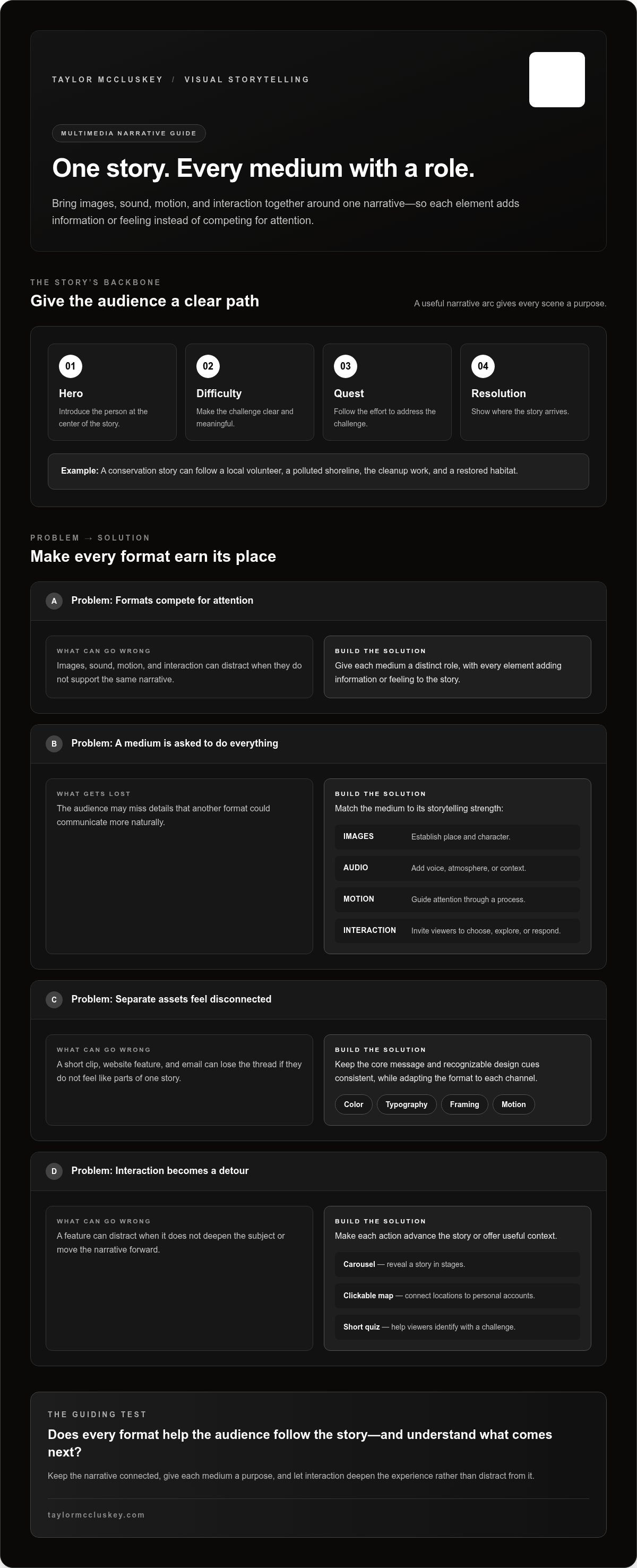
A multimedia story brings images, sound, motion, and interaction together around one narrative. Each element should add information or feeling rather than compete for attention. Imagine a community theater promoting a new production: a short film introduces the central conflict, rehearsal audio reveals the cast’s preparation, and a digital page lets viewers explore the characters. The formats differ, but all serve one story. That connection helps audiences follow the sequence and remember its central idea.
Start developing the narrative with a clear arc. One useful structure introduces a hero, presents a difficulty, follows a quest, and reaches a resolution. In a conservation campaign, the hero might be a local volunteer, the difficulty a polluted shoreline, and the quest the cleanup work, ending with a restored habitat. This structure gives every scene a purpose and helps creative teams decide where dialogue, music, explanatory text, or visual emphasis belongs.
Give each medium a distinct role. Images can establish place and character. Audio can add voice, atmosphere, or context that a frame alone cannot convey. Motion can guide attention through a process, while interactive features invite viewers to choose, explore, or respond. A museum exhibit might pair archival photographs with recorded recollections and a navigable map. Interaction works best when it deepens the subject instead of distracting from the narrative.
Continuity makes separate assets feel like connected touchpoints. Set a consistent visual language for color, typography, framing, and motion, then adapt it to each channel. A short social clip might introduce a character, a website feature reveal their challenge, and an email deliver the resolution. Keep the core message and recognizable design cues consistent. Adapt the format to the platform while preserving the story’s sequence and tone.
Plan the audience’s role before adding interactive features. A carousel can reveal a story in stages; a clickable map can connect locations to personal accounts; a short quiz can help viewers identify with a challenge. Each action should move the narrative forward or provide useful context. Test the experience by asking whether a viewer can understand the next step without instructions. For a film-led narrative, explore cinematic storytelling on screen as one way to consider how sound and visuals can work together.
Visual storytelling differs from traditional advertising by using emotionally resonant narratives to connect people with a brand, rather than pushing features or slogans. Images should serve the narrative, not decorate it; a striking frame earns its place when it deepens the audience’s understanding or feeling. Color, typography, photography, composition, motion, and interactivity can all shape a campaign’s visual language. Make sure these choices reinforce the same story.
That language need not stay fixed: visual storytelling campaigns should adapt to cultural shifts and can use modern design and AI tools to develop stories with agility and impact. Interactive content, gamification, and motion visuals can attract an audience’s attention. Eye-catching visuals, engaging copywriting, and interactive elements such as action buttons and carousel ads can also invite participation. Keep each invitation connected to the narrative, so attention becomes a path into the story rather than a detour.
Visual storytelling as a way to communicate complex messages
Complex information becomes easier to follow when each visual element has a clear role. A public health campaign, for example, could use a diagram to show how prevention works, a short video to demonstrate a practical action, and concise captions to clarify the sequence. The message stays accurate while viewers see how its parts connect. Visual communication is especially useful when people need to compare, locate, or understand relationships quickly.
Use these figures as a reason to design for quick recognition, not as a reason to remove context. A transit map still needs labels, and a chart still needs units. Pair visuals with plain-language explanations so viewers understand what they see and why it matters.
When people need to retain information, combine imagery with carefully chosen words. A nonprofit explaining food distribution could pair a short explanation with a map of collection points. Clear labels, readable typography, and photography that reflects the community can make the information more accessible.
Visual storytelling can connect data to lived experience. An infographic might show a process from start to finish, while a video follows one participant through the same stages. The chart communicates scale; the person’s account provides context. For an audience unfamiliar with the subject, define specialized terms beside the relevant element. Avoid decorative details that compete with evidence or suggest conclusions the data cannot support.
Businesses benefit from visual storytelling when they need to explain a process, service, or information that is difficult to convey in a short paragraph. Healthcare organizations can illustrate patient journeys; manufacturers can show how materials move through production; nonprofits can map a community program’s effects. Let the audience’s question guide the format. A process diagram suits a sequence, while photography can show people, place, and real-world context.
Community collaboration strengthens accuracy and relevance. Invite local participants to review scripts, captions, and visual choices before release. A neighborhood history project, for instance, could involve residents in selecting photographs and identifying missing perspectives. Pairing emerging creators with experienced editors can also support mentorship: a shared storyboard review can develop skills in framing, pacing, and ethical representation while improving the narrative. Collaboration gives the people represented a meaningful role in how their stories are told.
Visual storytelling media formats
Visual storytelling can take shape through graphic design, social media, digital marketing, film, and photography. The best format depends on the message and the audience’s next action. A museum introducing an exhibition might use a short film to establish its atmosphere, then publish portraits and captions introducing individual artists. Each asset works on its own, while the shared subject creates a consistent experience across channels.
Video combines movement, sound, and performance. An explainer can clarify how a service works; a testimonial can center a customer’s perspective; a tutorial can show a process step by step. Brand videos establish tone, while animation can make abstract systems visible. For example, an animation could trace how water moves through a treatment system, using labels and motion to clarify each stage.
Photography creates a direct visual record of people, places, and details. A travel brand like Tripaholics might use documentary photography to show a destination’s character, while a product campaign could focus on materials and craft. Strong images need a narrative role: a portrait can introduce a person, and a sequence can show change. Captions add context that the image alone cannot communicate.
Graphic design and infographics suit information that depends on comparison, sequence, or relationships. A nonprofit could turn a program’s process into a visual timeline, while a public information campaign might use a map to show where services are available. Typography, color, scale, and spacing guide attention. Crowded labels or unclear color distinctions can obscure the very message the design should clarify.
Social formats include short videos, carousel ads, and interactive posts. A carousel can reveal a story panel by panel; an action button can point viewers to a relevant next step. Design for the screen and viewing context. A compact vertical video, for example, needs readable captions and a clear opening frame. Advertising should earn attention quickly and deliver a complete idea, not rely on a teaser alone.
Creative visual storytelling can include concept development, scripting, design, photography, film or video production, animation, and adaptations for different platforms. These elements can form a connected campaign or a focused piece. Choose by asking what the audience needs to understand, what feelings the story should evoke, and what action should follow. A complex demonstration may need video; a comparison may need an infographic; a character-led story may need photography and text. Match the format to the purpose, not novelty.
Steps for creating a visual storytelling strategy
Begin with a purpose, not a mood board. A strategy should clarify what the story needs to achieve, who it must reach, and what viewers should understand or do afterward. For a community arts program, the objective might be to increase awareness of local performances. That aim shapes the story, graphics, and channel choices. Without a clear objective, attractive assets can pull in different directions.
Use this sequence to turn an objective into a coherent plan:
- Define the objective. Choose a specific communication goal, such as explaining a service or introducing a new initiative. A clear goal gives each creative choice a purpose.
- Describe the target audience. Record its needs, interests, and context. For a public library campaign, families and students may need different examples and viewing formats.
- Develop the concept. Find a central idea that makes the message relevant. A recycling campaign could follow one household’s choices from sorting waste to collection.
- Map the story structure. Identify the opening, central challenge, turning point, and resolution. A storyboard can show how each scene advances the narrative.
- Select visual and text elements. Set the photography style, typography, color, captions, and any motion. During brainstorming, limit the palette to 5 - 6 colors, then test legibility.
- Plan distribution. Adapt the story for each channel while keeping its core message recognizable. A short social video and a detailed website feature can share the same narrative.
After drafting the sequence, check that every element supports the same idea. Define image subjects, framing, and filters to establish a consistent photography style. A balanced composition can combine large, medium, and small elements. For example, a campaign poster might give a central portrait the most space, set a headline at medium scale, and reserve smaller details for supporting information.
Test the strategy with actual viewers before producing every asset. Show a storyboard or sample graphic to people who match the target audience, then ask what they think the story communicates and which moment feels unclear. Their responses can reveal where the sequence needs context or where the emotions feel disconnected. Refine the concept, text, and visual hierarchy before adapting the finished story across platforms.
Use the strategy as a practical creative brief. Connect the objective, audience, concept, structure, visual language, text, and distribution in one plan. This helps teams create stories that resonate and stay relevant as formats change. Apply the sequence to a current campaign, then review whether every scene earns its place.
Ground design choices in project goals and real viewers, drawing on UX research and audience feedback. Keep colors, typography, and other design elements consistent with the brand identity.
Taylor McCluskey: Music Albums and Singles
Taylor McCluskey offers music albums and singles for listeners drawn to music as a form of storytelling. The songs offer a direct way to experience the creative voice behind the work, while Film Production Services connect with readers exploring visual narratives through film. These offerings are a natural next step for anyone wanting to engage with creative work beyond strategy and formats.
Concert tickets offer a way to experience performances in person, while artist merchandise lets fans carry a piece of that creative world with them. Each suits a different interest, from listening and watching to attending and collecting.
Explore Taylor McCluskey’s work, or visit the website to learn more.
Give Your Next Story a Clear Starting Point
Begin your next visual story with one decision: what should someone understand, feel, or do after experiencing it? Write that outcome in a sentence. Then identify a moment that makes it tangible, such as a person facing change, a process unfolding, or a sound carrying emotional weight. This gives the creative work a center before production begins.
Creative visual storytelling services are most effective when craft serves an idea worth carrying forward. Keep the concept focused, then let its details add depth without obscuring the message. A one-line premise and a rough sequence of opening, turning point, and resolution can make your project easier to discuss, without locking it into a rigid template. Taylor McCluskey’s work across music and film offers a point of connection for people exploring stories through performance and screen. If you’re ready to develop a filmed narrative, contact Taylor McCluskey to discuss your story. Give the idea room to grow, and begin with the part that matters most.
Frequently Asked Questions
How Can Visual Storytelling Impact Your Content Marketing Strategy?
Visual storytelling can make a content strategy easier to recognize and act on by giving related posts a shared narrative thread. For example, a home energy company could follow one household’s renovation across a short video, a project diary, and a downloadable guide. Creative visual storytelling services can keep connected campaign assets aligned while meeting different audience needs. Review comments, saves, and meaningful site actions to see which story elements prompt engagement.
What is the process for developing a visual storytelling campaign?
Develop a campaign by turning its communication goal into a story, then planning how each asset serves it. A practical workflow moves from a brief and audience insight to a core premise, script or storyboard, production plan, and channel-specific versions. Creative visual storytelling services can translate the campaign goal into these deliverables. Set review points before production, after a draft, and before release. Check accuracy, relevance, accessibility, and message consistency.
How do visual storytelling services vary by city or region?
Regional work may need adapting to local culture, language, settings, and casting. A story grounded in one community may need changes to work in another.


