

A music video can have striking images and still feel disconnected from the song. The strongest work starts with the track: its mood, movement, lyrics, and point of view. Music video production services turn those qualities into a visual concept, then carry that concept through production to a finished video.
Before production begins, it helps to understand what the process covers and how creative decisions become a shoot and final delivery. A clear brief, agreed priorities, and focused feedback can keep the work connected to the song as practical details take shape. This article walks through the key stages, compares common creative approaches, and offers ways to prepare for a productive project discussion. Taylor McCluskey’s work across music and filmmaking informs the visual storytelling at TaylorMade Films, from concept through final video delivery.
Key Takeaways
- Use the track’s tone, lyrics, rhythm, and performance to develop a visual concept that feels connected to the song.
- Understand how music video production services carry an idea through visual development, production, and final delivery.
- Compare narrative-led, performance-led, and abstract approaches against the track and the experience you want viewers to have.
- Prepare a focused brief with references, audience and release context, and clear priorities to guide the project’s scope.
- See how Taylor McCluskey’s background across music and filmmaking informs TaylorMade Films’ concept-to-delivery visual storytelling.
Why music video production services begin with the song
A visual direction should grow from the track, not sit on top of it. Before choosing settings, imagery, or visual effects, identify what makes the song distinct: its emotional tone, lyrical point of view, rhythm, and the way the artist performs it. Those details give the video a creative centre and help keep individual choices connected.
Music video production services bring a track and an artist’s vision into a cohesive visual work, from developing the concept through production and final delivery. The process combines creative decisions about what viewers will see with the practical work of bringing that idea to the screen.
A strong premise gives each image a reason to belong. A sequence of attractive but unrelated shots may catch the eye, yet leave viewers unsure what the video is expressing. A clear central idea creates continuity, so visual choices feel like parts of the same world even when the pace or mood changes with the music.
Music videos range from performance-focused work to visual narratives and experimental approaches. The history and evolution of music videos offers useful context for that range. For a particular track, the practical creative question is narrower: which visual approach will make this song’s identity more vivid?
What do music video production services cover?
The work connects concept development, direction, production, and final video delivery. Creative development establishes the idea and visual language. Direction guides how that idea appears on screen. Production turns the agreed approach into a practical plan and footage, and final delivery completes the visual work. Creative video agencies like 313 Media Group often manage the filming and post-production execution across these phases. These stages support one another, and the project’s scope should reflect its creative aims and production requirements.
How does the song shape the visual idea?
Listen for more than the lyrics. Notice the emotional tone, tempo, shifts in intensity, and performance style. A restrained vocal over a driving arrangement might suggest a deliberate contrast. A direct, high-energy performance may call for visuals that keep the artist’s presence central. These are starting points, not formulas.
Decide what to translate and what to leave open. A video doesn’t need to illustrate every lyric literally. It might use a recurring image to echo a theme, let editing respond to the rhythm, or use contrast to deepen the song’s emotional tension. The aim is resonance, not a frame-by-frame explanation.
Before developing the concept further, write down a few anchors: the feeling viewers should carry away, the track’s defining visual or lyrical themes, and how the artist should appear on screen. Use these to assess proposed images, settings, and performance moments. If a choice doesn’t reinforce the song’s identity, reconsider its place. A consistent visual approach makes the finished piece feel shaped by the music, not assembled around it.
From music video concept to final delivery: the production journey
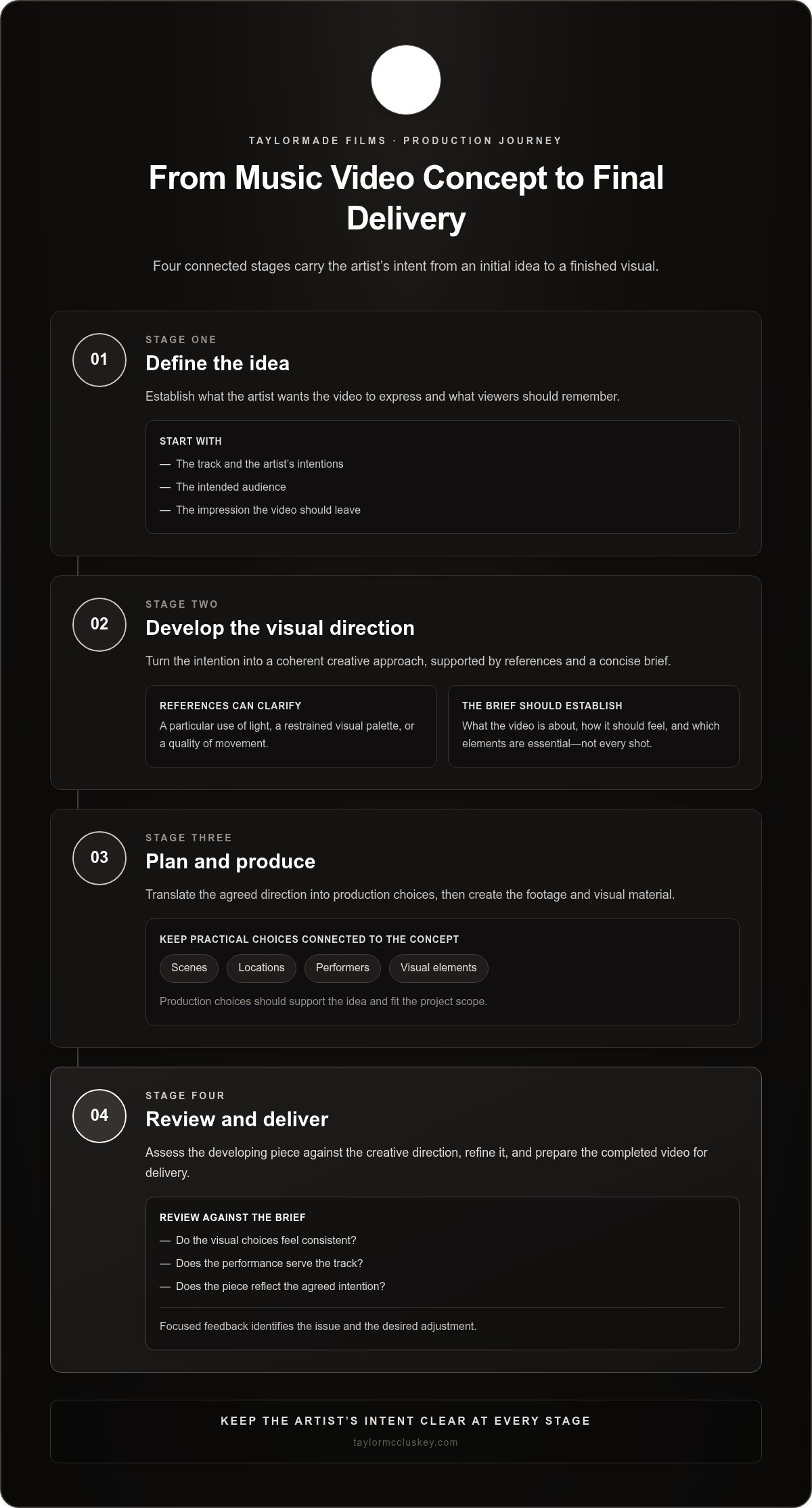
A music video develops through a series of connected creative and production decisions. The exact plan varies with the concept and project scope, but the goal remains the same: keep the artist’s intent clear as the work moves from an initial idea to a finished visual.
At a glance, the production journey follows four stages:
- Define the idea. Establish what the artist wants the video to express and what viewers should remember.
- Develop the visual direction. Turn that intention into a coherent creative approach, supported by references and a concise brief.
- Plan and produce. Translate the agreed direction into production choices, then create the footage and visual material.
- Review and deliver. Assess the developing piece against the creative direction, refine it, and prepare the completed video for delivery.
Developing the concept and visual direction
Begin with the track, the artist’s intentions, the intended audience, and the impression the video should leave. References can make abstract ideas more precise: for example, a particular use of light, a restrained visual palette, or a specific quality of movement. A concise creative brief gathers these choices in one place and helps collaborators work toward the same idea.
The brief doesn’t need to prescribe every shot. It should make the core direction clear: what the video is about, how it should feel, and which elements are essential. That gives the team room to solve creative and practical questions without losing the concept. It also gives the artist a reference point when considering alternatives.
Moving from production planning to final video
Planning bridges the creative direction and coordinated production. Decisions about scenes, locations, performers, and visual elements should support the concept and fit the project scope. A plan can adapt as details take shape; it doesn’t need to force every video into the same sequence or scale.
Artist feedback is most useful when it refers back to the brief. If a draft feels too literal, or the performance no longer carries the intended mood, identify the issue and the desired adjustment. A clear creative reference helps distinguish a meaningful change from a new idea that could pull the piece in another direction.
During review, return to the video’s purpose. Consider whether the visual choices feel consistent, the performance serves the track, and the piece reflects the agreed intention. Final delivery completes the production journey. TaylorMade Films provides film production and direction from concept to final video delivery, with the project’s scope and expectations discussed as the work takes shape. Its concept-to-delivery visual storytelling gives artists a project-focused path from the first idea to the finished video.
Choosing a music video approach that fits your track
The right format isn’t necessarily the most elaborate or fashionable. Music video production services can shape different visual approaches, but the choice should start with the track’s character and the experience you want to create for its audience. Ask what viewers should notice, feel, or remember after watching.
Three broad approaches offer distinct ways to connect image and music. They can also be combined, provided the creative direction stays coherent.
| Approach | Best suited to | Trade-off to consider |
|---|---|---|
| Narrative-led | A story, lyrical theme, or emotional change that benefits from characters and scenes. | A strong plot can draw attention from the artist or track if the story takes over. |
| Performance-led | Making the artist’s presence, musical delivery, and connection to the song central. | It relies on compelling performance and visual choices to sustain attention without a prominent story. |
| Abstract | Emphasizing mood, texture, colour, movement, or visual rhythm over literal storytelling. | Images may feel open to interpretation, so a consistent visual language matters. |
Narrative, performance, or abstract visuals?
A narrative-led video can give a lyrical theme a visible arc. If a song moves from isolation toward release, for instance, the story might reflect that shift without staging every line literally. Performance-led work keeps the artist and delivery in focus, making expression, movement, and presence central to the viewing experience. Abstract imagery foregrounds atmosphere, using recurring shapes, textures, or edits to echo the music’s feel.
Each approach asks something different of viewers. Narrative invites them to follow events. Performance brings them close to the artist. Abstract visuals invite them to experience and interpret. None is universally best. A hybrid can work too, such as a performance framed by a recurring visual motif, if every element supports one central idea.
How do format and storytelling work together?
Consider the song’s emotional arc and the artist identity you want to express. A gradual build might benefit from visuals that evolve with it; a direct, intimate track may call for a focused frame and restrained imagery. These are creative possibilities, not rules. The test is whether the approach strengthens the track rather than distracting from it.
Trends can spark ideas, but they shouldn’t decide the concept. First identify what the video needs to do: foreground a story, capture the artist’s performance, or translate sound into image. Then weigh the trade-offs against the intended viewer experience and project scope. For a wider perspective on connecting image and sound, explore cinematic storytelling services.
Bring a preferred approach, references, and a reason they fit the track into concept development. Taylor McCluskey’s work across music and filmmaking informs the creative process at TaylorMade Films. A project can take form through artist-led visual storytelling.
Preparing for music video production: brief, collaboration, and priorities
A focused brief gives a production project a clear starting point. It turns an artist’s intentions into shared creative priorities while leaving room to develop the idea. Before a project discussion, gather the essentials: the track, what you want the video to express, who it’s for, and how you plan to release it.
Use this checklist to organize your thinking:
- Track: Share the song or working version that will guide the project.
- Creative intention: Describe the central idea and the emotional impression you want the video to leave.
- Audience: Consider who you hope will connect with the work and what you want them to notice.
- References: Gather images, films, or other visual references that communicate mood, movement, or texture.
- Release context: Explain how the video fits into the track’s release and the artist’s wider creative direction.
- Priorities: Separate essential elements from ideas that would be welcome but could change.
What belongs in a useful music video brief?
A useful brief is concise but specific. Name the track, core idea, intended audience, and desired emotional effect. Add visual references to communicate qualities that can be difficult to describe, such as intimacy or restless energy. Treat references as prompts, not rigid templates. Then mark which ideas are essential and which are optional, so creative ambition can be shaped around the project’s scope.
This distinction makes decisions easier. If a particular setting is central to the concept, explain why it matters. If it’s one possible way to express the mood, keep alternatives open. Music video production services work best when the brief communicates both the creative destination and the priorities that will guide choices along the way.
How can artists keep collaboration focused?
Choose a primary creative contact to gather comments and communicate decisions. Organize feedback around shared objectives: does the work express the intended mood, support the artist’s identity, and stay true to the central concept? Specific notes, such as “the performance feels too restrained for this section,” give clearer direction than a general request to make it more exciting.
Not every collaborator needs to weigh in on every detail. Consolidated feedback helps distinguish a creative issue from a personal preference and keeps revisions aligned with the brief. Agreeing on key moments for artist input, such as discussing the developing direction or reviewing the work, makes collaboration more purposeful without imposing a fixed workflow. For more context on the director’s role in that process, read this professional music video director guide.
With your track, brief, references, and priorities in hand, explore TaylorMade Films production and begin shaping your project.
TaylorMade Films music video production services: a creative path forward
A music video is both a musical expression and a work of visual storytelling. Taylor McCluskey works across music, acting, and filmmaking, bringing those disciplines into one creative practice. This cross-disciplinary perspective informs the development of visuals that respond to a track’s identity rather than treating the song as a backdrop.
Under the TaylorMade Films label, film production and direction services carry visual storytelling from concept to final video delivery. For a music video, that means developing an idea and visual direction, then carrying the direction through production. The creative approach can be shaped around the artist’s track and intentions rather than assuming every project needs the same format or process.
A music and filmmaking perspective under one creative identity
Music brings its own structure, feeling, and performance. Filmmaking offers ways to translate intention into images, scenes, and a visual point of view. Working across both disciplines creates a connection between listening to a track and considering how its character might appear on screen. The video’s direction can respond to the artist’s choices and the qualities that make the song distinct.
That connection doesn’t prescribe a result. A project might centre on the artist’s performance, a narrative idea, or a more impressionistic visual language, depending on its creative aims. The important thing is that each choice serves the work. A concept can be ambitious while still being shaped around the project’s scope, with creative decisions discussed as the idea develops.
TaylorMade Films approaches production as visual storytelling from concept to delivery. This gives artists a creative framework for discussing what they want the video to express and how the idea can carry through production. No approach can guarantee a particular artistic response or audience outcome; the aim is to build a considered visual work around the project’s intent.
Taking the next step with TaylorMade Films
You don’t need a finished treatment to begin a project discussion. Bring the track, an early idea, or a more defined creative direction. References can communicate the tone you’re drawn to, while a few clear priorities show what matters most. These starting points give the conversation something tangible to build on, whether the concept is still taking shape or already has a clear visual identity.
A project discussion can focus on the song, the intention behind the video, and the visual experience you want to create. From there, the creative direction and production scope can be developed together. Start with the project’s aims rather than trying to fit the idea into a preset format.
Explore TaylorMade Films production and bring your music video idea into focus.
Give your next track a visual direction
The first step doesn’t need to be a finished treatment. Start with one clear thought: what should a viewer feel or remember when the song ends? That intention can become the creative anchor for a project discussion, helping turn an early instinct into a purposeful visual direction.
Music video production services connect that initial spark to the work of making it visible. Taylor McCluskey’s experience across music, acting, and filmmaking brings an understanding of how sound and screen can inform one another. Through TaylorMade Films, visual storytelling develops from concept through final video delivery, shaped around the project’s creative aims.
Bring a track, an early idea, or a direction you’re ready to explore. Start with what makes the song yours and what you want its visuals to express. Explore TaylorMade Films production and take the next step toward a video with a point of view.
Frequently Asked Questions
What do music video production services include?
Music video production services can include creative development, direction, production, and preparation of the finished video for delivery. The balance depends on the project: one artist may need help shaping an early idea, while another may arrive with a clear visual plan. Discuss which stages, decisions, reviews, and final materials are in scope so everyone shares the same understanding before work begins.
How much do music video production services cost?
The cost depends on the project’s creative aims and production requirements, so there’s no single price that applies to every video. Factors affecting scope include the concept’s complexity, production needs, and the work required to complete the video. A focused performance concept and a multi-scene story call for different plans. Define your priorities, then discuss a project-specific scope with TaylorMade Films.
How long does it take to produce a music video?
Production time varies with the concept, planning needs, coordination, review process, and final edit. A project with more creative elements or decisions to coordinate may need a different schedule from a straightforward approach. Timing also depends on when key choices and feedback are ready. Discuss schedule expectations as part of defining the project scope, and allow time for review rather than planning only around production.
What should I prepare before discussing a music video project?
Bring the track or working version, a short description of what you want the video to express, and any visual references that communicate your taste. It’s also useful to note the intended audience and release context. For a practical starting point, identify one or two moments in the song that feel especially important, such as a change in energy or a defining lyric, and explain why they matter to you.
Can a music video production project begin with just an idea?
Yes. An early idea is enough to begin a creative discussion, even if you haven’t settled on a storyline or visual style. You might start with a feeling, a lyric, or a question about how the song should come across on screen. Sharing what inspired the idea helps develop it into a clearer direction. You can also bring references or a rough written note, but a finished treatment isn’t required to start thinking through the project.
Who owns the rights to a finished music video?
Ownership and usage rights depend on the agreements for the project, so don’t assume that payment alone settles every rights question. Clarify in writing who owns or may use the finished video, and distinguish it from rights in the song, recording, footage, and any third-party material. If you need particular permissions for distribution, promotion, or future edits, raise those needs during project discussions and document the agreed terms.
Can one music video project create content for different platforms?
A project can be planned with multiple platforms in mind, but additional versions or edits should be included in the agreed scope. Share where you expect to use the video and whether you have specific framing, length, or delivery requirements. These details can influence creative and production decisions from the outset. Planning for platform needs early helps clarify what the finished project is intended to deliver without assuming every version is automatically included.


