

A song’s symbols don’t simply decorate its message; they help carry it. Interpreting the meaning of abstract song lyrics means tracing how images, recurring motifs, and contrasts shape a song’s central idea. Their significance comes from the surrounding lyrics, not from a fixed symbolic meaning.
An open-ended lyric can still have a clear emotional direction. A single image might suggest desire, loss, escape, or change, while the surrounding lines sharpen or complicate that reading.
This guide shows how to follow those clues with focused questions and carefully chosen lyrics. You’ll explore how imagery contributes to a song’s message, with examples from Leonard Cohen and Taylor Swift, and learn to build an interpretation grounded in the words rather than guesswork.
Key Takeaways
- Choose an analysis approach that fits your goal, whether you’re tracing a theme, following the verses, or examining a symbol.
- Ask focused questions about an image’s context, repetition, and emotional effect to develop a grounded interpretation.
- Use selected lyric excerpts as evidence, then connect their imagery to the song’s wider message.
- Compare how Leonard Cohen and Taylor Swift use images to create meaning, and explore Taylor McCluskey’s music through albums and singles.
How do these symbols contribute to the song's message?
A symbol connects a concrete image to a song’s broader emotional or thematic direction. Choose an approach that fits the question you want the lyrics to answer.
Reading Themes and Story Structure
Use theme analysis to identify a central idea, or verse-by-verse analysis to track how it develops. Emotional analysis follows shifts in feeling; symbolic analysis examines images; contextual analysis considers the song’s setting and perspective. Fans may connect an image to personal experience, while critics may focus on structure or recurring themes. One abstract song can support multiple readings, as long as each interpretation fits its details. A recurring image or shift between verses can help distinguish plausible readings from unsupported guesses.
Connecting Lyrics and Musical Elements
Metaphor compares unlike things, symbolism gives an image wider associations, and imagery makes an idea vivid through sensory detail. Together, they shape the mood and suggest meanings beyond the literal words. As an imagery exercise, pair “Rolling in the Deep” with fire, which may suggest passion and destruction, and “Chasing Cars” with a car, which may suggest freedom and motion. These are interpretive prompts, not fixed definitions. Listen for how tempo and rhythm interact with the words: a quick pulse can add urgency, while a pause can make an image feel exposed. Compare these musical cues with the lyric’s tone.
Tracing the Artist’s Point of View
Point of view reveals who seems to speak, what they know, and how their attitude shifts. Mark pronouns and changes in address, then ask whether the speaker sounds certain, regretful, distant, or conflicted. An artist interview may clarify the circumstances or intention behind a lyric; liner notes can provide context about its creation. Use that material as supporting context, then compare it with the song itself. The recorded words and musical choices remain essential evidence, even when an artist shares a personal explanation.
Supporting Interpretations with Textual Evidence
Build an interpretation in three steps: state a possible message, select a short lyric detail, and explain how that detail supports your reading. Track repetition, contrasts, and changes in imagery across verses. For reliable lyrics, begin with official album materials or the artist’s official channels; use reputable music criticism for commentary. Compare commentary with the actual wording rather than treating any interpretation as definitive. The Kennedy Center lesson aligns with Common Core standards ELA-LITERACY.RL.9-10.1 and RL.11-12.1, which emphasize textual evidence and inference. That approach keeps an analysis grounded in what the song presents.
Asking focused questions about lyrics and imagery
Focused questions turn a vague impression into a reading you can test. Start with one striking phrase, then examine its role in the song.
Formulating Focused Lyric Questions
Ask questions that point to a specific word, change, or relationship. For example: Who is speaking? What does the speaker want? What shifts between the opening and final verse? If a lyric mentions a locked door, ask whether it signals separation, protection, or a barrier the speaker hopes to cross. Compare each answer with nearby lines instead of settling on the first association. A precise question keeps your interpretation anchored to the song.
Examining Imagery for Interpretation
Focus on what an image lets you see, hear, or feel. Note whether it returns, changes, or appears beside contrasting images. A storm might suggest upheaval in one verse, then give way to calm imagery that signals a shift. Ask what the image does in that moment: does it intensify tension, reveal a memory, or make an emotion tangible? Its placement and surrounding words help narrow its possible significance.
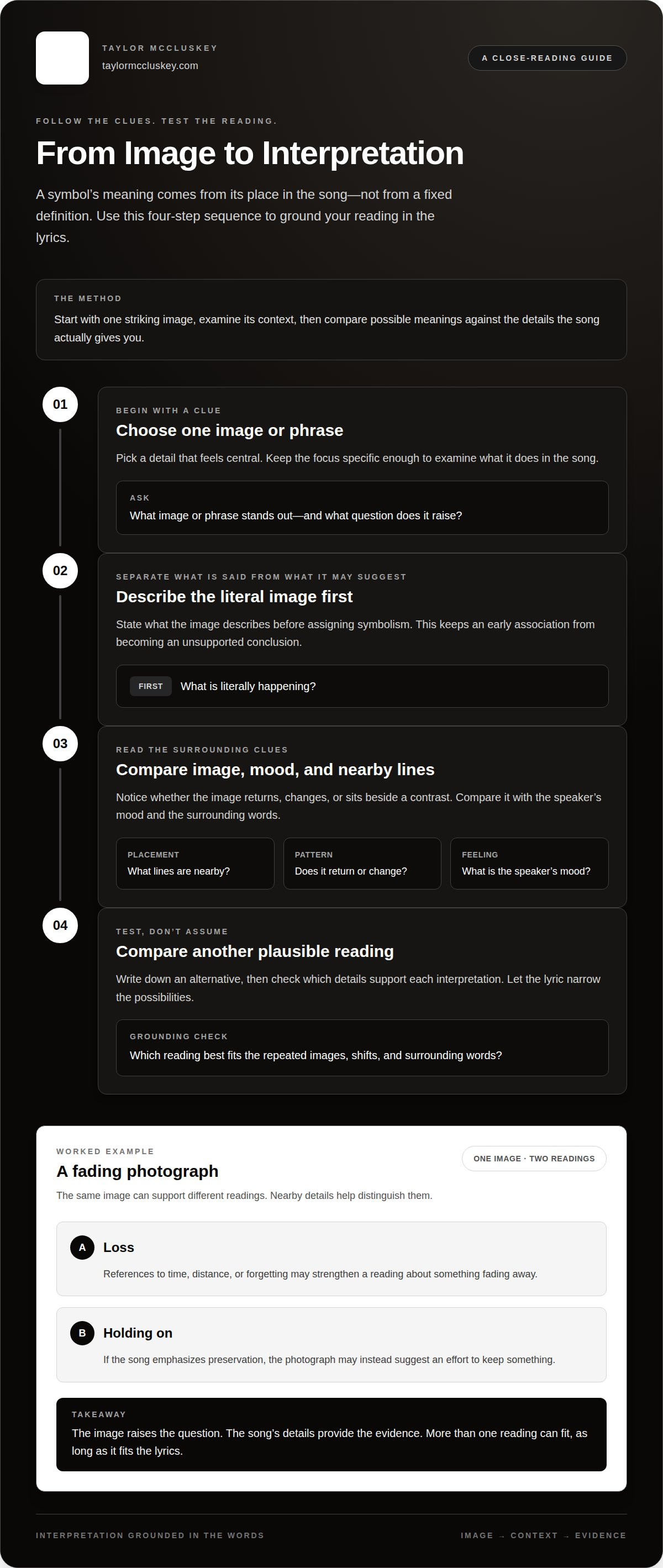
Use this sequence to test an initial reading without forcing every image into a single explanation:
- Choose one image or phrase that feels central.
- Describe its literal meaning before assigning symbolism.
- Compare its appearance with the speaker’s mood and the surrounding lines.
- Write down another plausible reading, then see which details support each one.
For example, if a lyric describes a fading photograph, ask what is fading: the image itself, a memory, or a relationship. Look for nearby references to time, distance, or forgetting. If those details recur, they strengthen a reading about loss; if the song emphasizes preservation, the photograph may instead represent an effort to hold on. The question guides your attention, while the lyric supplies the evidence.
When a focused reading inspires a visual treatment, Film Production Services can connect written imagery with screen storytelling.
Adding selected lyrics for a more focused interpretation
Selected lines give a close reading a clear focus. When interpreting the meaning of abstract song lyrics, choose an excerpt that contains the image or change you want to examine, with enough surrounding context to understand its role.
Look for a passage that introduces a new image, shifts the speaker’s tone, or changes how an earlier phrase feels. For instance, a shift from remembering a place to avoiding it may reveal a change in the speaker’s relationship with the past. This is an illustrative pattern, not a quotation from a released song.
Selecting and Reading a Useful Excerpt
Keep the excerpt focused, but don’t isolate a phrase so tightly that its meaning changes. If an image returns later, note both appearances. If the speaker’s attitude shifts, compare the lines before and after that moment. This lets you examine the song’s progression without assuming every detail serves the same purpose.
- Write down the question your reading will address.
- Select the relevant lines and note where they appear in the song.
- Mark changes in word choice, tense, or the speaker’s address.
- Explain how those details support your reading, then consider what might complicate it.
Imagine a song that mentions a “paper moon” near the beginning and again at the end. Note what surrounds each appearance: celebration in one passage might give way to separation in another. That contrast could make the image feel less secure as the song progresses. Your interpretation should account for both contexts instead of treating the repeated object as a symbol with one automatic meaning.
Keep your notes tied to the selected lines and their placement. When interpreting the meaning of abstract song lyrics, a useful excerpt helps you trace how one detail contributes to the larger work without standing in for the entire song. This focused approach makes your reasoning clear and leaves room to revise it as you notice new details.
Examples from Leonard Cohen and Taylor Swift
Leonard Cohen and Taylor Swift show how a recurring image can hold several meanings. Compare each image with the speaker, surrounding details, and the song’s emotional movement before drawing a conclusion.
In Cohen’s “Hallelujah,” biblical references sit alongside intimate reflections on love and loss. The title’s religious association can suggest praise, but the song’s shifting emotional register complicates a purely devotional reading. Ask how sacred language interacts with human disappointment. Does it express faith, longing, irony, or several at once? Follow the shifts in tone and the images surrounding each use of spiritual language. A stronger interpretation accounts for both reverence and vulnerability.
Taylor Swift’s “cardigan” offers a different route into symbolism. A cardigan can be an ordinary object, a keepsake, or a marker of intimacy and memory. To test those readings, identify who recalls the object and what the song connects it to. Then ask whether the image changes as the speaker looks back. The clothing itself doesn’t dictate one message; its associations emerge through the narrative and the feelings attached to it.
Use these examples as close-reading models, not fixed answers. For either song, try this comparison:
- Image: Identify the recurring object or reference, such as a garment or biblical language.
- Speaker: Note who uses the image and what they seem to feel.
- Movement: Track whether the image gains a new association as the song unfolds.
- Interpretation: State a reading that explains those details, while recognizing other readings may also fit.
Cohen’s layered spiritual language and Swift’s intimate object imagery reveal different ways songs build emotional meaning. Explore more music and creative work through Taylor McCluskey’s creative work.
Taylor McCluskey: Music Albums and Singles
Taylor McCluskey offers music albums and singles for listeners who want to spend more time with songs, their imagery, and their emotional detail. After exploring how lyrics can carry different meanings, listening closely to recorded music offers another way to notice how words and music interact.
Return to a verse after considering its symbols. Listen for how the vocal delivery, rhythm, and surrounding musical choices shape your response to the lyrics. Close attention can deepen your reading without reducing the song to a single explanation.
Explore Taylor McCluskey’s music albums and singles, or contact Taylor McCluskey to continue the conversation.
Let the next listen reveal something new
Give your interpretation room to evolve. Return to the song after a pause and notice whether a different image now carries more weight. Your response may change as your experiences change. That shift doesn’t invalidate an earlier reading; it offers another perspective to consider.
Try turning your interpretation into a creative prompt. Write a short scene inspired by one image, or sketch how its emotional tone might translate into a visual sequence. These exercises can reveal what you noticed in the lyric and where your imagination begins. Interpreting the meaning of abstract song lyrics can become a starting point for your own artistic choices, not simply a search for a final answer.
If you’re ready to explore the ideas behind your lyrics, contact Taylor McCluskey to discuss your lyrics. Bring the image or line that keeps drawing your attention, and let it lead you toward what comes next.
Frequently Asked Questions
What might these symbols represent beyond their literal meaning?
A symbol can point to an emotion, relationship, conflict, or change beyond the object itself. A train ticket, for example, might suggest departure, opportunity, or an unwanted separation, depending on who holds it and what happens nearby. Look for patterns around the image. If the song connects it with hesitation or farewells, those details help distinguish a supported interpretation from a personal association.
What objects or characters appear recurrently?
Recurring images vary by song, but rain, mirrors, doors, and roads often reward close attention. Characters may include a traveler, a stranger, a child, or an unnamed “you.” Make a short motif list as you listen, noting where each image returns and whether its tone changes. A mirror described first as clear and later as distorted, for instance, may track a speaker’s changing self-perception.
What are common ways to interpret abstract song lyrics?
Listeners often begin with a song’s central theme, then examine its narrative, emotional arc, imagery, or cultural setting. A comparison chart can distinguish these approaches: write one interpretation in each column, then add the lyric detail that supports it. In a song about departure, for example, a narrative reading might follow a character leaving, while an emotional reading considers whether the speaker sounds relieved or uncertain.
How does a song’s historical and cultural context affect its meaning?
Context can clarify references listeners might otherwise take literally. Consider a place name, slang term, public event, or cultural practice mentioned in the lyrics, then ask what it meant when the song was written or released. Separate documented background from assumptions about the artist’s intentions. This helps explain how listeners from different generations or communities may hear the same image through different experiences.
How do melody, vocal delivery, and production influence lyrical interpretation?
Musical performance can change how a line lands. A rising melody may make a phrase sound like a plea, while clipped vocal delivery can suggest restraint or frustration. Production choices matter too: an exposed vocal feels different from one surrounded by dense instrumentation. Compare the same lyric across contrasting sections, such as a quiet verse and a forceful chorus, to hear how its emotional emphasis changes.
How can listeners distinguish evidence-based interpretations from speculation?
Separate what the song explicitly presents from what you infer. A repeated place name is direct evidence; reading it as a specific real-life location requires supporting context. Test your interpretation against other details, including lines that might challenge it. Avoid treating a theory about an artist’s private life as fact without reliable public information to support it. Distinguishing observation from inference keeps your analysis credible.


