

What if the cinematic feeling begins before the camera rolls? Beautiful images can catch the eye, but they can’t carry a film without a clear story. If you’re searching for a “cinematic video video production company,” the important question is whether its creative direction can turn your idea into a film that connects with its intended audience.
Cinematic craft is more than visual polish. It brings story, performance, pacing, sound, and image together with purpose. A strong production process starts by understanding the idea, shaping a clear creative direction, and keeping the intended audience in view through the final cut.
This article explores what makes a video feel cinematic, what each stage of production should address, and how to assess a creative partner’s approach. At TaylorMade Films, Taylor McCluskey brings a perspective shaped by music, acting, and filmmaking to film production and direction, guiding projects from concept through final video delivery. The aim is a cohesive film, not polish added without a story to support it.
Key Takeaways
- Cinematic impact comes from story-led choices in image, pacing, performance, and sound, not visual polish alone.
- Understand how a film moves from concept and creative direction through production, post-production, and final delivery.
- Assess a cinematic video video production company by how its process and direction serve the story, not just by striking imagery.
- Build a stronger brief by clarifying your purpose, audience, core message, tone, references, and intended use.
- Explore how Taylor McCluskey’s experience across music, acting, and filmmaking informs TaylorMade Films’ approach from concept to delivery.
What makes a cinematic video production company right for a story?
A cinematic film earns its impact through choices that make the story clear and memorable. Image, pacing, performance, and sound work together to guide attention, establish tone, and shape the audience’s response. In a brand film, for example, showing a person’s motivation before revealing a finished product can give the product a clearer role in the story. Every creative decision should serve a purpose.
Cinematic craft is the deliberate use of film language to serve a narrative, not simply the addition of visual effects or polish. Camera work, lighting, and colour grading can create a distinctive look, but they can’t replace a point of view. A cinematic video video production company should connect visual ambition to the message and intended audience, so style supports meaning rather than competing with it. That relationship between vision and execution is central to the broader filmmaking process.
Cinematic style versus cinematic storytelling
Style is what viewers see and hear: a composed frame, a moving camera, a shaped soundtrack, or a restrained colour palette. Storytelling is why those choices are there. Framing can make a subject feel isolated or connected. Camera movement can create intimacy, momentum, or distance. Editing can give an emotional beat room to land or build anticipation toward a key moment.
Imagine a film about a craftsperson preparing an object for a customer. Close shots of hands at work could communicate precision. A slower rhythm might give the process a reflective tone, while the customer’s reaction could show why the work matters. The images aren’t cinematic simply because they look dramatic. They become meaningful when each choice reinforces the central idea.
That’s the difference between a visual treatment and a directed story. Ask whether the imagery, performance, and sound express the same intention. If the visuals are striking but leave viewers unsure what to take away, the film hasn’t fully connected craft to communication.
When a cinematic approach serves a project
A cinematic treatment can suit a project that needs atmosphere, emotional connection, or a carefully shaped point of view. The right choices still depend on the audience and purpose. A film introducing a brand may call for warmth and human detail. A concise instructional video may work better with direct explanations and uncluttered visuals. Neither approach is automatically better.
Set the creative intention before choosing camera movement, lighting, soundtrack, or pace. Start with a few practical questions:
- What should the audience understand, feel, or remember?
- What tone will feel credible to that audience?
- Which images and sounds can communicate the core message clearly?
The answers give the director a basis for shaping the film and help keep ambitious visuals purposeful. Cinematic success isn’t measured by how much production is visible on screen. It’s measured by whether the creative choices draw the audience closer to the story.
How a cinematic video moves from concept to final delivery
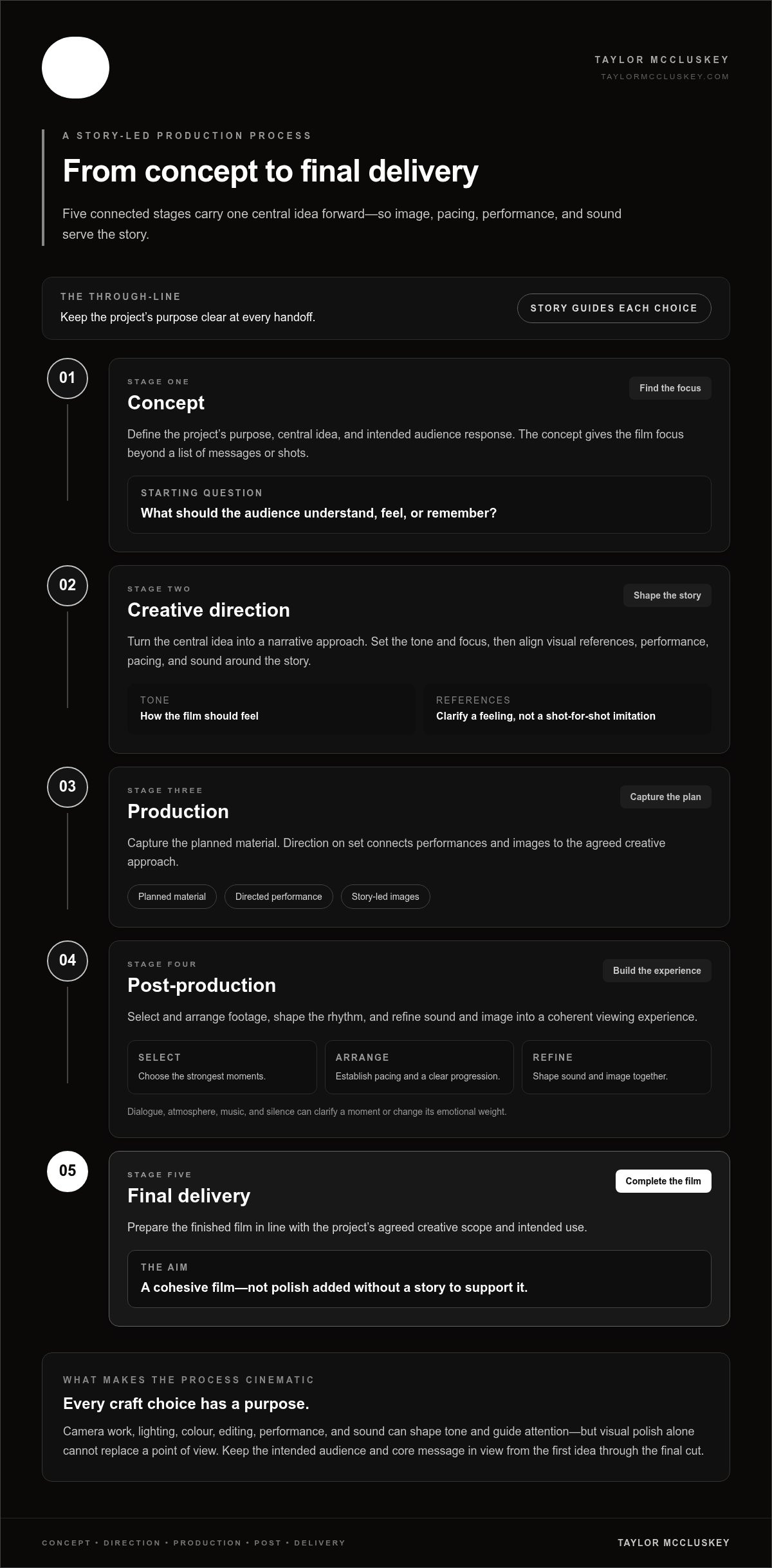
A cohesive film takes shape through connected decisions, not isolated production tasks. The process moves from concept and creative direction through production and post-production to final delivery, with the story guiding each handoff. The purpose established at the start should remain clear in the finished film.
For a cinematic video video production company, a useful process makes those decisions visible. The creative team and client can align on what the film needs to say, how it should feel, and what the completed work needs to accomplish. Each stage carries that shared intention forward.
- Concept: Define the project’s purpose, central idea, and intended audience response. A concept gives the film focus beyond a list of messages or shots.
- Creative direction: Turn that focus into a narrative approach. Tone, visual references, performance, pacing, and sound take shape around the story.
- Production: Capture the planned material. Direction on set connects performances and images to the agreed creative approach.
- Post-production: Select and arrange footage, shape the rhythm, and refine sound and image into a coherent viewing experience.
- Delivery: Prepare the finished film in line with the project’s agreed creative scope and intended use.
Concept development and creative direction
Strong development starts with a simple question: what should the audience understand, feel, or remember? The answer helps distill the project’s purpose into a central idea. From there, creative direction establishes a tone and narrative focus. References can clarify the intended feeling without dictating a shot-for-shot imitation.
Early alignment supports every later handoff. A director can use the central idea to guide choices during production, while an editor can use it to decide which moments belong in the final story. For a deeper look at the role of artistic perspective in shaping a film, explore this guide to artist-led film production.
Production, post-production, and delivery
Production turns the direction into captured material. Post-production then shapes the film: an editor selects the strongest moments, establishes pacing, and builds a clear progression. Sound works alongside image, not as an afterthought. Dialogue, atmosphere, music, and silence can clarify a moment or change its emotional weight.
At each handoff, the central idea remains the reference point. A beautifully composed shot may be cut if it distracts from the message. A quieter moment may stay if it gives the audience room to understand. That discipline helps keep production choices aligned with the story.
The Bureau of Labor Statistics offers broader context on motion picture and video production industry trends. For a project-specific creative path, Taylor McCluskey provides film production and direction through TaylorMade Films, guiding projects from concept through final video delivery.
How to evaluate cinematic video production beyond the visuals
A striking frame can make a portfolio memorable, but it doesn’t show how the film’s story was developed. Camera work, lighting, and colour grading are only part of the craft. A cinematic video video production company should be able to connect its creative choices to a central idea, an intended audience, and a clear production path.
Use the criteria below to look past surface polish. The aim isn’t to rank one aesthetic above another, but to understand whether the creative approach can serve the story you want to tell.
| Criterion | What to look for | What it reveals |
|---|---|---|
| Story understanding | A clear explanation of the film’s central idea and audience. | Whether the creative approach starts with meaning, not just imagery. |
| Direction | Visual, performance, pacing, and sound choices that support a consistent tone. | How the story may be shaped across the finished film. |
| Process clarity | A connected account of concept, direction, production, and delivery. | Whether the creative intention can carry through each stage. |
| Portfolio relevance | Examples that demonstrate craft and storytelling choices relevant to your goals. | More than technical polish: evidence of considered narrative work. |
Creative alignment and narrative clarity
Listen for whether the project can be expressed as a clear central idea, rather than a collection of visual references. References help establish tone, but direction gives them purpose. Consider whether the proposed images, performances, and sound fit the intended audience and message. Taylor McCluskey’s work brings music, acting, and filmmaking perspectives to questions of how sound and vision can work together to shape a narrative.
Gear alone can’t prove that a production will feel cinematic. The value lies in how creative decisions connect. A close frame might create intimacy, while a slower rhythm gives a key moment room to register. Those choices matter because of what they communicate.
Process transparency and portfolio fit
A useful process description makes the handoffs understandable. The concept informs creative direction, direction shapes production, and the captured material is formed into a finished film. Through TaylorMade Films, Taylor McCluskey works across music, acting, and filmmaking, offering production and direction for visual storytelling from concept through final video delivery.
As you review portfolio work, look beyond the colour grade or camera movement. Notice what the film asks you to understand, how performances are guided, and whether sound and pacing reinforce the intended feeling. A relevant example doesn’t need to match your subject exactly. It should help you see how a filmmaker makes story-led choices and carries them through execution.
How to prepare a strong brief for cinematic video production
A useful brief doesn’t need to prescribe every shot. It should give the creative team enough context to make purposeful choices. Share what the film should achieve, who it’s for, and what you know about its tone and use. Treat the brief as a starting point for collaboration, not a script for every decision.
For a cinematic video video production company, this context helps connect creative direction to the project’s needs. A few clear priorities are more valuable than a long list of effects or technical details with no underlying purpose.
The essentials to define before production
Start with the message and audience. Describe what viewers should understand, feel, or remember, and who you hope will watch. If the video needs to include specific information, people, or story elements, identify them as essentials. This separates what the film must communicate from what can be explored creatively.
Use this checklist as a flexible guide. Some projects will call for more detail than others.
- Purpose: What role should the video play, such as introducing an idea, sharing a story, or supporting a campaign?
- Audience: Who is the intended viewer, and what might they already know or care about?
- Core message: What is the one thought you most want them to take away?
- Tone: Should the film feel intimate, energetic, reflective, playful, or something else? Explain what those words mean to you.
- Essential elements: Note any key messages, people, moments, or narrative points that need to be considered.
- Intended use: Describe where the finished video is expected to appear, if you know. Its context can influence how the story is shaped.
Keep unresolved points visible. Record open questions, known constraints, and areas where you’d welcome creative guidance. Being clear about what’s fixed and what’s still open gives the first production conversation a useful starting point.
Turning references into a creative starting point
References make abstract direction easier to discuss. A still image might suggest a framing or palette. A film could communicate a mood or performance style. Music may help convey pace, atmosphere, or emotional intensity. For each reference, explain what draws you to it instead of assuming the production team will interpret it the same way.
Separate the inspiration from what should remain distinct. You might admire a reference’s quiet pacing but want an original visual world, or appreciate its natural performances without wanting to reproduce its story. This distinction gives the director room to translate your intention into choices that fit the project. Understanding the professional music video director’s role can also clarify how a creative vision is shaped through direction.
Bring your brief, references, and questions to Taylor McCluskey’s film production and direction to explore how the project can develop from its initial idea.
TaylorMade Films: a multidisciplinary approach to cinematic production
Taylor McCluskey works across music, acting, and filmmaking, bringing a perspective shaped by each discipline to film production and direction through TaylorMade Films. The production scope follows visual storytelling from concept through final video delivery. This gives a project room to develop as a connected creative journey, with direction keeping its purpose in view from the first idea to the finished film.
Choosing a cinematic video video production company is about more than finding a visual style you like. It’s also about finding a creative partner who engages with the idea behind the film and shapes an approach around its needs. TaylorMade Films offers film production and direction focused on story, direction, and execution.
A creative perspective shaped across disciplines
Music, acting, and filmmaking each offer a different way to think about a viewer’s experience. Music draws attention to rhythm, atmosphere, and the emotional weight of sound. Acting focuses on performance, expression, and character. Filmmaking brings those elements together in a visual narrative. These perspectives can inform how a story is framed and guided, without suggesting that every film needs a musical or acting component.
The value of a multidisciplinary lens lies in the questions it brings to a project. What should the audience notice first? How should a moment feel? What role can sound play alongside image? Those questions connect creative choices to the film’s intent without prescribing a single style. A restrained approach may suit one story, while another may call for more energy or visual contrast.
This perspective is useful when an idea is still taking shape. Rather than starting with a fixed look, creative direction can respond to the project’s subject, audience, and purpose. The result is an approach developed for the film itself, rather than a template imposed on every story.
Move from a first idea to a production conversation
You don’t need a finished script or complete visual plan to begin exploring a project. Bring a purpose, a rough concept, a reference that captures the mood, or a question you’re still working through. Sharing what matters most and what remains open gives the first conversation a clear starting point.
From there, the film’s direction can take shape around its individual needs. One project may call for a clear narrative structure; another may begin with a visual or emotional idea that needs development. The next step is to make that idea more specific while keeping the intended audience and message in focus.
Explore film production and direction through TaylorMade Films, and bring your first idea into a conversation about how it could become a finished film.
Give Your Film Idea Its Next Step
A creative vision doesn’t need to arrive fully formed. A purpose, a question, or a mood you want the audience to feel can be enough to begin shaping a direction. The next step is to consider what the film should express and how its creative choices can support that intention.
Choosing a cinematic video video production company is ultimately about finding a partner who treats your idea as the film’s compass. Bring what you know, including your audience, message, references, or open questions. Leave room for the process to reveal possibilities you may not have considered.
With TaylorMade Films, Taylor McCluskey’s multidisciplinary creative perspective informs film production and direction from concept through delivery. If you’re ready to explore what your idea could become, explore a film project with TaylorMade Films. Your first idea is a strong place to begin.
Frequently Asked Questions
How much does cinematic video production cost?
The investment depends on the project’s creative scope and production needs, so a generic figure may not reflect your film. To make an initial conversation more concrete, describe the story you want to tell, the production elements you have in mind, and where the finished video will be used. Those details focus the discussion on the actual project rather than assumptions about what every cinematic production requires.
How long does a cinematic video production project take?
Timing depends on the project’s development, production, and post-production needs. An idea that is still taking shape may require different planning from one with a clear narrative direction and defined scope. Consider what the project needs at each stage, including development, filming, editing, and finishing. Factoring those stages into the project plan is more useful than relying on a standard turnaround that may not fit.
Can a cinematic video work without dialogue?
Yes. A film can communicate without spoken words when its images, performances, pacing, and sound work together to make the idea understandable. For example, a sequence might show a person preparing for an important moment, using gestures and changes in pace to build anticipation. Music or ambient sound can contribute to the mood. The right approach depends on the story and audience, so consider whether dialogue adds meaning or simply explains what viewers can already see.
What should I include in a cinematic video production brief?
Include the project’s purpose, intended audience, main message, desired tone, useful references, and expected use of the finished film, if known. Add essential content, such as a particular person or idea that must be represented. Separate firm requirements from open questions. You might know the audience and message but still be exploring the visual approach. That distinction helps focus the creative discussion on what’s settled and where new ideas can take shape.
Can music and visuals be developed together for a film?
Yes. Music and visuals can be considered together as storytelling elements, particularly when rhythm or atmosphere is central to the idea. A quiet visual sequence paired with a forceful musical mood may create tension, while a lighter sound can shift how a scene feels. These are creative possibilities, not fixed formulas. Considering sound early helps the team think about how it can complement the images and maintain a coherent emotional tone.
What happens if the creative direction changes during production?
A change in direction can affect creative decisions already made. Its impact depends on what changes and when. Share new information as it emerges, then clarify what prompted the shift and which parts of the original idea still matter. If the intended audience changes, for example, the message or tone may need to change too. Clear discussion helps the creative team understand the updated priorities and plan around the project’s evolving needs.
What is the difference between a video production company and a director?
A production company generally refers to the broader production offering, while a director leads the creative interpretation of a film. The roles can overlap or be organized differently depending on the project, so job titles alone may not explain how decisions are handled. Consider how the story’s creative direction connects with production and final delivery. For a cinematic video video production company, that link shows how an idea can be guided into a finished film.


