

A music video can look striking and still miss the song. A professional music video director does more than operate a camera: they interpret the track’s intent and build a visual language that gives its emotion, lyrics, and rhythm a clear screen presence. The strongest creative choices support the music rather than compete with it.
If you’re unsure who shapes the concept, how decisions are made, or what happens beyond the shoot, you’re asking the right questions. Direction connects the creative vision to practical choices, from the treatment and visual references to performances, locations, shot planning, and the final edit.
This article explains a director’s role across pre-production, filming, and post-production. You’ll see how a coherent concept can deepen a song, what to consider before speaking with a filmmaker, and how Taylor McCluskey’s background in music and filmmaking informs the work of TaylorMade Films. By the end, you’ll have a clearer framework for discussing the film you want to make.
Key Takeaways
- A professional music video director shapes the creative vision and guides its execution, bringing story, performance, and visual choices together.
- Concept development moves from listening and discussion to visual planning, filming, and editing, with each stage checked against the song’s central feeling or message.
- Narrative-led, performance-led, and image-led approaches serve different creative purposes. Pacing, color, and composition help define the video’s character.
- Before meeting a director, clarify what the song means to you, who you want to reach, and how you want viewers to feel. Share references and explain what works in them.
- Taylor McCluskey’s work across music, acting, and filmmaking informs the music-led visual storytelling at TaylorMade Films.
What Does a Professional Music Video Director Do?
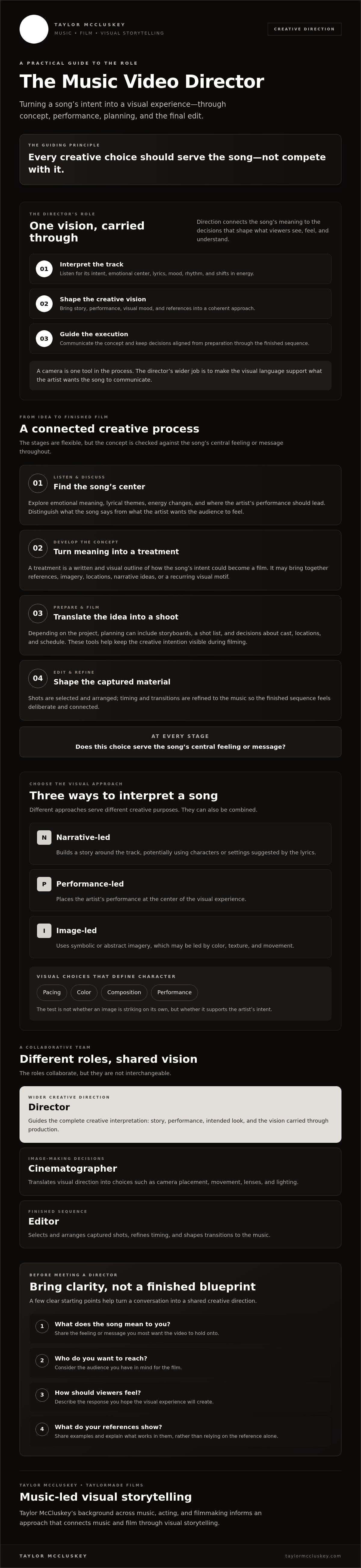
A professional music video director shapes the video’s creative vision and guides its execution, from the central idea to the choices that bring it to the screen. The role combines interpretation, storytelling, performance direction, and collaboration. A camera is one tool in that process, not the whole job. A Music video director helps determine what the audience sees, feels, and understands as the song unfolds.
The director considers how each element serves the artist’s intent. That might mean building a narrative, drawing out a performance, establishing a distinctive visual mood, or combining these approaches. They communicate the concept to the creative team and help keep decisions aligned, so the finished video feels deliberate rather than like a collection of disconnected images.
A music video director turns a song’s intent into a visual experience that gives the music room to resonate.
How a music video director serves the song
Lyrics can suggest characters or settings, while rhythm can shape movement, cuts, and pacing. Mood and performance offer further cues: a restrained vocal might call for intimate framing, while an explosive chorus could prompt a wider, more kinetic visual shift. These are creative possibilities, not fixed rules.
A concept might interpret the lyrics literally, translate the song’s emotion into symbolic images, or take an abstract approach led by color, texture, and movement. The test is whether the visual language supports what the artist wants the song to communicate. If an image draws attention but weakens that intent, it may be the wrong choice.
Director, cinematographer, and editor: distinct contributions
The director guides the complete creative interpretation. They shape the approach to story and performance, communicate the intended look, and work with the team to carry that vision through production. The cinematographer translates visual direction into image-making decisions, including camera placement, movement, lenses, and lighting.
After filming, the editor works with the captured material to build the finished sequence. They select and arrange shots, refine timing, and shape transitions to the music. The roles overlap through collaboration, but they aren’t interchangeable: the director holds the wider creative direction, while cinematography and editing bring specific parts of that vision to life.
How a Professional Music Video Director Develops the Concept
A concept takes shape through listening, conversation, visual development, planning, filming, and editing. It isn’t a rigid formula. The project’s scale, the artist’s input, and the creative team all affect how these stages unfold. At every point, the director returns to a useful test: does this choice serve the song’s central feeling or message?
A music video treatment is a written and visual outline of the concept, showing how the song’s intent could become a film. It gives the artist and creative team a shared reference before production decisions gather momentum.
From first listen to a workable visual treatment
Development often begins with close listening and discussion. The director considers the emotional center, lyrical themes, shifts in energy, and the moments where the artist’s performance should lead. The conversation helps distinguish what the song says from what the artist wants the audience to feel.
Those insights can inform references, imagery, locations, and narrative ideas. A treatment might describe a story that unfolds across the track, a recurring visual motif, or a performance shaped by a particular atmosphere. For each idea, ask what it contributes to the song’s meaning or mood. For a deeper look at how sound and image can work together, explore cinematic storytelling services. Berklee’s overview of a career as a music video director also highlights skills such as storyboarding and team collaboration, which help move a vision toward production.
Planning the shoot around the creative idea
Once the concept is clear enough to develop, planning translates it into practical choices. Depending on the project, that may include storyboards to map key images, a shot list to identify what needs to be captured, and decisions about cast, locations, and schedule. These tools keep the creative intention visible as the team prepares to film.
Good preparation protects the moments that matter most. If a particular performance, transition, or visual detail carries the song’s emotional turn, the team can plan how to capture it rather than leave it to chance. Production details vary with the concept and collaboration; there’s no single timeline or setup that fits every video.
During filming, the director and team use the plan as a guide while adapting to what works on set. The edit then tests the material against the track again: pacing, performance, and image sequence should preserve the original intent. Artists curious about how music and filmmaking meet in practice can explore Taylor McCluskey’s creative work.
What Makes a Music Video Director’s Visual Choices Effective?
Effective direction starts with purpose, not scale. A professional music video director chooses an approach that fits the song, the artist’s intent, and the experience the video should create. A large set or elaborate effects can make an impression, but they won’t automatically make the film more meaningful. A focused performance, a strong recurring image, or a well-timed cut can carry more weight when it connects directly to the music.
Narrative, performance, and image-led approaches
These approaches aren’t competing styles. Each gives the song a different kind of visual structure. A narrative can give lyrics or themes a dramatic arc. Performance-led direction puts the artist’s presence, energy, and connection with the audience at the centre. Image-led work uses atmosphere, symbolism, and visual rhythm to communicate without relying on a linear story.
The right choice depends on what the track needs. A narrative can clarify a song’s emotional progression, while a performance-led treatment may preserve the immediacy of the artist’s delivery. Abstract imagery can leave room for interpretation. The examples below are illustrative, not credits for Taylor McCluskey or TaylorMade Films.
| Approach | Purpose | Illustrative example |
|---|---|---|
| Narrative-led | Give a theme a visible arc | A character moves from isolation toward connection as the song develops. |
| Performance-led | Centre the artist’s presence | The camera stays close to the vocalist, shifting framing as the performance builds. |
| Image-led | Express mood through visual association | Recurring reflections and changing light echo a song’s uncertainty. |
How visual coherence supports the song
Visual coherence comes from decisions that feel as if they belong to the same world. Art direction, color, composition, and recurring imagery can establish a visual language, then develop it as the track changes. For example, a recurring shape might appear in different settings, gaining meaning through repetition rather than explanation.
Editing rhythm matters too. Cuts can land on a beat to intensify momentum, or hold across several musical accents to create tension and contrast. Neither choice is automatically better. The question is whether the timing strengthens the song’s character or changes how the audience feels it.
Artists considering who steers the creative vision may find useful context in this guide to artist-led film production. For broader information about the profession and its working standards, the Directors Guild of America is a relevant industry reference.
How Artists Can Prepare to Work With a Music Video Director
A productive first conversation doesn’t require a finished concept. It needs a clear starting point. The more a director understands what the song means to you, who you hope will connect with it, and how you want viewers to feel, the easier it is to explore visual ideas with purpose.
What to bring into an initial creative conversation
Bring the final track if it’s ready, or the current working version if it isn’t. Lyrics can help clarify themes, but your perspective matters too. Explain what inspired the song and what you want the video to express. Then identify what must be present and where you’re open to discovery.
- Song intent: What should viewers understand or feel, even if they don’t interpret every lyric the same way?
- Audience: Who do you hope will connect with the video, and what might resonate with them?
- Essential moments: Are there lyrics, instrumental shifts, or performance details you want the visuals to emphasize?
- Creative boundaries: What feels true to your identity, and what approaches would feel out of character?
References can make a conversation more specific. Share videos, stills, films, or other visual material, but explain what resonates: perhaps the framing, atmosphere, pacing, or a performer’s presence. A reference is a way to describe a quality, not a request to reproduce someone else’s work. That distinction gives a professional music video director room to develop a concept that feels distinct to your song.
Questions that clarify creative alignment
Use the conversation to understand how the director thinks and works. Ask how they develop concepts with artists, how they interpret feedback, and how creative decisions are made if you see an idea differently. You can also ask how communication will work as the project moves from concept to filming and editing.
Raise practical considerations early. Discuss the project’s scope, priorities, intended deliverables, and any known constraints, such as access to a location or artist availability. Confirm what is included rather than assuming every production follows the same terms or process. Clear expectations give the creative discussion a useful framework without limiting its possibilities.
Before wrapping up, check that you can describe the concept’s intended feeling in similar terms. You don’t need every detail settled. You do need a shared understanding of what the video is trying to achieve.
To learn more about Taylor McCluskey’s work across film and music, explore Taylor’s filmmaking work.
Taylor McCluskey’s Music Video Direction: Connecting Music and Film
Taylor McCluskey works across music, acting, and filmmaking, with film production work under the TaylorMade Films label. That combination offers a relevant perspective on the central challenge of music video direction: carrying a song’s intent into a visual form without losing the qualities that make the music distinctive.
A multidisciplinary perspective on music and film
Working across music and film can inform the questions that shape a creative conversation. What is the song expressing beneath its lyrics? Which moments depend on the artist’s performance? What should the visual world add, and what should it leave open to the listener? These questions help connect the track’s identity to decisions about story, imagery, and tone.
This perspective isn’t a substitute for understanding each artist’s goals. It’s a way to approach the exchange with both forms in view: music as a carefully shaped emotional experience, and film as a sequence of images, performances, and sounds. A professional music video director can use that dialogue to explore visual interpretations while keeping the artist’s intention central.
Songwriting choices can also shape how a visual concept develops. The structure, lyrical themes, and emotional shifts in a track may suggest where images build, pause, or change direction. For a closer look at the creative foundations of a song, read about the songwriting process for rock musicians.
Where to explore the work and take the next step
Taylor’s website presents his creative work and contact information for fans and collaborators. If you’re considering a music-led film project, reviewing the material there can help you understand the range of his creative practice and decide what questions to bring to an initial conversation. Confirm specific project credits or capabilities directly rather than assuming them from a multidisciplinary background.
A useful starting point is to share the song, describe what you hope it communicates, and ask how that intention might guide the visual approach. This keeps the discussion focused on creative fit while leaving room for a director to contribute ideas. Explore Taylor McCluskey’s work.
Bring Your Song’s Vision Into Focus
A professional music video director does more than shape images. They translate a song’s intent into a coherent visual approach, guide creative decisions through production, and help shape how the finished film feels. Effective direction isn’t measured by scale alone. It’s measured by how well each choice serves the music.
Artists can make the collaboration stronger by describing the song’s meaning, audience, and desired emotional effect, then sharing references with a clear explanation of what resonates. Open discussion about priorities, scope, and creative feedback helps turn a promising idea into a workable plan.
Taylor McCluskey brings a multidisciplinary perspective as a musician, actor, and filmmaker. His film production and direction work operates under the TaylorMade Films label, connecting music and visual storytelling through a shared creative lens.
If you’re ready to explore that connection, explore Taylor McCluskey’s filmmaking work and get in touch through his website to discuss a film project. Start with the song and the feeling you want it to leave behind. The right visual conversation can begin there.
Frequently Asked Questions
What is the difference between a music video director and a cinematographer?
The director guides the complete creative interpretation of the video, while the cinematographer focuses on how images are captured. A director might set a mood of intimacy and stillness; the cinematographer translates that intention into choices about framing, camera movement, lenses, and lighting. The roles work closely together, but their focus differs. The editor then shapes the captured material into a sequence, refining shot selection and timing.
Does every music video need a professional director?
No. An artist may choose to make a video independently, especially when the concept is simple and they’re comfortable planning, filming, and editing it. A director can be valuable when the project needs a developed visual concept, coordinated performances, or a consistent creative vision across production. The right choice depends on the artist’s goals, experience, resources, and desired level of collaboration, not on a single rule for every release.
How does a music video director develop a concept?
A director typically starts by listening to the track and discussing its emotional center, lyrical themes, audience, and the artist’s intentions. They may explore narrative, performance, or image-led possibilities, then develop a treatment and visual plan. As production and editing progress, the team checks whether the choices still support the song’s core feeling or message. The exact process can vary with the project and how the artist wants to collaborate.
What should an artist prepare before meeting a music video director?
Bring the final track or current working version, lyrics if available, and a short explanation of what the song means to you. Consider who you hope will connect with it and how you want viewers to feel. Note any essential moments and what you’re open to exploring. References can help, too. Explain what you like about each one, such as its mood, framing, or pacing, rather than asking for a copy.
Can a music video director help if I already have an idea?
Yes. A director can help clarify your idea, explore how it serves the song, and develop it into a workable plan for production. They may suggest ways to strengthen the story, performance, or visual language while preserving what matters to you. Share what inspired the concept and which elements are non-negotiable. That gives the director room to contribute creatively without losing sight of your original intention.
What is a music video treatment?
A music video treatment is a written and often visual outline of the proposed concept. It explains how the song might translate into images, performance, story, or atmosphere, giving the artist and creative team a shared reference before filming. Treatments can vary in detail, but their purpose is practical: to communicate the creative direction clearly enough for everyone to discuss, refine, and plan the project.


