

A polished final cut rarely begins with a camera choice. It begins with a story and a clear brief. Yet visual media production services can cover very different stages of a project, making it hard to know what’s included, what you need, and where professional support will make a difference.
If the process feels complicated before you’ve even written a brief, that’s understandable. A useful production plan isn’t just a list of equipment or services. It connects the creative idea to the audience, distribution channel, and finished content you want to deliver.
This guide explains the journey from concept through pre-production, filming, editing, and final delivery. You’ll learn what each stage typically involves, which deliverables to clarify, and how to prepare a focused brief. With a clearer view of the process, you can choose an approach that serves the story, fits the intended audience, and keeps decisions moving in the right direction.
Key Takeaways
- See how visual media production services can span creative planning, production, and post-production, with scope shaped by each project.
- Follow the key decisions from defining your goal to delivering finished content, and learn what information to bring to each stage.
- Compare end-to-end production, selected-stage support, and individual specialists to find an approach suited to your needs.
- Use a focused brief to clarify your objective, audience, core message, format, distribution, references, and constraints.
- Explore how Taylor McCluskey’s artist-led perspective informs film production through TaylorMade Films.
What visual media production services cover, and what they do not
Visual media production services plan, create, and finish visual content for a specific purpose. Depending on the project, the scope may include developing the idea, organizing the shoot, filming, editing, and preparing the finished work for delivery. A short artist film and an event recording, for example, call for different creative choices, schedules, and resources.
Production involves more than recording footage. Planning connects images and sound to the story, audience, and channel. Not every project needs a large crew or elaborate production. A straightforward recording may be right when the goal is to document something as it happens. A more considered approach may suit a project that needs a particular tone, visual structure, or carefully shaped message. Let the goal guide the approach rather than following a format trend.
Which kinds of projects can production services support?
Production services may support promotional films, artist content, documentaries, and event recordings. Each format serves a different communication goal. A promotional film might introduce an idea or organization; artist content can express a distinct creative identity; a documentary can build a story around real people or events; and an event recording can preserve a performance or gathering. These are examples, not a fixed menu. Choose the format that helps the intended audience understand, feel, or remember the message.
Which stages may be included in a production scope?
A project may include five connected stages: concept development, shaping the core idea and purpose; pre-production, planning the shoot and organizing its requirements; filming, capturing the planned visuals and sound; editing, selecting and assembling material into a coherent piece; and final delivery, preparing the approved work for its intended use. These stages connect to the broader three main stages of video production: pre-production, production, and post-production.
Some projects need support from concept development through final delivery. Others already have a developed idea or recorded footage and need help with selected stages. Before discussing scope, list what is complete, what remains, and what the finished content needs to do. That helps connect the production plan to the story, audience, distribution channel, and resources available. It also makes it easier to separate essential work from tasks that do not serve the project’s purpose.
How visual media production moves from concept to final delivery
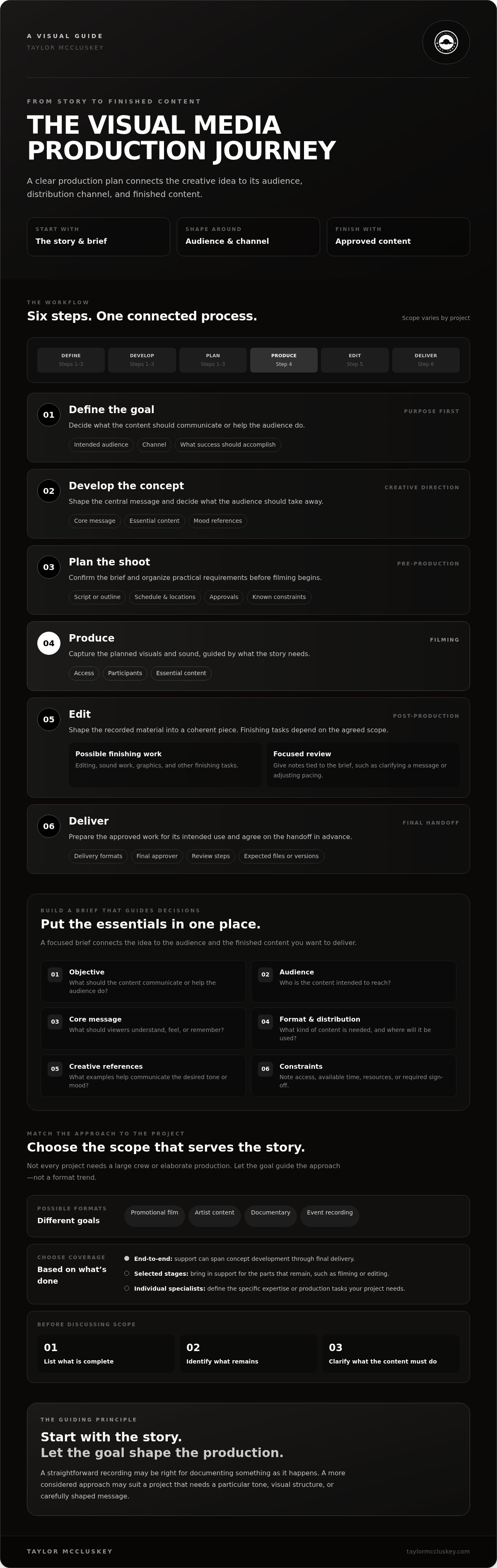
A clear workflow turns an idea into a finished piece while keeping its purpose in view. At each step, the project owner has decisions to make and information to share so the creative team can move forward. The exact scope varies, but these six steps offer a practical map.
What happens during concept development and pre-production?
Pre-production is the planning stage before filming begins. It turns the goal into a workable creative direction and gives the team a chance to address practical constraints before the shoot. A useful brief captures the project’s purpose, intended audience, central message, and references that clarify the desired tone. Adobe’s guide to how to write a creative brief can help organize those early decisions.
- Define the goal. Decide what the content should communicate or help the audience do. Share the intended audience, channel, and what a successful result should accomplish.
- Develop the concept. Shape the central message and creative direction. Identify what must be included, what the audience should take away, and any references that convey the mood.
- Plan. Confirm the brief, script or outline, schedule, locations, and approvals where relevant. Identify known constraints, such as access, available time, or required sign-off, before filming.
How do filming, editing, and delivery fit together?
- 4. Produce. Capture the planned visuals and sound. Decide what material the story needs, then share information about access, participants, and essential content with the production team.
- 5. Edit. Shape recorded material into a coherent piece. Editing, sound work, graphics, and other finishing tasks depend on the agreed scope. Review the cut at planned checkpoints and give focused notes tied to the brief, such as clarifying a message or adjusting pacing, rather than unrelated preferences.
- 6. Deliver. Prepare the approved work for its intended use. Agree in advance on delivery formats, who gives final approval, review steps, and which files or versions are expected at handoff.
Feedback works best when decision-makers share one set of consolidated notes at each review. This keeps revisions aligned with the original direction and makes it easier to distinguish essential changes from new ideas that could alter the scope.
For a project that needs a connected creative path from concept to final video delivery, explore TaylorMade Films production work. It’s an example of film production informed by an artist’s perspective.
How to match production services to your project
The right scope depends on what the content needs to achieve, who it needs to reach, where it will appear, and what your team can manage internally. A single piece for a defined channel may need a different approach from a layered story with several stakeholders and approval points.
Build the production scope around the intended outcome, not the longest service list. Use this comparison to start a conversation, then adjust it to your project’s actual needs.
| Project goal | Likely format and stages | Review needs to consider |
|---|---|---|
| Introduce an idea or organization | Promotional film; concept development, planning, filming, and editing may all be relevant | Who approves the central message and creative direction? |
| Capture a live performance or gathering | Event recording; filming and editing may be central, with planning shaped by the event | What moments matter, and who confirms the recording meets the brief? |
| Shape existing footage into a story | Edited film; editing and any agreed finishing work | Who selects or approves the source material and cut? |
These are starting points, not fixed packages. Distribution matters: content intended for one platform may need different framing or versions from content made for another channel. Complexity also affects scope. Consider the number of locations, contributors, story elements, and approvers, along with the time and skills your team can contribute. This makes the scope of visual media production services explicit rather than assumed.
When does a project need end-to-end production support?
End-to-end support may suit a project where concept development, planning, filming, and editing all need coordination, especially when the project owner has limited production capacity or several decisions to manage. One clear brief and a designated decision-maker can help carry the creative direction across stages. Confirm that the proposed scope fits the project’s requirements, and do not assume one provider can meet every technical or creative need.
When might selected services or individual specialists be enough?
How to prepare a visual media production brief
A useful brief gives the creative team a clear destination without dictating every step. It helps shape the scope of visual media production services around what the content needs to communicate, rather than assumptions about format or production scale.
What should the project brief answer?
Start with the viewer. What should they understand, feel, or do after seeing the content? Then capture the essentials:
- Objective: The project’s purpose and what a successful result should achieve.
- Audience: Who the content is for, including relevant needs or context.
- Core message: The main idea viewers should remember.
- Format and distribution: The preferred content format and where it will appear.
- Creative references: Examples that communicate tone, pacing, or visual style.
- Constraints: Known limits or requirements, such as available resources, access, or approvals.
References are prompts, not automatic requirements. Explain what you value in each example, such as its mood or storytelling approach, and flag anything that must be included. If the project is at an early concept stage, describe the goal, audience, message, and open questions. If the idea is developed, add the script or outline, chosen direction, required content, and decisions already approved. For more on translating an idea into visual choices, explore the professional music video director’s role.
How can a team keep feedback focused?
Set the review process before production begins. Name the people who can give feedback, identify who has final approval, and agree how notes will be gathered and shared. Where practical, route comments through one authorized decision-maker. This helps avoid conflicting direction and keeps creative choices connected to the brief.
Ask reviewers to tie each note to the agreed objective. “The opening takes too long to establish the message” gives the team a specific issue to assess. A preference that does not connect to the brief may be worth discussing, but it should not silently reset the project’s direction. For further context on how an artist’s perspective can inform creative decisions, read about artist-led film production.
Bring your project idea and brief to Taylor McCluskey’s film production work to explore an approach grounded in the story you want to tell.
TaylorMade Films and the next step for your production project
Once the story, audience, scope, and brief are clear, compare your needs with a real production perspective. Taylor McCluskey works as a filmmaker and offers film production under the TaylorMade Films label. The stated scope spans visual storytelling from concept through final video delivery. Confirm the specific stages and deliverables for your project before work begins.
What an artist-led production perspective can bring
Creative decisions are connected. The story shapes what viewers need to see, performance influences how a moment feels, and images help carry meaning from one scene to the next. Taylor McCluskey works across music, acting, and filmmaking, experience that can inform conversations about how these elements serve a project’s intent. That does not guarantee a particular result; it offers a perspective to consider as the concept takes shape. For a related discussion, explore cinematic storytelling services.
Keep the conversation grounded in the audience and message. A visual choice should help tell the story, not simply add polish. Ask how the concept, performance, and image can work together, and identify which creative decisions are essential to the project.
What to clarify before starting a conversation
Bring a concise outline, even if the idea is still evolving. Share:
- Goal and audience: What should the content communicate, and who is it for?
- Current concept: What’s established, and where would creative input be useful?
- Desired delivery: How do you expect to use the finished video?
- Open questions: Which stages might need support, and what project details still need confirmation?
Ask which stages are available for your project and confirm the specific scope, approvals, and final delivery expectations before moving forward. This helps distinguish what’s established from what still needs discussion, without assuming every production includes the same work.
If this perspective aligns with your project, explore Taylor’s film production work and make an inquiry with your goal, audience, concept, and desired delivery in hand.
Bring your visual story into focus
Strong visual media production services start with a clear purpose. Define what your audience should take away, then shape the scope around the story, delivery channel, and support your project needs. A focused brief and agreed approval process help keep creative decisions aligned from concept to final cut.
Whether you need support across the full journey or at selected stages, make the handoffs and final expectations clear. That gives the work direction without adding steps that do not serve its purpose.
Taylor McCluskey works across music, acting, and filmmaking, bringing an artist-led perspective to film production offered under the TaylorMade Films label. The stated scope spans concept through final video delivery. Confirm specific project details in conversation.
Ready to explore what might suit your project? Explore Taylor McCluskey’s film production work. Bring your goal, audience, and concept to start the conversation.
Frequently Asked Questions
What do visual media production services include?
Visual media production services can include planning, creating, and finishing content for a defined purpose. Depending on the project, that may involve concept development, pre-production planning, filming, editing, and preparing the final video for delivery. Some projects need support across the full process; others need help at selected stages. Confirm the scope, review process, and expected deliverables before work begins so everyone shares the same understanding.
What is the difference between video production and visual media production?
Video production focuses on creating moving-image content, while visual media production can be used more broadly for visual content created for a purpose. The terms can overlap, and their meaning may vary between providers. Ask what each provider includes in their scope rather than relying on the label alone. If your project needs a finished video, clarify the planning, filming, editing, and delivery work required to produce it.
How does the visual media production process work?
A typical process moves from defining the goal to developing the concept, planning, producing, editing, and delivering the finished work. The project owner helps by sharing the audience, core message, intended channel, references, and practical constraints. Agree on review points and who can approve decisions before production begins. During editing, consolidated notes tied to the brief help keep revisions focused on the intended outcome.
What should I include in a production brief?
Include the project objective, intended audience, core message, preferred format, distribution channel, creative references, and known constraints. Explain what viewers should understand, feel, or do after seeing the content. Mark which elements are essential and which references are simply inspiration. If the concept is still early, describe the goal and open questions. For a developed concept, add an outline or script and note decisions already approved.
Do I need a full-service production team for my project?
Not always. End-to-end support may help when several connected stages need coordination or your team has limited production capacity. Selected-stage support can be appropriate if you already have a concept, footage, or in-house skills for part of the work. Consider project complexity, audience, distribution, internal resources, and approval needs. Whichever approach you choose, confirm who owns each task and how materials pass between contributors.
When should I bring a production professional into a project?
Bring a production professional into the conversation once you can describe the project’s goal, even if the creative concept is still taking shape. An early discussion can help clarify the approach, stages, and practical requirements before key decisions are locked in. If you already have footage or a developed plan, explain what’s complete and where you need support. Confirm the professional’s scope and relevant experience for those specific needs.
How can I tell whether a production service is right for my project?
Check whether the provider understands your objective, audience, intended delivery, and creative direction. Ask which stages are included, what information or materials you need to provide, how reviews and approvals work, and what the final handoff covers. Compare the proposed scope with your team’s capacity and project constraints. A good fit is one whose clearly defined responsibilities support the story and outcome, not simply one with the longest service list.


