

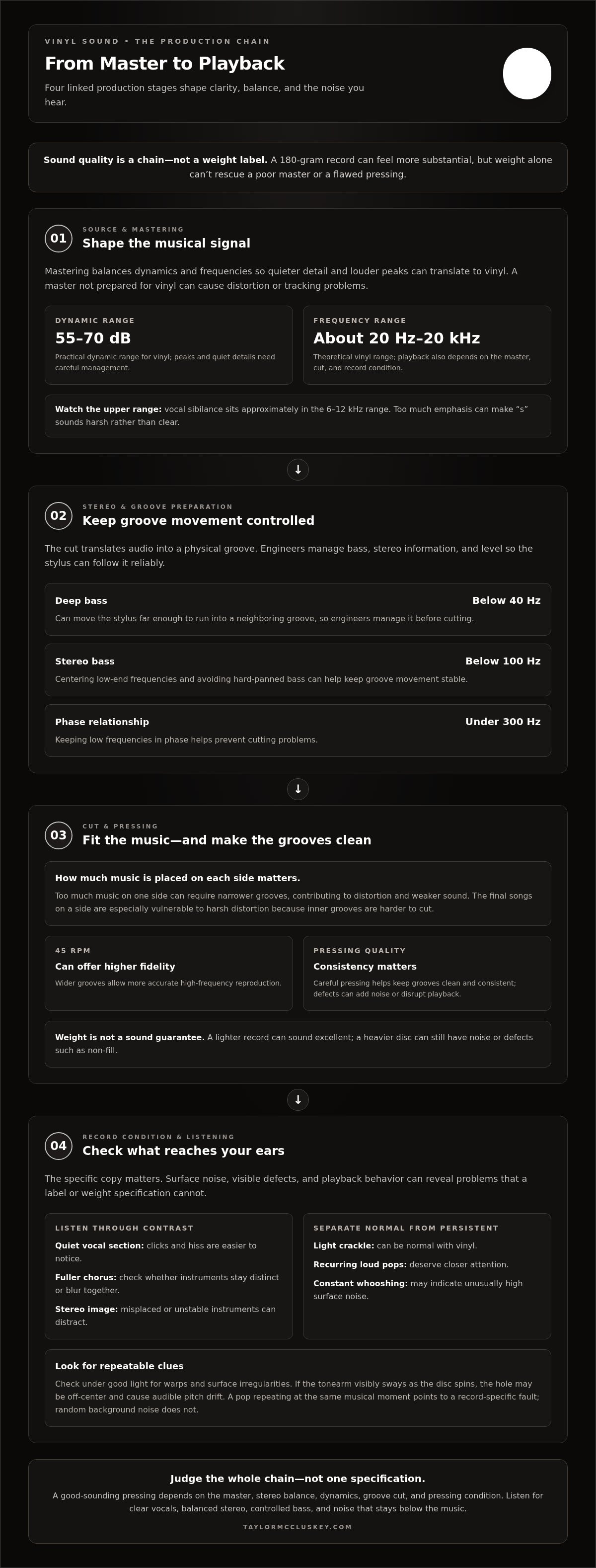
A 180-gram record can feel more substantial, but it doesn’t guarantee better sound. What makes a vinyl record pressing sound good is the quality of its master and cut, balanced stereo information and dynamics, and careful pressing that keeps the grooves clean and consistent. Weight alone can’t rescue a poor master or a flawed pressing.
That distinction matters when comparing editions: a lighter record can sound excellent, while a heavier one can still have noise or distortion. The best results depend on the full chain of production choices, not one specification on the label.
This guide explains how mastering, stereo balance, dynamics, pressing equipment, and record weight shape playback. You’ll learn why the source master and pressing quality matter more than weight, and what surface noise or distortion can reveal about a record.
Key Takeaways
- Judge a pressing by its sound and condition, not its “audiophile” label alone. Light crackle can be normal, but persistent pops or whooshing may point to excess surface noise.
- Listen for clear vocals, balanced stereo, and controlled bass. Mastering choices affect how well the music translates to vinyl.
- Compare how the music is distributed across each side. Crowded grooves can contribute to distortion, especially near the label.
- Modern equipment doesn’t automatically make a pressing better than an older one. Production care and quality control matter more than the age of the machinery.
- Treat record weight as a physical characteristic, not a sound-quality guarantee. A heavier disc can still have pressing defects such as non-fill.
What makes an album "Audiophile"?
An “audiophile” pressing aims for clear, balanced playback, with surface noise kept below the music. The label alone can’t tell you how a specific copy sounds.
Clarity and Tonal Balance
Clarity and tonal balance mean musical details stay distinct, while vocals and instruments sound proportionate rather than masked. Mastering, stereo balance, and pressing condition all shape what reaches your ears. For example, distortion or recurring noise can compete with a vocal and make it harder to hear clearly.
Listen to contrasting passages on the same side. A quiet vocal section makes clicks and hiss easier to notice; a fuller chorus reveals whether instruments remain distinct or blur together. Stereo balance matters, too. If an instrument intended to sit to one side seems misplaced or unstable, it can distract from the performance.
Some background crackle is normal with vinyl. The key is whether it stays light or starts to dominate. A few faint ticks between songs differ from loud pops that recur during the music. Constant whooshing can also indicate unusually high surface noise, rather than the quiet playback associated with a clean record.
Judge the whole listening experience, not one isolated sound. A brief click doesn’t define an entire pressing. Persistent crackle across quiet passages, however, can make subtle details harder to hear. Listen for both musical clarity and consistent noise, especially as the record moves from a loud section into a softer one.
Vinyl Purity and Surface Defects
Vinyl purity refers to the cleanliness of the material, while surface defects can add unwanted noise or disrupt playback. The vinyl formulation alone does not guarantee cleaner playback; the condition of the specific record and its production also matter. That distinction may inform a pressing’s appeal, but it doesn’t replace listening for faults on the specific copy.
Check the record under good light for visible warps and surface irregularities, then listen for recurring symptoms. Mild crackle may be part of ordinary vinyl playback; loud recurring pops or a steady whoosh deserve closer attention. If the tonearm visibly sways as the disc spins, the hole may be off-center, which can cause audible pitch drift.
Defects matter most when they recur or interfere with tracking. A mild warp may play without trouble, while a more serious one can affect tracking and eventually damage the stylus. Compare a suspect passage with another section: a pop that repeats at the same musical moment points to a record-specific fault, unlike random background noise.
Before choosing a pressing, look for reports about that exact edition, especially recurring complaints about defects, warps, or off-center holes. One account describes a poorly pressed record wearing out after a couple of years of infrequent listening. That example isn’t a lifespan rule, but it shows why a clean-looking label or “audiophile” description can’t replace evidence about the specific pressing.
Dynamics, clarity, and frequency balance
Vinyl clarity depends on more than treble or bass. Dynamic range, frequency balance, and groove geometry all shape playback.
Dynamics and Frequency Response
Dynamic range describes the difference between quieter and louder musical passages, while frequency response describes which pitches a recording reproduces. Both shape clarity: a wide dynamic range preserves contrast, and balanced frequencies help instruments remain distinct. Vinyl records have a practical dynamic range of around 55-70 dB, so mastering must manage peaks and quiet details with care.
Vinyl can theoretically reproduce frequencies from about 20 Hz to 20 kHz. The human audible frequency range extends from 20 Hz to about 20,000 Hz (20 kHz), but playback also depends on the master, cut, and record condition. Vocal sibilance occurs approximately in the 6 to 12 kHz range. Excessive emphasis there can make “s” sounds harsh rather than clear.
Groove Geometry and Low Frequencies
Groove geometry is the physical pattern that carries the signal, and low-frequency control helps keep its movement trackable. This matters because extreme bass excursions can crowd neighboring grooves and create playback problems. Frequencies below 40 Hz can move a stylus far enough to run into a neighboring groove, so engineers manage deep bass before cutting.
Stereo bass needs particular attention. Centering all low-end frequencies below 100 Hz and avoiding hard-panned bass information can help maintain stable groove movement. Keeping everything under 300 Hz in phase also helps prevent cutting problems. These choices don’t remove the bass; they shape how its energy is represented across the groove.
Listen for bass that feels firm without overwhelming vocals or percussion. A centered kick drum, for example, gives the groove a stable low-frequency foundation. Careful control matters in dense arrangements, where several low instruments compete for space and can blur clarity. These details help explain what makes a vinyl record pressing sound good beyond its surface appearance.
Mastering and Cutting Choices
Vinyl mastering prepares audio for the physical limits of a record, while cutting transfers the signal into a lacquer groove. These decisions matter because a master not prepared for vinyl can cause distortion or tracking problems. Engineers control bass, stereo information, and level so the stylus can follow the groove reliably.
At 45 RPM, records can offer higher fidelity because wider grooves allow more accurate high-frequency reproduction. Placing too much music on one side can require narrower grooves, contributing to distortion and weaker sound. The final songs on a side are especially vulnerable to harsh distortion because inner grooves are harder to cut well.
Compare a record’s opening and closing tracks during focused listening. Notice whether cymbals, vocals, or consonants become sharper near the label. That comparison reveals how cutting choices affect playback and helps clarify what makes a vinyl record pressing sound good in practice. For another perspective on musical dynamics, explore concert tickets and hear quiet passages and peaks in a live setting.
Modern pressing equipment and automation
Modern equipment doesn’t automatically produce a better record than vintage machinery. Sound quality depends on who made the pressing and how carefully each production stage was managed. A well-maintained older press can produce a strong release, while newer equipment can still yield flaws if quality control slips.
Automation can help operators repeat production settings across a run. Consistency matters because each copy must form properly and cool before handling. But a machine can’t fix a weak master or poor cutting decisions. The whole chain matters: preparing the audio, cutting the lacquer, pressing and cooling the record, then inspecting and packaging it.
Pressing also depends on the stamper, which transfers the groove pattern into the vinyl. Each stamper can press several hundred records before needing replacement. As it wears, results may change, so monitoring copies throughout a run helps catch developing defects. A clean early test copy alone doesn’t establish that every later record will sound identical.
Temperature and cooling affect a record’s shape. Vinyl that cools too quickly may warp, making playback uneven on a turntable. A slight dish warp may play without trouble, while a serious warp can affect tracking and eventually damage the stylus. Inspection after pressing can identify a physical problem before packaging and delivery.
To compare vintage and modern pressings, focus on the specific edition rather than its era. Check the same musical passage across copies, if available. Listen for recurring crackle, distortion, or pitch instability, then observe whether the record sits evenly as it spins. Matrix numbers can also help collectors investigate pressing details and plant information.
Production consistency is only one part of a good release. If a master is heavily compressed, newer pressing equipment won’t restore the lost musical contrast. If the cut pushes the format too hard, automation won’t remove the resulting distortion. Equipment affects how reliably the prepared signal becomes a record; mastering and cutting determine what signal reaches the press.
Think of production as connected stages, not a simple old-versus-new contest. Inspection can reveal warping or visible defects, while listening exposes faults that appearance misses. A record that looks flat, for example, can still produce repeated noise. Good packaging protects a finished record during handling, but can’t repair a pressing flaw already present in the groove.
The practical takeaway is simple: judge the pressing you can hear and inspect. Consider its sound, physical condition, and edition-specific history together. Neither vintage machinery nor modern automation guarantees quality. Careful production at every stage, from cutting through pressing and final inspection, helps distinguish a consistent release from one with avoidable defects.
Does Vinyl Weight Guarantee Quality?
No. A heavier record can feel more substantial, but weight doesn’t reveal the quality of its master, cut, or pressing.
The price of a high-quality pressing depends on the project and is provided after a quote request. Mastering, lacquer cutting, format, pressing quantity, and packaging all affect the cost.
Turntable setup, cartridge alignment, and stylus tracking force affect how accurately the groove plays. Set tracking force with a digital gauge and use a cartridge alignment protractor to help the stylus contact the groove correctly.
To preserve playback, use a carbon fiber record brush before every play and store records upright in protective sleeves. Careful handling helps limit dust and surface debris that can add noise.
Pressing Quality Control
Pressing quality control means checking records for manufacturing faults, including non-fill, before approving a full run. This matters because a flaw can create audible noise even when the original recording and lacquer are strong.
Non-fill occurs when vinyl doesn’t fully fill the grooves during pressing. It can produce tearing or zipper-like sounds. Cloudy or matte patches may indicate incomplete filling, while repeated visible defects across copies can point to plant quality-control problems. Test pressings let artists review sound quality before approving the full run.
Listen to a test pressing for recurring noise and distortion, not just its overall tone. Then compare later copies for the same fault. A smooth, centered-looking record can still have a groove defect, so visual inspection and playback both matter. The source recording and mix matter too: pressing quality can’t restore detail lost before the lacquer is cut.
Record Weight and Sound Quality
Record weight describes the disc’s mass, not the quality of its audio master. This distinction helps readers avoid treating a “heavyweight” label as proof of superior sound.
Standard records are typically pressed on 120-140 gram vinyl. A 180-gram record may feel more substantial and resist warping slightly better, but it doesn’t indicate master quality or guarantee quieter playback. Some records pressed on 180 gram or 200g are marketed as audiophile pressings; the weight remains only one physical characteristic.
Consider the entire production chain. The source recording, mix, mastering, lacquer cut, and pressing quality each affect the result. A carefully balanced mix, cut well onto standard-weight vinyl, can sound better than a poorly mastered album pressed on heavier material. Judge the specific edition by its sound and condition, not weight alone.
How do vinyl record mastering and cutting affect sound quality?
Mastering adapts a recording for vinyl, and cutting transfers that prepared signal onto a lacquer. These stages shape how clearly a pressing can reproduce the music. A poor cut can’t be fixed by heavier vinyl or careful pressing, so sound quality starts with decisions made before manufacturing.
Vinyl mastering must account for the format’s physical limits. The RIAA curve reduces bass and boosts treble before the master lacquer is cut. During playback, reverse equalization restores the intended tonal balance. Engineers also control peaks and stereo information, helping the stylus track the groove without excessive distortion.
Headroom gives the cutting process room to handle musical peaks. One recommendation is to keep peaks between -3 and -6 dBs when preparing a vinyl master. Audio information above 20 kHz can overheat the cutting head and cause noise and distortion. A high-resolution file, such as 24-bit/96kHz or higher, can sound excellent when mastered correctly for vinyl.
Playing time also affects cutting choices. For a 12-inch record at 33 1/3 RPM, 12 to 14 minutes is listed as optimum timing. Longer sides can put greater demands on the cut and may affect sound quality. If an album still runs longer than 40 minutes after songs and levels are adjusted, a double LP is worth considering.
Speed changes the available groove space. A 12-inch record at 45 RPM can offer wider grooves and more accurate high-frequency reproduction, with 9 minutes listed as optimum timing. That can suit an album split across more sides. The trade-off is practical: more sides mean more record changes, while a longer single side puts tighter demands on the cut.
Pay attention to where distortion appears during playback. The final tracks on a side are especially vulnerable to harshness because inner grooves are difficult to cut well. If a vocal or cymbal sounds increasingly sharp near the label, inner-groove performance may be a factor. Comparing the same passage across editions can reveal how mastering and cutting choices changed the sound.
A heavily compressed digital master can make a modern vinyl record sound loud but lifeless. Vinyl doesn’t automatically restore dynamics lost through compression. The strongest result comes from a master shaped for the medium, with controlled bass, balanced stereo, and room for musical contrast. The lacquer cut then translates those choices into a physical groove.
Explore music shaped for attentive listening to hear how arrangement and dynamics contribute to a finished recording.
Taylor McCluskey: Music Albums and Singles
Taylor McCluskey offers Music Albums and Singles for listeners who want to explore his recorded work after learning how mastering and pressing shape playback. Live performance offers another way to experience musical detail. If you’re comparing recorded and live sound, Concert Tickets offer the chance to hear the music on stage.
These offerings are a natural next step if you’re ready to move from evaluating a record’s production to discovering music. Explore Taylor McCluskey’s Music Albums and Singles, or choose a live performance that suits your listening interests.
Visit Taylor McCluskey’s website to explore the music and concert options.
Carry the Listening Experience Forward
Let your next record be a starting point, not just a specification comparison. As you listen, notice which performances draw you in, how the arrangements unfold, and which details reward another play. Understanding what makes a vinyl record pressing sound good can sharpen your ear, but the lasting connection comes from the music itself.
Taylor McCluskey creates work across music and film. Explore Music Albums and Singles, discover Film Production Services, or choose Concert Tickets to experience music live. Each offers a different way to engage with the craft behind a performance and its presentation.
Follow the work that speaks to you, whether it’s a recording, a film project, or a live show. Contact Taylor McCluskey to start the conversation and take your next step into the creative process.
Frequently Asked Questions
Does 180 gram mean better sound?
No. A 180-gram disc is heavier, but that number describes its weight, not its mastering or pressing quality. The extra mass may help it resist warping slightly better, yet it can’t improve a weak recording or correct a flawed cut. If two editions share the same album, treat weight as a physical difference and compare their sound, condition, and pressing-specific reports instead.
What makes a good vinyl record pressing plant and pressing process?
A good pressing process keeps production consistent from the first approved copy through the run. Test pressings let artists review sound before approving full production, while ongoing inspection can help catch emerging faults. Each stamper can press several hundred records before needing replacement, so wear needs monitoring. Cooling matters, too: records that cool too quickly may warp and sit unevenly on a turntable.
How do vinyl mastering levels, bass, and stereo width affect playback?
Mastering determines how level, bass, and stereo information translate into grooves that a stylus can track. Low bass spread widely across the stereo field can create difficult groove movement, so engineers commonly center low-end frequencies below 100 Hz. Keeping everything under 300 Hz in phase also helps avoid cutting problems. Excessive compression can reduce musical contrast, while uncontrolled peaks can complicate the cutting stage.
What vinyl record materials and formulations produce the best sound?
Virgin vinyl is described as purer and capable of cleaner playback than recycled vinyl, but material alone doesn’t establish how a particular copy sounds. The master, cut, and pressing execution still shape playback. Look beyond a material claim: listen for consistent noise and inspect the surface for irregular patches. A clean formulation can’t compensate for a poorly prepared recording or a manufacturing defect.
How do groove spacing and record playing time affect vinyl sound quality?
Longer sides require tighter groove spacing, which can reduce the room available for musical detail and level. A 12-inch record at 33 1/3 RPM can hold up to 22 minutes of audio per side; 12 to 14 minutes is listed as optimum timing for that format. When an album still runs longer than 40 minutes after songs and levels are adjusted, splitting it across a double LP can give the cut more room.
How do pressing defects like warps, off-center holes, and non-fill affect sound?
Defects can cause different playback symptoms. An off-center hole may make the tonearm sway and create audible pitch drift; non-fill can produce tearing or zipper-like sounds. A serious warp can interfere with tracking and eventually damage the stylus. A mild dish warp may still play fine, so note whether the fault disrupts the music or affects the arm’s movement as the record spins.
How can you compare vinyl pressings of the same album by sound quality?
Compare the same track and passage on each edition, using the same playback setup. A quiet passage can expose background noise, while a dense chorus can reveal whether instruments remain distinct. Focus on audible differences rather than sleeve claims. Collectors can inspect matrix numbers for pressing details and plant information, then use those identifiers to distinguish editions when documenting their listening impressions.
Do 180-gram vinyl records sound better than standard-weight records?
Not by weight alone. Standard records are typically pressed on 120-140 gram vinyl, while a 180-gram disc feels more substantial and may resist warping slightly better. Neither figure tells you whether the album’s master was well prepared or its grooves were pressed cleanly. For a practical comparison, assess the particular edition’s playback and condition instead of assuming a heavier disc must sound superior.


