

The strongest route to a director may begin with a conversation, not a casting call. The practical answer to how to find a director for a passion project film is to meet people who share your creative interests, then build trust around a clear idea. A no-budget production can start with a few friends and grow as the team connects with more collaborators.
You might assume you need a substantial budget or industry connections before anyone will take your project seriously. In practice, a focused concept, genuine collaboration, and visible creative momentum can help you find a director who cares about the material and wants to shape it with you.
This guide shows how to identify potential creative partners, approach filmmakers whose work resonates with your vision, and make a small local production more compelling. You’ll also see how professional advice and thoughtful networking can open doors, plus what film examples reveal about building a team around a passion project. The goal is practical: leave with clear next steps for finding a director and moving your film from idea toward production.
Key Takeaways
- Begin with a small, committed creative team, then grow the crew as the project’s needs become clear.
- Look for collaborators who share your filmmaking interests, and use existing footage to show them the project’s direction.
- Approach experienced professionals with a focused request for advice and a clear sense of what you’ve already accomplished.
- Build a local film around accessible locations and community connections; a strong project can create opportunities beyond its initial production.
- Keep outreach concise, explain the project and your past collaborations, and treat networking as the start of a relationship.
Forming creative partnerships and production teams
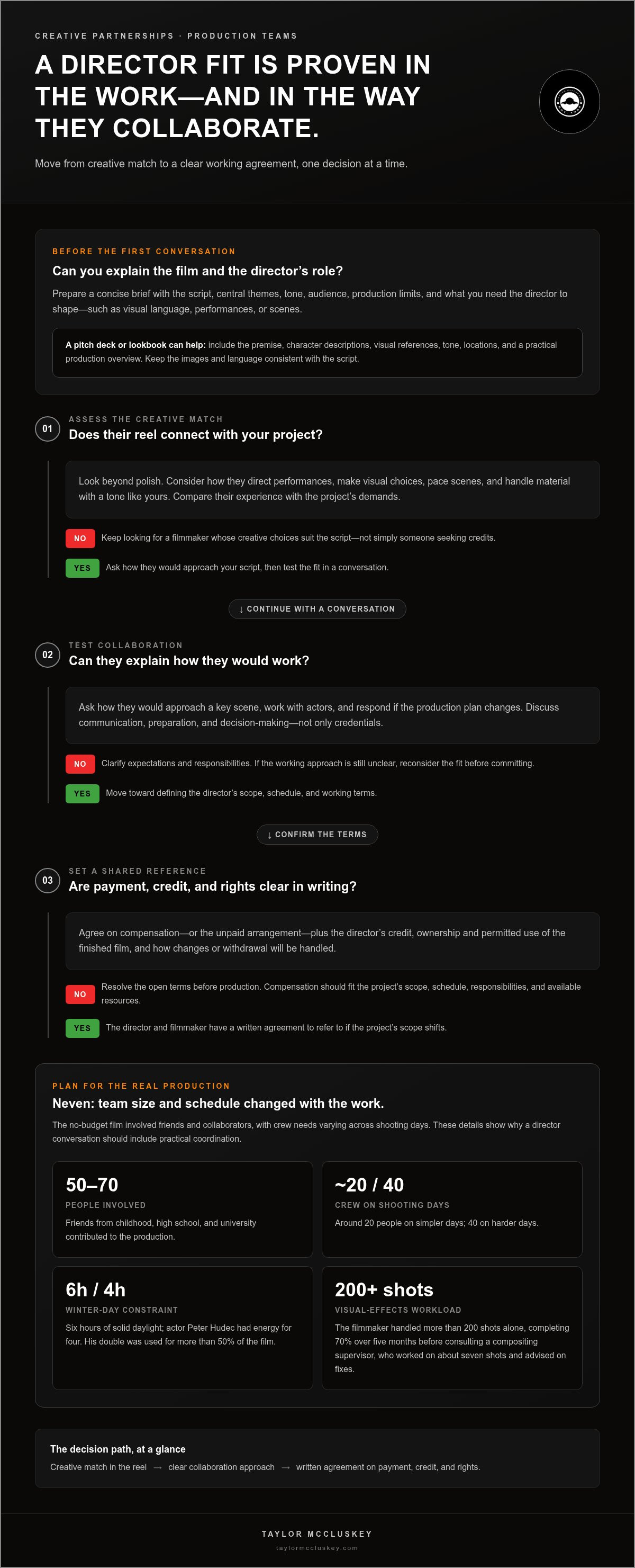
Director compensation depends on the project’s scope, schedule, responsibilities, and available resources. Set a realistic production plan first, then agree on compensation that fits the work. For perspective, the no-budget film Neven involved around 50 to 70 people, including friends from childhood, high school, and university. A large network can contribute skills, but it still needs clear roles.
A compelling director brief gives a filmmaker a clear creative target. Summarize the script, central themes, intended tone, audience, production limits, and what you need from the director. Specify which decisions they can shape. For example, explain whether you want them to develop the visual language, guide performances, or refine scenes with you.
A pitch deck or lookbook should make the film’s world easy to picture. Include a concise premise, character descriptions, visual references, tone, locations, and a practical production overview. Keep the images and language consistent with the script. A director should quickly see what makes the project distinctive and where their creative contribution could matter.
Evaluate a director’s reel by looking beyond polish. Consider how they direct performances, make visual choices, pace scenes, and handle material with a tone like yours. Compare their experience with the project’s demands, then ask how they would approach your script. A strong creative fit means they understand the material and can clearly explain their choices.
Use an interview to test collaboration, not just credentials. Ask how the director would approach a key scene, work with actors, and respond when a production plan changes. Discuss communication, preparation, and decision-making. On Neven, simple shooting days used a crew of around 20 people, while harder days required 40, making practical coordination essential.
Put payment, credit, and rights terms in a written agreement before production. Define compensation or the agreed unpaid arrangement, the director’s credit, ownership and permitted use of the finished film, and how changes or withdrawal will be handled. Clear terms give both collaborators a shared reference if the project’s scope shifts.
Approach a director with a brief, personal message. Mention a specific piece of their work, describe your film in a few lines, and explain why their perspective fits. Invite a conversation rather than asking for an immediate commitment. A no-budget production can start with friends and grow as shared enthusiasm brings new collaborators into future projects.
Unpaid or inexperienced directors can bring energy, but unclear expectations and limited production experience can create delays or creative conflict. Agree on responsibilities and milestones early. For Neven, winter filming offered six hours of solid daylight, while actor Peter Hudec had energy for four. The crew used his double for more than 50% of the film.
Neven also shows why teams should plan for post-production. The filmmaker handled more than 200 visual-effects shots alone, completing 70% over five months before consulting an experienced compositing supervisor. The supervisor composited about seven shots and advised on fixes. That targeted input helped address specific challenges without replacing the filmmaker’s work.
There is no single budget amount for a director. Compensation depends on the project’s scope, schedule, responsibilities, and available resources. Set a realistic production plan, then agree on compensation that fits the work.
Finding collaborators who share an interest in filmmaking
Start with people already making films in your circles. Ask former classmates, actors, editors, and filmmakers whose judgment you trust who might direct a project with your tone and scale. Film-school screenings, independent film festivals, and filmmaker groups offer natural ways to see work and start conversations. Look for directors whose creative choices suit your script, not simply people seeking credits.
To meet directors through film schools and festivals, attend student showcases, short-film screenings, and post-screening discussions. Introduce yourself with a concise description of your project, then ask which filmmakers might connect with its style. Filmmaker groups can also help you meet collaborators through project nights, workshops, and member introductions. Follow up with a specific note about the work you saw.
For a director-wanted notice, use community film groups, film-school boards, festival networking spaces, and online filmmaker communities that allow crew calls. Describe the story, intended format, location, schedule, available resources, and whether compensation is offered. State the director’s responsibilities clearly. A precise notice helps people decide whether the project fits their interests and capacity.
A shared passion can turn a small collaboration into a filmmaking opportunity. A no-budget production can begin with friends and expand as new collaborators join future projects. People may offer help when they see the team’s commitment. Show that commitment through consistent planning, respectful communication, and visible progress.
Situation: Benh Zeitlin made the 2008 short film Glory at Sea with college peers under the Court 13 moniker. Action: The collaborators developed the work together rather than waiting for a large production structure. Result: Their shared creative practice became a foundation for making films as a group. For an emerging director, the example shows how peer relationships can grow through completed work.
To attract a filmmaker who’s building experience, offer a defined role and a useful exchange. Share the script or a short scene, explain the intended tone, and invite their perspective before asking for a commitment. If you have footage, show it: seeing the project in motion can help a potential collaborator understand its direction. Treat feedback as the start of a working relationship.
Protect your screenplay and pitch materials with clear, professional habits. Keep dated drafts and records of whom you shared them with. Send only the material needed for the conversation, and agree in writing on confidentiality or permitted use when appropriate. For a sensitive rights question, seek advice from an entertainment attorney before sharing the full script.
As your team develops, film production work can offer a useful reference point for how creative projects move from concept toward production.
Approaching experienced professionals for advice
Approach an experienced filmmaker with a focused question, not a request to solve your entire production. Identify one challenge in your script, such as pacing, visual tone, or a difficult scene. Explain the audience you hope to reach and the film’s mission. That context helps an adviser respond to the creative decision instead of having to guess what you need.
The question of how to find a director for a passion project film often becomes clearer when you seek advice on a specific creative challenge. Send a concise project summary, a short sample, and the question you want answered. Ask whether they can suggest a directing approach, a production priority, or a skill the project needs. A clear request respects their time and gives you guidance to apply to your next draft or production plan.
For example, a filmmaker facing complex visual effects can ask an experienced compositing supervisor to review challenging shots. In Neven, the supervisor composited about seven shots and advised on fixes. The situation called for targeted expertise, the action was focused input, and the result was practical guidance on specific composites. Ask for advice that addresses your actual bottleneck.
Structure your follow-up around decisions. After a conversation, send a brief note summarizing what you heard and the step you plan to take. If an adviser recommends changing a scene, test the suggestion against the script’s central idea. Share the result only if it advances the discussion. This can turn a single exchange into a professional relationship grounded in thoughtful work.
Film Independent’s Project Involve offers an example of a defined filmmaking schedule. The program runs from January through October. Its short-film pre-production takes place in April and May, principal photography in June, and post-production from July through October. These stages show how to frame a question around a specific phase, such as preparation, set execution, or finishing.
Timing can make your request more relevant. Before production, ask a director how they would translate a script’s emotional turn into visual choices. During preparation, ask which scenes need the most rehearsal or location planning. After a rough cut, request feedback on clarity and audience engagement. Naming the project stage and your question helps an experienced professional offer actionable advice.
Keep the relationship respectful and specific. Agree on how to credit the adviser’s contribution, protect confidential material, and distinguish feedback from a commitment to join the film. If the discussion reveals a larger need, ask whether they can recommend a specialist or point you toward a relevant professional community. Their perspective can clarify your next move without turning one conversation into an open-ended obligation.
If you’re considering how to find a director for a passion project film, treat each exchange as a chance to test the project’s direction, not secure an instant commitment. Record the question, recommendation, and decision in a simple project document. Revisit it after a script revision or production milestone. That record helps you assess which guidance supports the film and keeps the team aligned with its creative mission.
Making a low-budget local film
A story rooted in its setting can make a small production more manageable. Choose a location your team can reach, then shape the script around available places, people, and daylight. A director who understands the community can help turn practical limits into visual choices. Before filming, list essential scenes and identify locations that can serve several moments without weakening the story.
Build the schedule around what each location can actually offer. Confirm access, noise conditions, power, parking, and permission before locking scenes. Then group shots by location rather than script order. This reduces unnecessary moves and gives the director and crew more time for performances. Keep a backup plan for weather or access changes, especially when a scene depends on an outdoor setting.
Situation: Roo Smith made a film for an adaptive-sports nonprofit. Instead of approaching brands for funding, he volunteered his time. Action: He filmed the project over three days and edited it in two days. Result: The finished film was selected for half a dozen film festivals. The example shows how a clear community mission can anchor a compact production.
Smith’s nonprofit film also created a new connection. It led to a collaboration with Patagonia to host a screening promoting the nonprofit. The screening gave the film a purpose beyond its initial release. For a community project, plan an audience-facing outcome early, such as a screening, then let that goal guide the director’s filming and editing choices.
Local relationships can also make a location more accessible. In one production example, a location provider liked the project and charged less than 50% of the usual price. The practical lesson is to explain why a place matters to the story and approach its owners respectfully. A strong fit between location and script may help start a productive conversation.
Make your offer specific. Share the scene, schedule, crew footprint, and how the space will be treated. A director can help adapt blocking and camera placement to the location, while the producer clarifies access and responsibilities. Put permissions and agreed conditions in writing. That clarity protects the shoot and lets the team focus on the work.
For an independent film, write around what the team can control. Favor contained scenes, a focused cast, and locations that serve the story. Ask a prospective director to identify production pressure points in the script and suggest practical alternatives. The strongest local plan connects the film’s creative intent with real places, community relationships, and a schedule the crew can execute.
People may be willing to help a no-budget project because they see the team’s passion for it, the filmmaker says. The filmmaker also says showing a potential collaborator footage already shot can help bring that professional onto a no-budget project; the stated value is 80%. This gives a prospective collaborator something concrete to consider when deciding whether to join.
Networking and industry access
Networking works best when each conversation has a clear purpose. Identify the kind of director your project needs, then look for people connected to that filmmaker’s world. A cinematographer, editor, actor, or athlete may know directors whose sensibility suits your story. Build relationships through shared work, not only around an immediate request.
Roo Smith recommends keeping a cold-pitch email brief. Introduce yourself, describe relevant past collaborations, and explain the project idea. Make the next step easy to understand, such as a short conversation about whether the concept fits. A concise message respects the recipient’s time and makes your creative intention easier to grasp.
Smith says cold-pitching brands has brought him little success, even with popular projects. If a brand connection genuinely suits your film, find its marketing director or creative director on LinkedIn. First learn what the organization is trying to communicate. Then frame your project as a possible creative match instead of sending a generic request for support.
A phone conversation can clarify whether there’s shared interest before you prepare a detailed pitch deck. Ask about the brand’s audience, current priorities, and the kind of content it needs. Listen for a genuine connection to your film’s mission. If the discussion points to a fit, follow up with a focused proposal shaped by that conversation.
Smith also recommends connecting with athletes, who may need content and introduce filmmakers to brand marketing directors. An athlete’s public profile can create an entry point to a broader creative conversation. Approach with a specific idea that serves the athlete’s goals, then explain how the project could connect with an audience. Don’t treat an introduction as a guaranteed commitment.
Situation: Smith’s nonprofit film didn’t secure brand funding. Action: He continued building professional relationships through the project. Result: It led to an introduction to a Denver advertising agency, which hired him for multiple bank commercials. The practical lesson for filmmakers is that a project can create valuable connections even without the funding outcome they initially sought.
Keep the relationship active without making every exchange a pitch. Share a concise update when the script advances, a screening is scheduled, or new footage clarifies the project. Ask thoughtful questions about film or television work that relates to your intended style. Consistent, relevant communication helps collaborators remember your project and understand how it’s developing.
If you’re ready to move from networking toward production, explore creative film possibilities as you shape your next steps.
Make communication useful by sharing progress that gives contacts a reason to respond, while respecting their own priorities. Roo Smith says a project that does not receive brand funding may still lead to connections for future collaborations. That possibility makes it worthwhile to treat each discussion as relationship-building, not simply as a yes-or-no decision about the current film. Be clear about what you’re seeking, stay attentive to what others need, and let future opportunities grow from a genuine creative fit.
Taylor McCluskey: Music Albums and Singles
Taylor McCluskey provides film production services for creators ready to move a developed idea toward production. This is a natural next step when your project needs production support beyond finding a director. The creative groundwork still matters: a clear script, an aligned team, and a practical plan help shape the next stage. Taylor McCluskey’s music albums and singles also bring music and film together within a broader artistic practice.
To discuss your project’s production needs, contact Taylor McCluskey through taylormccluskey.com.
Give Your Film a Clear Next Step
A passion project moves forward when someone turns creative intent into a shared plan. Decide what your next conversation should accomplish: testing the script’s direction, setting production priorities, or exploring who can help bring the film to life. That focus makes it easier to explain your vision and recognize a director who connects with it.
The answer to how to find a director for a passion project film isn’t a single introduction. It’s a deliberate process of matching your story with a creative partner, then building a working relationship around the film’s needs. Keep the project’s purpose at the center as you take the next step.
Taylor McCluskey offers Film Production Services, alongside Music Albums and Singles and Concert Tickets. If you’re ready to discuss your project, contact Taylor McCluskey to discuss your project.
Every film begins with a decision to make the idea real. Take the next step with clarity and give your project room to find its direction.


