

What if your music, acting, and film work aren’t separate careers, but different expressions of the same creative point of view? A multi disciplinary artist portfolio can make that connection clear. The challenge is real: without a strong thread, even excellent projects can read like a scattered list of credits.
A compelling portfolio doesn’t need to flatten your disciplines into one style. It needs to show why they belong together. Taylor McCluskey’s work across music, acting, and filmmaking offers a grounded example, with TaylorMade Films identifying the film-production side of a wider creative practice.
In this guide, you’ll learn how to shape a cross-disciplinary portfolio, choose projects and media with intention, and give each work enough context to demonstrate your craft. You’ll compare approaches across music, acting, and filmmaking, then see how a clear point of view can help fans and collaborators follow the connections from one project to the next.
Key Takeaways
- A multi disciplinary artist portfolio is a curated body of work, not simply a résumé or a directory of links.
- Give music, acting, and film distinct sections, with samples that show the craft and audience each discipline serves.
- Use project context and recurring creative choices to make multiple disciplines feel connected rather than scattered.
- Review a portfolio from the visitor’s perspective: identify their needs, scan the sections, inspect the work, and look for a clear through-line.
- Taylor McCluskey’s website brings creative work, updates, videos, and photos together for fans and collaborators.
What Makes a Multi-Disciplinary Artist Portfolio Feel Coherent?
A multi-disciplinary artist portfolio is a curated presentation of work across connected creative practices. The key word is curated. It doesn’t need to show everything an artist has done. It should help visitors understand the work, recognize the artist’s point of view, and see why distinct practices belong together.
Coherence comes from selection, context, and presentation, not from making every project look or sound the same. Music, acting, and filmmaking each call for different skills and forms of evidence. A clear portfolio gives each discipline room to stand on its own while offering a wider view of the artist behind it. This connects to an interdisciplinary approach, where different art forms can meet or inform one another without losing their distinct qualities.
Portfolio, résumé, or archive: what does each show?
A portfolio is an audience-facing edit of selected work. It presents samples and enough context to show what the artist contributed, what the project set out to do, and what visitors should notice. A résumé serves a different purpose: it emphasizes roles, credits, training, and professional history. Both can be useful, but a list of credits alone rarely gives someone a feel for the work.
An archive gathers material for preservation or reference. That breadth can be valuable to the artist, but it may ask visitors to sort through projects that don’t help them assess the practice. A portfolio makes those choices on the visitor’s behalf. It prioritizes relevant work, orders it thoughtfully, and provides clear pathways to explore more.
How can different disciplines belong under one artist identity?
Start with the artist’s point of view, not a forced visual style. Look for recurring themes, the emotional tone of a performance, or the way the artist shapes a story. These connections can guide the portfolio’s introduction and sequence while allowing the work itself to remain distinct.
Music, acting, and filmmaking aren’t interchangeable skills. A music section might foreground releases and live performance. An acting section can present representative performance samples. A film section can show filmmaking work and clarify the production context. Each area should make sense on its own, then connect to a wider creative identity.
A multi-disciplinary artist portfolio is a selective, contextual presentation of work across distinct creative practices, connected by the artist’s point of view.
Taylor McCluskey provides a grounded example for this framework. He works as a musician, actor, and filmmaker, with film production presented under the TaylorMade Films label. Those are separate practice areas, not one blended credit list. Each can offer its own entry point while contributing to a fuller picture of the artist’s work.
Three Portfolio Examples: Music, Acting, and Film in One Creative Practice
A strong multi disciplinary artist portfolio gives each practice its own space and makes the connections visible through thoughtful selection. The examples below show what different audiences need to see across music, acting, and filmmaking.
Music portfolio examples: releases and live performance
For music, selected releases can show an artist’s sound, authorship, and direction. Include listening samples, then add concise context so visitors understand the artist’s role and what makes the work representative. A focused selection is more useful than a long, unexplained list. When choosing samples, consider whether they reflect the range of the artist’s work or demonstrate a particular style especially clearly.
Live-performance information adds another dimension. It shows how recorded work translates to a stage and gives fans a way to follow performance activity. Taylor’s live music includes The Mfics tour. Presented alongside music releases, that activity can lead listeners from a recording to the experience of seeing the work performed.
Film and acting examples: roles, work samples, and context
Film work can sit under a clear production identity. TaylorMade Films is the label for Taylor’s film work within his wider creative practice. For each film sample, identify the artist’s role and provide brief context about the project. A clip or still may catch attention, but visitors also need to understand what the artist contributed. A concise caption can name the medium, role, and relevant project context without turning the portfolio into a long credit list.
Acting deserves its own presentation, not a passing mention in a general biography. Useful samples might include performance footage or another representative excerpt, accompanied by the role and relevant project context. Keep the framing factual and specific: identify what the sample shows, and distinguish the artist’s performance from other parts of the production. The goal is to help a viewer assess the acting on its own terms.
These sections serve different entry points. Music listeners may begin with releases or live activity. Film collaborators may look for production work and a clear account of the artist’s role. People exploring acting may want a direct view of performance. Each section can be distinct while still contributing to the wider portfolio. Art Prof makes a related point in its portfolio guidance: varied media can work together when there’s an underlying cohesion to the work.
To see how music, acting, and filmmaking sit within one creative practice, explore Taylor McCluskey’s creative work. A useful portfolio doesn’t ask every audience to arrive through the same door. It gives each one a clear way in, then lets the connections emerge.
How to Tell Whether a Multi-Disciplinary Portfolio Is Focused or Scattered
Several disciplines don’t make a portfolio scattered by default. The difference is whether visitors can quickly understand what each section contains and why it sits alongside the others. In a focused multi disciplinary artist portfolio, selection and context do that work. The projects don’t need identical styles or formats. They need an intentional presentation.
Use this quick test: can a visitor name the artist’s practice areas, understand what the artist contributed to a featured project, and see a reason to explore another section? If not, the issue may be the framing rather than the range of work. Taylor McCluskey’s music, acting, and filmmaking can each be presented distinctly, while concise descriptions and deliberate sequencing help visitors understand the wider practice.
Signs the portfolio has a clear through-line
A connected portfolio balances clear sections with a shared identity. Music, acting, and film each have a distinct purpose, but the introduction and project descriptions help visitors see the perspective linking them. This doesn’t require repeating the same colors or visual treatment. Cohesion can also come from recurring themes, tone, or a consistent approach to storytelling. For further ideas on visual unity, explore creative direction for indie films.
Descriptions should give each sample a useful frame: identify the medium, the artist’s contribution, and relevant context. Then review the order. A fan may want to find music first, while a potential film collaborator may look for production work. Clear navigation lets both reach relevant samples without making other disciplines feel hidden or incidental.
Signs a portfolio needs stronger curation
Look for moments where visitors have to guess. An unexplained clip may leave them unsure of the artist’s role. A long, undifferentiated project list may bury the strongest demonstration of craft. If sections have no labels or introductory context, visitors must do the work of connecting them.
Make the next edit practical:
- Label each discipline so visitors know what they’re viewing.
- Add concise project context that names the artist’s contribution without turning each entry into a long credit block.
- Sequence selectively to lead with relevant, representative work, then provide routes to explore other areas.
- Check the through-line by asking what creative perspective a visitor can recognize across the sections.
A useful portfolio gives each discipline room to speak, while its organization and context make the overall identity legible. If visitors can find a clear entry point and understand the connection between sections, variety reads as range, not distraction.
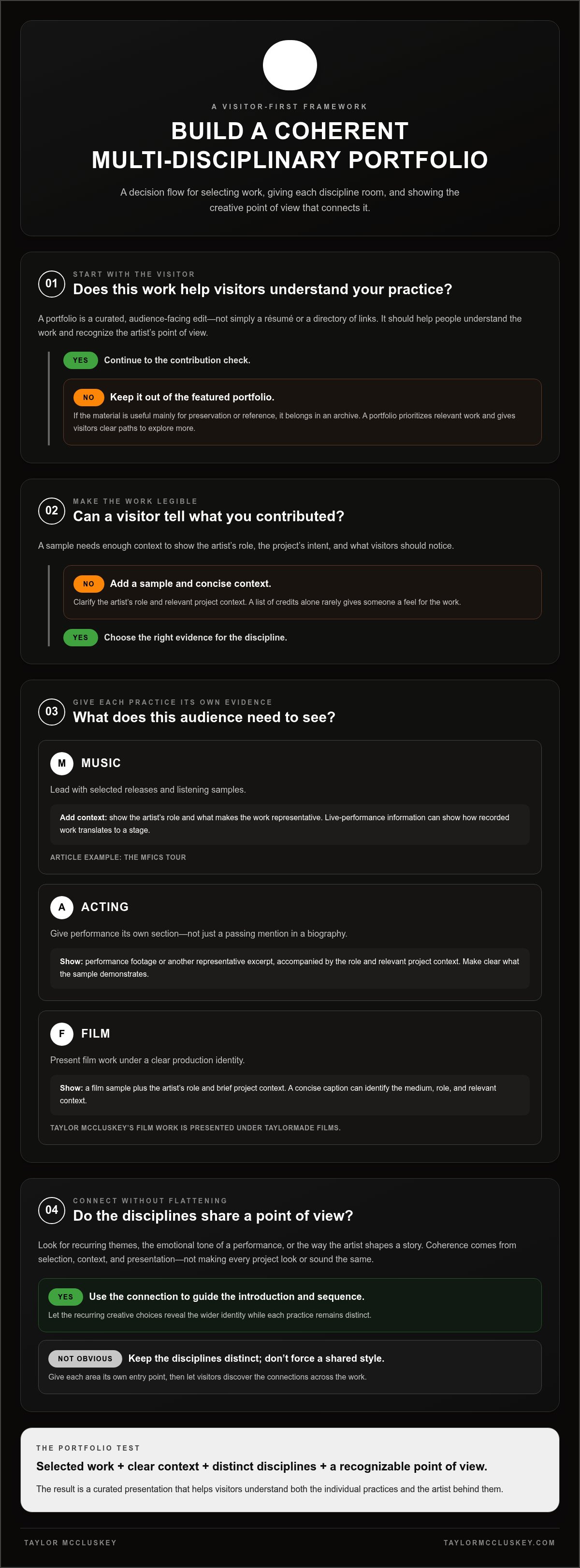
A Practical Framework for Reviewing Artist Portfolio Examples
Review a portfolio as a visitor with a specific purpose, not as the artist who already knows every project. This four-step pass can reveal whether the work is easy to navigate, supported by useful context, and connected by a recognizable point of view.
- Identify the visitor. Is the portfolio speaking first to fans, creative collaborators, or people interested in film production?
- Scan the sections. Can you quickly find the music, acting, and film work, and understand what each section offers?
- Inspect the samples. Does each selection identify its medium and explain the artist’s contribution?
- Assess the through-line. Do the choices reveal a perspective or sensibility across the disciplines?
These questions turn a quick browse into a useful assessment. A multi disciplinary artist portfolio doesn’t need to serve every visitor with the same first impression. It should provide clear routes into the work, then make the wider practice discoverable.
Four questions to ask when reviewing an artist portfolio
Start with clarity: can a new visitor tell who the artist is and which disciplines they practice? Next, check whether samples have enough context to show what they are and what the artist did. Finally, look beyond individual pieces. Do the selected projects suggest a recognizable creative point of view, or do they feel like unrelated entries collected in one place?
For film work, useful context can include the project’s purpose, the artist’s role, and how the finished piece reflects its creative direction. A practical overview of visual media production services can help frame the process behind a sample. For a focused example of how a creative vision informs a music video, see what a professional music video director does.
Match the portfolio evidence to the visitor
Different visitors look for different evidence. Fans may want an easy path to music, videos, live-performance updates, and merchandise. Potential collaborators may prioritize selected film samples and concise descriptions of the artist’s role. People exploring acting work need a clear way to find relevant performance samples and understand their context.
Keep the review grounded in what the portfolio actually shows. Don’t infer credentials from polished presentation or assume a contribution that the project description doesn’t state. Assess the samples, context, and navigation together. To see how creative work and updates are presented across disciplines, explore Taylor McCluskey’s portfolio.
Taylor McCluskey’s Portfolio: A Connected View of Music, Acting, and Film
Taylor McCluskey’s work offers a practical example of how one artist identity can hold distinct creative disciplines. He works across music, acting, and filmmaking. A coherent portfolio doesn’t need to suggest that every project has the same purpose. It needs to make each practice clear, then give visitors an easy way to explore the wider body of work.
One artist identity, distinct creative disciplines
Music, acting, and filmmaking call for different kinds of samples and context. Music can point visitors toward releases and live performance. Acting can be presented through performance material and relevant project context. Film work can show the filmmaker’s practice and make the production identity visible. Clear sections respect those differences instead of blending them into a single, indistinct gallery.
TaylorMade Films gives Taylor’s film work a recognizable identity within his broader creative practice. It functions as a clear part of the portfolio, not a separate artist persona that visitors must connect on their own. The wider site brings together creative work, news, videos, and photos, giving fans and collaborators different ways to enter. Those pathways can coexist without implying that a music release, acting performance, and film project all serve the same audience or artistic goal.
This is the central lesson of a multi disciplinary artist portfolio: connection comes from presenting distinct work under a legible identity, with enough organization and context for visitors to understand each part. Taylor’s example also illustrates why restraint matters. Focus on the artist’s disciplines and the information that helps visitors understand the work, rather than adding unnecessary detail that distracts from it.
Explore the work and follow what comes next
A portfolio can serve both as a record of creative practice and as a useful starting point for what’s next. Fans may follow music releases, look for performance updates, explore artist merchandise, or find concert tickets. Collaborators can use the film work and supporting information to understand the wider practice. Contact information provides a route for further engagement without taking attention away from the work itself.
Keep the invitation simple: point visitors toward the official site, where they can explore Taylor’s creative work, updates, videos, and photos. From there, they can follow music and tour news as it appears. Each discipline remains distinct, while the site offers a connected view of the artist behind it.
Explore Taylor McCluskey’s work and updates.
Build a Portfolio That Shows the Connections
A compelling multi disciplinary artist portfolio doesn’t make every project look alike. It gives music, acting, and filmmaking clear space, then uses thoughtful selection, context, and a consistent point of view to help visitors see how the work belongs together.
Use the framework from this article to check the essentials: can visitors find the discipline they care about, understand the artist’s contribution, and recognize a creative through-line? Taylor McCluskey’s work across music, acting, and filmmaking offers a real example. TaylorMade Films identifies his film work within a wider creative practice, while his website brings together creative work, updates, videos, photos, and contact information.
Explore the work and follow what’s next: Explore Taylor McCluskey’s music, film work, and latest updates. Every discipline can open a different door. With a clear presentation, those doors lead into one distinctive creative identity.
Frequently Asked Questions
What is a multi-disciplinary artist portfolio?
A multi-disciplinary artist portfolio is a curated presentation of work across more than one creative discipline. A musician who also acts and makes films might give each practice its own section, then connect them through a concise artist introduction and useful project context. The goal isn’t to make every piece look alike. It’s to help visitors understand both the range of the work and the perspective connecting it.
How do you make a multi-disciplinary artist portfolio feel cohesive?
Start with an introduction that names your disciplines and expresses your creative point of view. Give each practice a clear section, choose representative samples, and explain your role in each project. Consistent presentation and deliberate sequencing can help connect different forms without making them seem interchangeable. Visitors should be able to find the work most relevant to them, then understand how it fits within your wider practice.
What should a musician, actor, and filmmaker include in one portfolio?
Include selected music releases, live-performance information, film samples, and representative acting work. Organize each type separately and identify your contribution so visitors can assess the work in context. Keep project names, roles, dates, and credits accurate. A focused selection often communicates more than a long list: choose samples that demonstrate your craft and help visitors understand the character of each discipline.
Can one artist website showcase several creative disciplines?
Yes. One artist website can present several disciplines if its navigation makes each area easy to find and its introduction explains the broader identity. Separate sections let visitors focus on music, film, acting, or other practices without losing sight of the whole. The disciplines don’t need to share a style. A deliberate structure and concise project descriptions give visitors the context to explore each area and see how the work relates.
How many projects should an artist include in a portfolio?
There’s no universal project count that suits every artist or discipline. Include enough work to demonstrate range and craft, but don’t add samples just to make the portfolio longer. Prioritize representative projects with clear context and relevance to your intended visitors. Review the selection periodically. If a sample no longer supports the story you want the portfolio to tell, replace it or remove it so stronger work stays easy to discover.
What makes an artist portfolio look unfocused?
An artist portfolio can feel unfocused when samples appear without labels, context, or a clear structure. Visitors may struggle to identify the artist’s disciplines or understand their contribution to a project. Variety itself isn’t the problem; unclear organization is. Use purposeful sections, concise descriptions, and considered sequencing to guide visitors. A clear introduction can also explain the creative perspective that connects distinct forms of work.
How is an artist portfolio different from an artist résumé?
An artist résumé primarily records roles, experience, and credits. A portfolio lets visitors encounter selected creative work and understand its form, context, and the artist’s contribution. The two can complement each other, but they serve different purposes. A multi disciplinary artist portfolio should make samples easy to explore, while résumé details should stay accurate and clearly tied to relevant projects. Use the portfolio to show the work, not just list where you’ve worked.


