

What if a film’s visual identity came not from a bigger budget, but from more deliberate choices? Creative direction for indie films can turn a limited palette, one location, or a recurring sound into a world that feels unmistakably its own.
A promising concept can still feel visually vague when the director, cinematographer, production designer, and editor imagine its tone differently. On an independent production, limited time and resources make that misalignment costly. But constraints can become expressive choices rather than creative compromises.
This guide explores what creative direction covers and how its contributors shape a film’s identity. You’ll learn to translate theme and tone into practical decisions about color, framing, locations, costume, and sound, then build a flexible process that keeps collaborators aligned from development through production. Because image and sound work together to shape audience feeling, creative direction benefits from a joined-up perspective. The result is a cohesive vision that makes the most of what an indie film has and gives every choice a story-led purpose.
Key Takeaways
- Use creative direction for indie films to give story, image, and sound a unified identity, even when resources are limited.
- Turn themes, mood, and point of view into practical choices across settings, color, framing, and production design.
- Clarify how directing, cinematography, production design, and creative direction can intersect, while keeping responsibilities flexible to the project.
- Build a concise visual brief with references and motifs, then use focused questions to keep collaborators aligned.
- Explore how a perspective shaped by music, acting, and filmmaking can bring fresh connections between a film’s story, image, and sound.
Creative Direction for Indie Films: What It Means and Why It Matters
Making a small film feel like one coherent world is a real creative challenge. A location, costume, camera setup, or music cue can work on its own yet feel disconnected from the story’s tone. Creative direction for indie films addresses that challenge by giving collaborators a shared vision to use when making decisions, especially when time and resources are limited.
Creative direction is the shaping and communication of a film’s shared visual and sensory vision.
It connects the story’s intended effect with what audiences see, hear, and feel. The function may sit with one person or be shared across a close-knit team. It’s less about imposing a rigid look than giving each department a clear creative north star.
What does a creative director contribute to an indie film?
A guiding vision helps collaborators make choices that support the same experience. The director may focus on story, performances, and the overall telling; the cinematographer shapes how images are captured through light, composition, and camera movement; and the production designer develops the film’s physical world, including its settings and objects. These responsibilities can overlap. On independent productions, one person may take on several functions, or the team may develop the vision together.
The terminology also shifts across productions. Creative director describes the role in film as often associated with production design, but titles and boundaries aren’t universal. What matters is making the vision clear early enough for collaborators to make compatible choices. If a scene should feel intimate, for example, decisions about performance, framing, set dressing, and sound can all support that intention rather than pull in different directions.
When does a film need a clear creative direction?
Look for signs of a fractured vision: a scene feels comedic in one department’s choices but unsettling in another’s, visual motifs appear without purpose, or locations and costumes seem to belong to different films. These mismatches can make it harder for viewers to understand the intended mood, even if each individual choice looks polished.
Short films benefit from intentional direction just as features do. A concise runtime leaves little room for visual choices that don’t advance character, mood, or story. That doesn’t mean every frame needs decoration. A bare room, restrained palette, or fixed camera can feel precise and expressive when it has a story-based reason. Simplicity is a deliberate choice; vagueness is what happens when the team lacks a shared rationale. A clear vision helps a film’s choices feel connected without requiring a large production.
From Theme to Image: How Indie Film Creative Direction Works
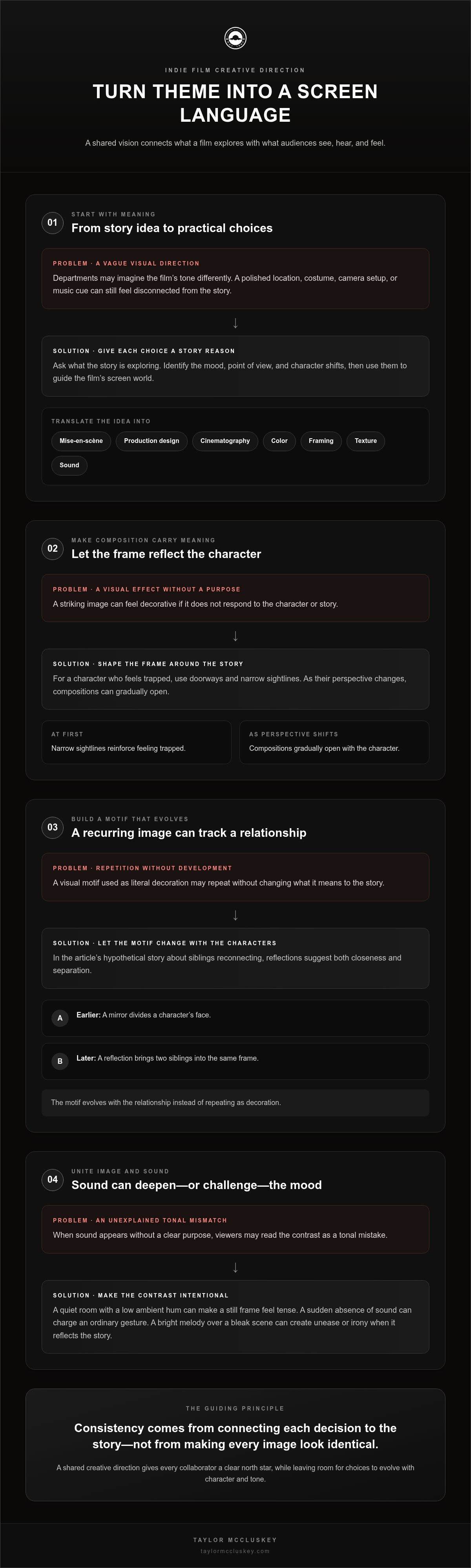
A theme becomes cinematic when it shapes decisions the audience can see and hear. Start by asking what the story is really exploring, then identify the mood, point of view, and character shifts that should guide the film’s screen world. From there, translate those ideas into choices about mise-en-scène, production design, cinematography, color, framing, texture, and sound.
This process doesn’t require a rigid formula. It does require a reason behind each choice. A character who feels trapped might be framed with doorways and narrow sightlines. As their perspective changes, the compositions could gradually open. The image carries meaning because it responds to the character, not because a visual effect was added for its own sake.
How do themes become visual motifs and production choices?
Hypothetical example: Imagine a story about a sibling trying to reconnect with a family they’ve drifted from. The creative team might use reflections as a motif, suggesting both closeness and separation. A mirror could first divide a character’s face; later, a reflection might bring two siblings into the same frame. The motif evolves with the relationship instead of repeating as literal decoration.
Build the idea into practical decisions. Production design might favor worn, familiar objects, while cinematography uses layered compositions to suggest emotional distance. A muted palette could shift subtly as the characters reconnect. For a useful industry perspective on how creative leadership intersects with art direction, see StudioBinder’s The Role & Responsibilities Defined. In creative direction for indie films, consistency comes from connecting each decision to the story, not from making every image look identical.
How do image and sound work together?
Sound can deepen a visual mood or deliberately challenge it. A quiet room with a low ambient hum may make a still frame feel tense; a sudden absence of sound can turn an ordinary gesture into a charged moment. Music can echo an image’s emotional direction, or create contrast that reveals a character’s private response beneath what they show.
The key is intention. A bright melody over a bleak scene might create unease or irony if that contrast reflects the story. If it appears without a clear purpose, viewers may read it as a tonal mistake. For a related look at how sound and image shape narrative, explore cinematic storytelling services.
Repeated visual choices establish a film’s screen language, teaching viewers how to read its images as the story unfolds. To carry a connected vision from concept into production, explore film production and direction with TaylorMade Films.
Creative Direction vs. Other Indie Film Roles: Where Decisions Meet
On an indie set, creative responsibilities often overlap. The director may shape the visual approach, the cinematographer may help develop the look, and the production designer may influence how a scene plays. The useful distinction is not a fixed job title. It’s clarity about who guides a decision, who contributes, and how the choice serves the film’s shared intention.
Creative direction for indie films acts as a point of connection across departments. It keeps individual contributions aligned without turning the vision into a rulebook. A framework gives collaborators a common reference, not a ban on fresh ideas. If a new choice strengthens the story, the team can adapt the approach together.
| Role | Focus | Decisions and collaboration |
|---|---|---|
| Creative direction | Coherence across the film’s visual and sensory identity | Connects story intentions to shared choices; aligns with the director and departments |
| Directing | Performances and the dramatic scene | Guides actors and shapes how the scene serves the story; collaborates with camera and design teams |
| Cinematography | How images are captured | Shapes lighting, composition, camera movement, and image texture with the director |
| Production design | The physical world on screen | Shapes locations, sets, props, and visual environment in dialogue with the director and other departments |
How is creative direction different from film directing?
Directing centers on bringing the story’s dramatic aims to life in filmed scenes, including performance, pacing, and how moments unfold. Creative direction considers how visual and sensory choices cohere across the film. The roles meet in decisions about tone and point of view. One person may contribute to both, particularly on a small production, but the team still benefits from knowing which decisions need shared agreement. StudioBinder’s overview of what a creative director does offers a further breakdown of the role.
How do cinematography and production design support the vision?
Cinematography gives the vision its image-making language. Lighting can shape atmosphere, composition can express distance or intimacy, and camera movement can affect how viewers experience a moment. Image texture also contributes to the film’s overall feel. Production design builds the environment around that image, from locations and sets to the props characters handle and notice.
These departments don’t work in isolation. A director’s priorities and the shared creative framework help them make choices that complement one another while leaving room for invention. For a related look at how directing guides a visual performance, explore professional music video direction.
A Practical Creative Direction Workflow for Independent Films
A workable visual plan should guide decisions without locking a production into choices that no longer fit. This flexible workflow for creative direction for indie films moves from story analysis to set alignment, while leaving room for department expertise and practical adjustments.
- Find the story’s central idea. Write down what the film is exploring, whose point of view shapes it, and what you want the audience to feel. Keep this focused. A clear emotional intention is more useful than a long list of abstract adjectives.
- Draft a concise creative brief. Include the central idea, intended tone, audience experience, and a few visual principles. For example, “the world feels observed, not staged” is more actionable than “make it cinematic.” Add a small selection of reference images or scenes, with notes on what to borrow and what to avoid. References should clarify qualities such as contrast or intimacy, not dictate exact shots.
- Choose motifs and a palette. Select a few recurring visual ideas that connect to character or theme, then decide how they can shift as the story develops. Define a palette by its function, such as separating emotional spaces or marking a change in perspective. Keep both flexible enough to work with available locations, wardrobe, and props.
- Translate principles into department questions. Ask the cinematographer what framing or lighting can reinforce the point of view. Ask production design how locations, objects, and textures can carry story meaning. Discuss how sound and music support, complicate, or withhold emotion. These questions invite informed solutions instead of prescribing every shot.
- Align, adapt, and record changes. Share the brief early, then revisit it as locations, schedule, and resources become clear. Separate essential story cues from adaptable details. If a planned setting is unavailable, preserve the scene’s dramatic purpose and find another way to express it. Record why significant choices change so departments can adjust in concert.
A concise visual brief helps collaborators make consistent choices without requiring them to make identical ones. That distinction matters. The brief provides common principles; each department brings its craft to the practical solution. For a broader view of how planning carries through production, see visual media production services.
Before production, check that every major creative choice has a story-based reason and that collaborators understand which elements are essential. If you’re ready to develop a film vision with professional support, explore TaylorMade Films’ production and direction services.
Building a Distinct Indie Film Vision with TaylorMade Films
A cohesive film vision is more than a set of attractive images. It’s a way to connect the story’s point of view with the audience’s experience, then carry that intention through creative decisions. The principles of creative direction for indie films apply across the whole process: every choice can contribute to the film’s identity, while remaining open to collaboration and discovery.
A production partner can help translate an early idea into a shared creative approach, keep departments working from compatible intentions, and carry key decisions forward as the film develops. The goal isn’t to remove change. It’s to make changes with the story in view, so an adjustment to a location, performance, or sound cue doesn’t accidentally pull the film in a different direction.
What can a cross-disciplinary perspective bring to an indie film?
Taylor McCluskey works across music, acting, and filmmaking, bringing distinct creative disciplines into conversation. Attention to performance can sharpen the emotional truth of a scene. A filmmaker’s perspective can connect that performance to framing and visual rhythm. A musician’s sensitivity to sound can inform how score, silence, or ambient detail shapes the audience’s response.
These elements work best as parts of a shared process, not as the signature of one person alone. Directors and collaborators contribute their own expertise; creative direction helps keep those contributions connected to the film’s central intention. The vision can guide the work while still making room for ideas that emerge in rehearsal, on set, or in post-production.
How can filmmakers take the next step with their visual vision?
Begin with one sentence that describes what the film should make its audience feel or understand. Keep it specific enough to guide a choice. Then select a few visual references and note the story purpose behind each one. Perhaps a reference informs the quality of light, another suggests a character’s distance from the world, and a third helps communicate the film’s pace. Naming the purpose matters more than copying the surface.
Bring that intention and those references into conversations with potential collaborators. They create a practical starting point for discussing performance, image, sound, and production design, while leaving room to refine the approach as the project takes shape.
TaylorMade Films brings film production and direction together with a perspective shaped by story, image, and sound. For filmmakers ready to develop a distinct vision and carry it into production, Explore TaylorMade Films.
Carry Your Film’s Vision Forward
A cohesive indie film vision begins with a clear story intention, then finds expression through connected choices in image, sound, performance, and design. Creative direction for indie films helps collaborators work toward that shared purpose while keeping the process flexible enough for fresh ideas and practical changes.
Start with a concise creative brief. Name the audience experience you want to create, choose a few references, and explain what each contributes to the story. Then use those principles to guide collaboration, not to prescribe every decision. The strongest visual identity isn’t about making every frame match. It’s about making each choice feel like it belongs to the same film.
Taylor McCluskey works across music, acting, and filmmaking, bringing a cross-disciplinary perspective to story, image, and sound. Film production and direction are available through TaylorMade Films. If you’re ready to develop your film’s creative vision with a production partner, explore TaylorMade Films.
Your resources may be limited, but your vision can still be distinctive. Make each choice count, and let the story lead.
Frequently Asked Questions
What is creative direction in an indie film?
Creative direction is the process of shaping and communicating a film’s shared visual and sensory vision. It connects story, tone, performance, imagery, production design, and sound so the audience experiences a cohesive world. On an indie production, one person may guide this vision or several collaborators may develop it together. The aim is to give departments a common creative reference while leaving room for individual craft and discovery.
Does an indie film need a creative director?
No, an indie film doesn’t always need someone with the formal title of creative director. What it does need is a clear approach to visual and sensory decisions, with collaborators understanding who guides key choices. The director, cinematographer, production designer, or another team member may help establish that approach. On a small production, roles often overlap, so agreeing on decision ownership can matter more than assigning a specific title.
How is creative direction different from directing a film?
Film directing typically focuses on guiding performances and shaping scenes toward the story’s dramatic aims. Creative direction focuses on coherence across the film’s visual and sensory choices, including how design, cinematography, and sound support its identity. The work intersects in decisions about tone and point of view. Depending on the production, one person may contribute to both, or the director may collaborate with others who help maintain the broader creative vision.
Can creative direction help an indie film with a limited budget?
Yes. Creative direction can help a team make deliberate use of the resources already available. A real location, a restrained palette, or a recurring prop can carry meaning when connected to the story. A clear vision also gives departments a shared basis for adapting plans when a location or production detail changes. The goal isn’t to disguise limitations, but to make practical choices feel intentional and connected to the film’s purpose.
What should an indie film creative brief include?
An indie film creative brief should state the story’s central idea, intended tone, desired audience experience, and a few guiding visual principles. Add a small set of references, with notes explaining what each one illustrates and what the team should avoid copying. Include relevant motifs or palette ideas if they serve the story. Keep the brief concise: it should clarify priorities and support decisions, not prescribe every frame or department detail.
How do you create a visual style for an independent film?
Start by identifying the story’s point of view, emotional tone, and character shifts. Translate those into practical choices about framing, lighting, color, locations, props, texture, and sound. Use a few references to communicate qualities such as intimacy or distance, then explain their story purpose. Consider how motifs can evolve as the narrative develops. Review the choices together so each department contributes to a connected style rather than working from separate interpretations.
What happens if a film’s creative vision changes during production?
A changing vision doesn’t have to break a film’s coherence. First, identify what has changed and why, then separate essential story intentions from details that can adapt. Share the reasoning with affected collaborators and update the brief or visual references so departments can make compatible adjustments. For example, a new location may alter the palette, but the scene can still preserve its intended feeling of isolation through composition, performance, or sound.


