

What if the smartest way to cut a short film budget is to protect the scenes that matter most? If you’re working out how to budget for a short film 2026, start with the story, not a generic cost-per-minute estimate. A quiet drama set in one room and a night shoot across several locations need different plans, even if they have the same runtime.
It’s easy to focus on visible production costs and miss expenses that surface later. Crew time, location logistics, sound and music, rights, storage, post-production, and schedule changes all affect what a film needs. A budget built on assumptions alone can leave the production with little room to respond.
This guide takes you from the script and production plan to a clear, workable budget. You’ll identify the main cost categories, compare trade-offs against your creative priorities, and account for risks without relying on one-size-fits-all figures. You’ll also learn how to track overlooked expenses, plan for uncertainty, and decide when professional production support could help clarify scope and execution. The goal is a budget that serves the film’s vision and gives you a firmer footing before production begins.
Key Takeaways
- Learn how to budget for a short film 2026 by starting with the script’s essential story elements and production needs.
- Organize costs across each production stage, while tracking donated labor and borrowed resources separately from cash expenses.
- Use a repeatable estimating process and label figures by how firmly they’re confirmed, so assumptions stay visible.
- Choose whether to protect, simplify, defer, or remove nonessential expenses without losing the film’s central vision.
- Turn your estimate into a production-ready plan with deadlines, responsible owners, and aligned permissions, rights, and delivery needs.
How to Budget for a Short Film in 2026: Start With the Story
Runtime is a poor starting point for an estimate. A short film’s budget depends on what the script asks the production to create and how the team will make it happen. A conversation in one accessible room has different requirements from a sequence involving night work, several locations, vehicles, or visual effects. To understand how to budget for a short film 2026, first identify what the audience must see and hear for the story to work.
A short film budget maps creative requirements to production resources. Treat it as a working estimate, not a fixed promise. As assumptions become confirmed, update the figures and record what changed. This keeps practical decisions connected to the creative plan.
Translate the script into production requirements
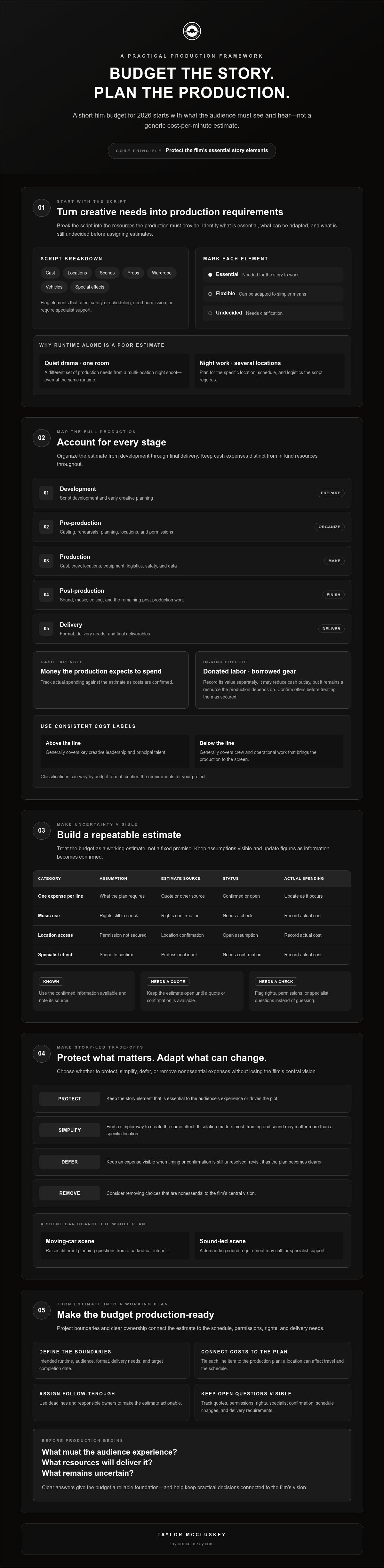
Break the script into the elements the production must provide: cast, locations, scenes, props, wardrobe, vehicles, and special effects. Flag anything that could affect safety or scheduling, require permission, or call for specialist support. A scene inside a moving car, for example, raises different planning questions from a parked-car interior. The goal isn’t to price every detail immediately. It’s to uncover what the production actually requires.
Then separate essential story beats from choices that can be adapted. If a character’s isolation is crucial, the location may matter less than the framing and sound. If a specific object drives the plot, it may be essential. Mark each element as essential, flexible, or undecided. That distinction helps the team protect the emotional core while exploring simpler ways to achieve the same effect.
Set the project’s boundaries before estimating
Define the intended runtime, audience, format, delivery needs, and target completion date. These boundaries shape the schedule and the resources needed, including post-production and final deliverables. For an overview of how budget sections are commonly organized, consult this guide to standard film budget structure. Use it as a reference, then organize your estimate around your own production stages and requirements.
Record available cash separately from in-kind support, such as donated labor or borrowed gear. Don’t treat an offer as secured until it’s confirmed. Keep an assumptions list too. Note items that still need a quote, rights check, or professional confirmation, such as music use, location access, or a specialist effect. Those open questions are part of the budget’s current state, not details to fill in with guesses.
Before estimating, ask: What must the audience experience? What resources will deliver it? What remains uncertain? Clear answers give the next budgeting steps a reliable foundation.
Short Film Budget Categories: Account for Every Production Stage
A complete estimate follows the work from early development through final delivery. Create separate sections for development, pre-production, production, post-production, and delivery. Within each section, distinguish cash expenses from in-kind support, such as donated labor or borrowed gear. Record the value of in-kind contributions separately. They may reduce cash outlay, but they’re still resources the production depends on.
Above-the-line costs generally cover key creative leadership and principal talent, while below-the-line costs cover the crew and operational work that bring the production to the screen. Classifications can vary by budget format, so use consistent labels and confirm the requirements for your project. Filmmaker Magazine’s lessons from a first-time producer offer a practical perspective on translating a script breakdown into budget decisions.
Pre-production and production line items
In pre-production, account for script development, casting, rehearsals, planning, and the work needed to prepare locations and permissions. For production, consider cast and crew, transport, meals, locations, insurance, safety, production design, wardrobe, props, camera, lighting, sound, and data management. Link each line item to the plan. An additional location, for instance, can affect travel and the schedule, while a demanding sound requirement may call for specialist support.
A simple tracking table makes it easier to see what’s known and what still needs attention. Put each expense on its own line, then update its status as estimates become confirmed:
| Category | Assumption | Estimate source | Status | Actual spending |
|---|---|---|---|---|
| Development | Script revisions required | Written estimate | Provisional | Enter after payment |
| Pre-production | Location access needed | Location quote | Awaiting confirmation | Enter after payment |
| Production | Crew days follow schedule | Current written quotes | To confirm | Enter after shoot |
| Post-production | Edit, sound, and color required | Post-production estimates | Provisional | Enter as incurred |
| Delivery | Captions and specified formats | Distributor or festival requirements | To check | Enter after delivery |
Before locking the plan, check current agreements, labor requirements, insurance needs, and permits with qualified sources. Requirements can depend on the production and where it takes place.
Post-production, music, and delivery
Allow for editing, color, sound editing and mixing, titles, captions, and each required deliverable version. Decide early whether the film needs original composition, recording, or licensed music. Rights depend on the intended use, so confirm the terms rather than assuming one permission covers every release. Include storage and backups, plus screening materials and distribution deliverables where relevant.
If you need help clarifying production scope, explore Taylor McCluskey’s film production services.
Build a Short Film Budget Estimate With a Clear, Repeatable Method
A useful estimate is more than a single total. It records what the production expects to spend, what has been committed, and what has actually been paid. For anyone learning how to budget for a short film 2026, the essential habit is to make assumptions visible and update them as decisions become firmer.
A useful estimate records its source, status, and assumptions. Build it in a sequence:
- Break down the script. Use the production requirements to identify what needs estimating and where uncertainty remains.
- Organize the line items. Group each expense under the relevant production stage, and name it clearly enough for the team to understand.
- Source each estimate. Seek project-specific information and record where each figure came from.
- Review the totals. Check category subtotals and the full budget against available funds, known commitments, and unresolved assumptions.
Give every figure a status. Quoted means you have a written quote. Researched means it’s based on current information but isn’t a project quote. Provisional means it’s an informed placeholder. Confirmed means the amount and relevant terms have been verified for this production. For each provisional item, note the underlying assumption and who will confirm it, along with a decision deadline.
Source estimates without false precision
Request written quotes that you can compare. Check what each includes and excludes, when the quoted terms apply, and what cancellation or change conditions are stated. Two figures aren’t meaningfully comparable if one includes required support and the other doesn’t. Use current, project-specific information rather than an old online average. If a quote isn’t available, label the line provisional instead of presenting an uncertain figure as settled.
Track the budget as production decisions change
Keep three amounts distinct: estimated for the current forecast, committed for approved spending or obligations, and actual for costs incurred. Assign one person to maintain the working document and log each approved change, including its reason and effect on the estimate. Before adding scope or extending the schedule, compare the new commitment with the current forecast and available funds.
Set contingency based on the project’s specific uncertainties, not a universal percentage. Consider which unresolved risks could affect spending, such as a weather-sensitive scene, a schedule change, or rights that still need confirmation. Set aside a reserve that reflects those risks, and state what it can be used for. Choose a spreadsheet or budgeting tool only after checking that it fits the team’s workflow, access needs, and version-control process. The tool should make changes easier to trace, not create another source of confusion.
Protect the Short Film Budget: Make Trade-Offs Without Losing the Story
A smaller budget doesn’t automatically mean a weaker film. It means each choice needs a clear purpose. When learning how to budget for a short film 2026, focus trade-offs on preserving what the audience needs to understand and feel. Simplify choices that add complexity without serving the story.
Prioritize spending by story impact
Rank creative requirements by how directly they support character, plot, atmosphere, and clarity. Then assess their effect on the schedule and production complexity. A comparison like this helps the team make decisions deliberately:
| Choice | Creative value | Schedule impact | Production complexity | Possible decision |
|---|---|---|---|---|
| Second location | Essential to the story’s turning point | Travel and setup may extend the day | Additional access and logistics | Protect, or simplify by finding a suitable alternative |
| Special wardrobe detail | Supports character, but isn’t central | May require extra preparation | Additional sourcing or continuity work | Simplify |
| Optional visual effect | Adds atmosphere, not plot clarity | May affect post-production time | Requires additional technical work | Defer or remove |
For nonessential expenses, consider four options: protect what carries the story, simplify how it’s achieved, defer it until scope or resources are clearer, or remove it if the film still works without it. Don’t treat safety, rights, or essential sound capture as optional polish. Poorly captured dialogue, for example, can undermine a scene even when its images are strong.
Look beyond the price of an individual choice. An extra location can add travel, setup time, permissions, and coordination. Night work may change scheduling and transport needs. A complex sound sequence may call for additional planning and post-production attention. The full impact comes from the requirements connected to that choice.
Plan for uncertainty and scope changes
List the risks that matter to this production, such as schedule changes, weather, availability, location access, or technical needs. For each risk, record its possible effect, who can approve a response, and what information they need to decide. Keep contingency separate from routine spending. Document approval before using it, including the reason, amount committed, and effect on the remaining work.
For a wider perspective on creative decision-making in independent projects, explore The Definitive Guide to Artist-Led Film Production in 2026. Consider how an artist-led approach can keep practical choices connected to the film’s intent. Explore artist-led film production.
Turn Your Short Film Budget Into a Production-Ready Plan
A budget becomes useful on set when it tells the team what happens next. Turn each estimate into a dated action with an owner, a decision deadline, and a confirmation status. Then check the budget against the script, shooting schedule, crew plan, permissions, rights, insurance, and delivery requirements. If one of these changes, review the related line items before approving the revised plan.
Separate secured resources from hoped-for support. Record confirmed funding, discounts, donated labor, and borrowed items according to their actual status. Don’t use an unapproved grant, informal offer, or expected contribution to justify a commitment the production can’t yet cover. This gives the team a clearer view of what’s available and what still needs a decision.
Complete a final budget readiness review
Before production, confirm that each major line has an estimate source, a responsible owner, a status, and expected payment timing. Review the schedule against the crew plan and location access. Check rights, releases, contracts, labor requirements, insurance, and permissions with qualified professionals who can assess the specific production.
Prepare a version-controlled budget for the team. Name each version clearly, identify who can make changes, and agree on how updates will be shared. This helps prevent an old estimate from quietly becoming the working plan.
Know when to bring in production support
Professional support may help when scheduling, coordinating departments, or meeting delivery requirements goes beyond the team’s experience. Before discussing the project, gather the script, schedule, budget draft, creative priorities, and a short list of open questions. That context makes it easier to identify where the plan needs clarification than asking for generic figures without production details.
Taylor McCluskey offers film production and direction services under the TaylorMade Films banner. For a related perspective, look for How Independent Film Production Services Elevate Stories, and consider how production support could help align the creative scope with the practical plan. When learning how to budget for a short film 2026, you don’t need to resolve every uncertainty alone. The key is to know which decisions are ready, which need confirmation, and where experienced support could help.
If you’re considering support for your project, explore TaylorMade Films’ production services and prepare the questions you’d like to discuss.
Move Your Short Film From Estimate to Action
A strong budget starts with the story, then follows its requirements through every production stage. It separates confirmed resources from assumptions and makes trade-offs visible. That helps you protect the film’s essential creative choices without treating every expense as fixed.
Use your working estimate to assign owners, deadlines, and confirmation steps. Review it as the script, schedule, rights, and delivery needs take shape. That’s the practical value of learning how to budget for a short film 2026: you gain a plan that can respond to change while keeping the film’s purpose in view.
Taylor McCluskey works across filmmaking, acting, and music, with film production and direction services offered under the TaylorMade Films banner. If professional support could help clarify your project’s scope and execution, explore TaylorMade Films production services.
Keep the story at the center, make each decision deliberately, and take the next step with confidence.
Frequently Asked Questions
How do you make a budget for a short film?
Start by breaking down the script into the resources each scene needs, then organize costs by development, pre-production, production, post-production, and delivery. Gather project-specific estimates and label each as quoted, researched, provisional, or confirmed. Track estimated, committed, and actual spending separately. When working out how to budget for a short film 2026, keep assumptions visible and update the estimate as the schedule, creative plan, or confirmed resources change.
What should be included in a short film budget?
Include costs across the full production, not just the shoot. Consider development, cast and crew, rehearsals, locations, permissions, transport, meals, safety, insurance, production design, wardrobe, props, camera, lighting, sound, and data management. Add post-production needs such as editing, color, sound, titles, and captions, plus storage and delivery materials where relevant. Track donated labor or borrowed gear separately from cash expenses, and check project-specific requirements with qualified sources.
How much does it cost to make a short film?
There isn’t one reliable figure for every short film. The budget depends on the script and production plan, including cast, locations, schedule, equipment needs, sound, post-production, rights, and delivery requirements. A contained story with a straightforward plan needs different resources from a production with multiple locations or complex technical demands. Build an estimate from current, project-specific quotes and clearly mark amounts that remain provisional instead of relying on a generic cost-per-minute figure.
Can you make a short film with no budget?
Is contingency necessary in a short film budget?
A contingency reserve can help a production respond to uncertainty, but its size should reflect the project’s specific risks rather than a universal percentage. Consider factors such as schedule changes, weather, location access, availability, or unresolved technical needs. Keep the reserve separate from routine spending, define who can approve its use, and document each draw, including the reason and effect on remaining funds. Review the reserve as assumptions become confirmed.
How do you estimate crew and equipment expenses?
Use the schedule to identify the roles, workdays, and equipment needs for each production day. Request comparable written quotes and confirm what each includes or excludes, along with how long its terms apply. Check relevant labor agreements and equipment arrangements with qualified sources. If you can’t get a quote yet, record a researched or provisional estimate, state its assumptions, and assign someone to confirm it by a decision deadline.
What happens if a short film goes over budget?
Pause new commitments and compare actual and committed spending with the latest estimate. Identify what caused the overrun, then assess its effect on the remaining schedule and essential story requirements. Options may include simplifying or deferring nonessential elements, adjusting the plan, or seeking confirmed additional funding. Don’t draw on contingency without approval. Record the decision, update the budget and schedule, and share the revised version with everyone responsible for production spending.


