

There are four practical places to start. Finding a film producer for an indie project can begin with filmmaker communities and film-school networks, industry lists, film offices, and festivals or other relevant events. A thoughtful introduction tailored to the producer and your project gives the connection a clear purpose.
When you’re developing a film and searching for the right creative partner, it can be hard to know where to focus. You don’t need to approach every producer you find. Start with routes that connect your project to people whose interests and experience are relevant. This guide explains how to use filmmaker networks, research industry lists, seek introductions through film offices, and make the most of events where producers gather. You’ll also learn how to make each approach specific and professional, so your project is easy to understand and the conversation has a natural next step.
Key Takeaways
- Build connections through filmmaker communities and film-school networks, and tailor your first approach to the person and project.
- Use industry publications’ producer lists to identify potential collaborators whose work aligns with your film.
- Ask local film offices for introductions that can connect your project with producers in your area.
- Choose relevant industry events with intention, and use them to start genuine conversations about your work.
1. Connecting filmmakers with producers and industry professionals
Start by identifying the role your film needs. A producer typically helps develop and oversee production, secure financing, and guide distribution and marketing. An executive producer’s contribution varies by project, while a line producer focuses on production logistics and budget management. A production company is an organization, not an individual role. Choose based on the work ahead, not the title alone.
For finding a film producer for an indie project in the United States, explore filmmaker social media groups, subreddits, film-school networks, and networking groups. Look for communities focused on independent film, your genre, or your area. When posting in filmmaking subreddits, state your location or country. Describe the project’s format and stage, along with the producing experience you’re seeking.
Make your introduction specific. Mention a film or credit by the producer that connects to your project, then briefly describe your story and the partnership you need. Don’t send a full script in your first message. Ask whether they’re open to hearing more, and follow their submission process.
Film-school course leaders or administrators may share your information with current and former producing-course students. At a festival, contact a producer after watching their film and mention a specific element that resonated. Director Ryan Koo met more than 50 producers before joining forces with Chip Hourihan for his first feature. The example underscores the value of persistent, focused outreach.
To assess a producer’s experience, review their credits, the films they completed, and their role on each project. Look for work relevant to your format, scale, and genre. Ask informed collaborators about the producer’s professional reputation, and request references before discussing a partnership.
Unverified credits can create mismatched expectations. Vague upfront-fee requests can also expose you to financial loss without clearly defined work in return. Before money changes hands, agree in writing on responsibilities, deliverables, and payment terms. A credible collaboration should make the producer’s role and proposed contribution clear.
Focus on the producer-finding methods that suit you rather than trying every option. Mesh Flinders spent two years writing the personal story he later shared with producer Neda Armian.
2. Using industry publications’ producer lists
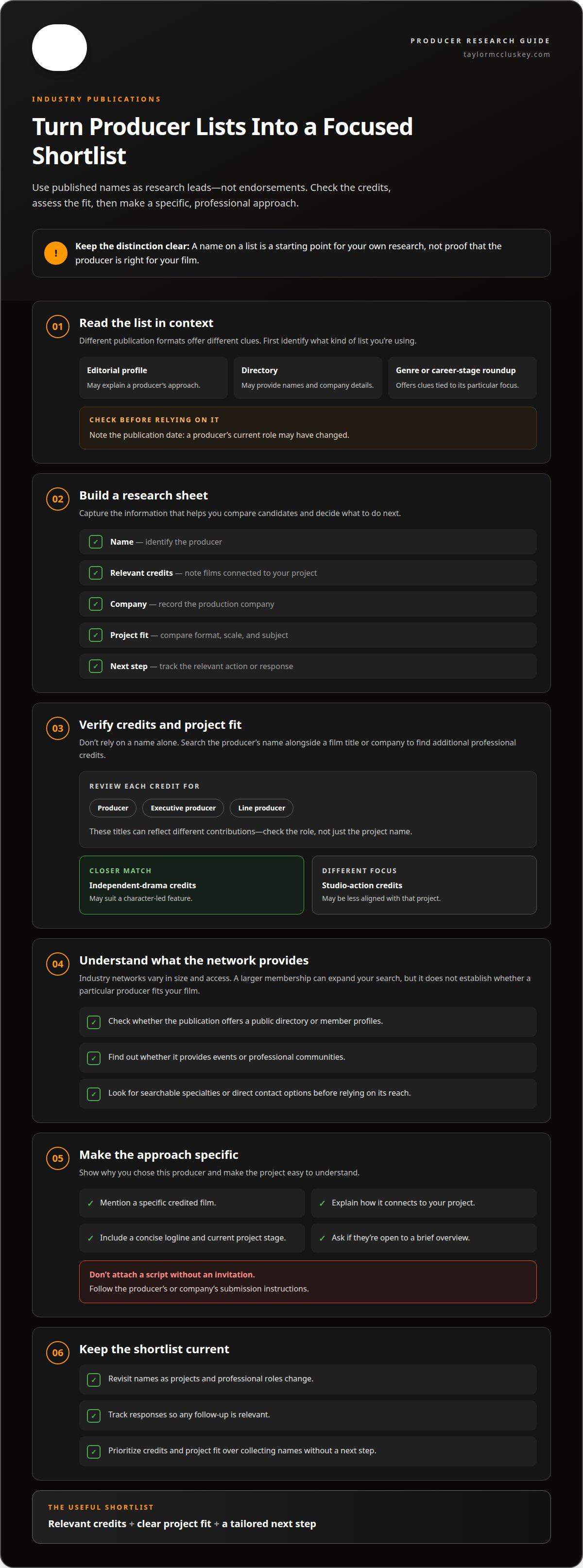
Producer lists in industry publications can turn a broad search into a focused shortlist. Treat each list as a starting point, not an endorsement. Record each producer’s credited films, production company, stated interests, and contact or submission guidance. A producer whose credits include independent dramas may suit a character-led feature better than one whose work focuses on studio action films.
First, consider the publication’s context. Is the list an editorial profile, a directory, or a roundup focused on a genre or career stage? Each format offers different clues. A profile may explain a producer’s approach, while a directory may provide names and company details. Note the publication date, since a producer’s current role may have changed.
Create a simple research sheet with columns for name, relevant credits, company, project fit, and next step. Search each name alongside a film title or company to find additional professional credits. Distinguish producer, executive producer, and line producer credits, since these titles can reflect different contributions. Prioritize credits that resemble your project’s format, scale, or subject.
Industry networks vary in their size and access. Some publications offer public directories; others connect readers with member profiles, events, or professional communities. A larger membership can expand your search, but it doesn’t establish whether a particular producer fits your film. Before relying on a network’s reach, find out what it provides, such as searchable specialties or direct contact options.
Turn your research into a tailored approach. Mention a specific credited film and explain its connection to your project in a few clear lines. Include a concise logline and the film’s current stage. Ask whether the producer is open to a brief overview instead of attaching a script without an invitation. Follow the producer’s or company’s submission instructions.
Keep your shortlist current. Revisit names as projects and roles change, and track responses so any follow-up is relevant. A focused list based on credits and project fit is more useful than a collection of names without a next step.
3. Asking local film offices for producer introductions
A film office can be a useful point of connection. Contact the office serving your intended filming area and ask whether it can introduce you to local producers. Explain your location needs and why a local producing partner would help. The office may suggest relevant contacts or direct you to regional film networks.
Make your request specific enough to guide an introduction. Describe your film’s genre, development stage, intended production area, and target budget range. For example, if you’re developing a contained drama for production in a particular city, ask for producers familiar with independent features and local production conditions. These details distinguish your project from a general networking inquiry.
An indie producer can help shape and oversee production, pursue financing, and guide distribution and marketing. Bring one in when your project needs that leadership, such as during development, packaging, or preparation for production. Compensation and backend participation depend on responsibilities, financing structure, and contributions. Negotiate them as project-specific terms rather than assuming a standard rate.
Keep your email brief and useful. Include a clear subject line, concise logline, genre, location, project stage, and the kind of producer you hope to meet. Add a short director’s statement or project overview when relevant, then ask whether the office can suggest an introduction. Don’t attach a full script unless requested.
When an introduction leads to a conversation, discuss the producer’s responsibilities and relevant experience. Put the agreed terms in a written contract, including duties, compensation, backend participation, screen credit, decision-making authority, and how either party can end the arrangement. An entertainment lawyer can review the agreement before you sign. Clear terms align expectations and help preserve the working relationship as the film advances.
A request for a stranger to read a script can feel like asking for 90 seconds of their time on the street. Keep the first ask focused, and make it easy for the recipient to understand what kind of connection you are seeking.
If you also approach producers directly, tailor each introduction to the person rather than sending the same note to everyone. A relevant, individual message makes your request clearer and keeps the conversation focused on whether their experience fits your project.
4. Attending events producers are likely to attend
Choose film festivals and industry events for their producer communities, not just their screenings. Look for panels, filmmaker meetups, pitch sessions, and project forums on the schedule. In the United States, SXSW and IFP’s Project Forum are examples of events connected with producer networking. Online, look for virtual festival events, industry panels, and filmmaker community sessions with producer participation.
Plan before you arrive. Review the program, identify films and sessions that relate to your project, and note relevant producers or speakers. Prepare a concise introduction that covers your film’s logline, genre, development stage, and the producing partnership you’re seeking. A focused conversation about a shared creative interest is more useful than handing someone a script without context.
Director Chad Hartigan met producer Cherie Saulter at SXSW in 2010. He had attended the festival for the previous five years, supporting friends’ films and meeting people. That history shows how relationships can develop through repeated participation, not a single pitch. Attend events where you can engage with the community as well as promote your own work.
Project forums can also connect films in development with industry professionals. Mesh Flinders had been developing his feature directorial debut for two years when he brought it to IFP’s Project Forum. Use the event’s stated format to decide what to prepare. A panel calls for thoughtful questions; a project forum may require a concise presentation or materials.
After meeting a producer, follow up with a tailored note. Mention the event, the conversation, or a film you discussed, then summarize your project and ask about an appropriate next step. Keep the message specific and respect any submission guidance. If you’re ready to move from industry conversations toward production planning, take the next step with your film project.
Taylor McCluskey: Film Production Services
Taylor McCluskey provides film production services for filmmakers moving from producer outreach toward production. If your project has a clear creative direction and you’re ready to discuss how to advance it, share its current stage, format, and goals. That context helps focus the conversation on the film and the support it needs.
Finding a producer is one part of building an indie project. A production partner can help turn creative intent into a practical plan for the work ahead. Taylor McCluskey’s film production services offer a next step when your project is ready to move beyond networking and introductions.
Have a film in development or preparing for production? Contact Taylor McCluskey to discuss your project.
Turn a promising connection into a next step
The next step in finding a film producer for an indie project is deciding what progress means for your film. That could mean clarifying the creative direction, agreeing on the producer’s role, or shaping a realistic path from development toward production. Write down the decision you need to make next. A focused conversation is easier to begin when you can explain what’s ready, what remains open, and where you want the project to go.
Keep the project’s creative intention at the center. A producer relationship works best when expectations and artistic priorities can be discussed openly. You don’t need every detail settled before starting the conversation, but knowing your next challenge gives it purpose.
Ready to discuss your film and its next phase? Contact Taylor McCluskey to discuss your project. Every independent film begins with a decision to move forward. Make yours with clarity and confidence.
Frequently Asked Questions
What fees, compensation, and backend participation do indie film producers typically receive?
Producer compensation and backend participation depend on responsibilities, financing structure, and contributions. Negotiate them as project-specific terms rather than assuming a standard rate, and put the agreement in writing.
How do I write a pitch, logline, and lookbook to approach a film producer?
Make your approach concise and tailored. Include a logline, genre, project stage, and the producing partnership you need, and explain the connection to a specific film or credit by that producer. Ask whether they’re open to hearing more, follow their submission process, and don’t send a script without an invitation. The article gives no guidance on preparing a lookbook.


