

A production partner’s fit is not measured by striking images alone. A boutique film production house should connect a clear point of view with the work needed to bring a project to the screen. Yet production-house descriptions can sound interchangeable, and a portfolio may not show how a filmmaker approaches story, collaboration, or delivery.
This guide explains what the boutique model means and how to assess creative fit beyond the screen. You’ll find practical questions for evaluating a portfolio, clarifying production scope, and preparing for a project conversation. TaylorMade Films, founded and led by Taylor McCluskey, offers a concrete example of a multidisciplinary filmmaking practice. McCluskey is an actor, writer, filmmaker, and musician, with film credits that include the award-winning short Greenback$, The Mirror, and the American Express-backed documentary Legends. These projects show how a creative perspective can carry across formats while each story takes its own shape.
Key Takeaways
- A boutique film production house brings a focused creative perspective to a project and connects that vision with practical execution.
- Assess creative fit by comparing the work itself, relevant credits, production scope, and communication approach.
- Before discussing a project, clarify its audience, purpose, format, tone, key message, and creative references.
- Trace how an idea will move from story development through production to final delivery, and how creative intent will guide decisions at each stage.
- TaylorMade Films brings a multidisciplinary perspective shaped by Taylor McCluskey’s work as an actor, writer, filmmaker, and musician.
What Makes a Boutique Film Production House Different?
A boutique film production house is a filmmaking partner with a focused creative approach, aligning a project’s vision with the work required to bring it to the screen. “Boutique” describes an approach, not a fixed company structure. The label alone does not establish a particular budget, crew size, production quality, speed, or outcome.
Look at the work and the stated scope to understand what a company actually does. A directory helps people discover production companies, but it does not necessarily develop or make a film. A production house may shape a concept, guide creative decisions, coordinate production, and carry the work through post-production. A useful production house overview describes these functions and distinguishes production activity from the structures that finance or distribute films.
What does boutique mean in film production?
In practice, “boutique” signals creative focus and attention to the needs of a specific project. The process starts by identifying what the film is meant to express, then keeping that intent in view as decisions take shape. The story, direction, performances, visual language, and production choices should support a coherent point of view.
That focus can also shape collaboration. Rather than treating every project as interchangeable, the production approach centers on its particular goals and creative requirements. Clear communication helps everyone stay aligned on the idea, responsibilities, and next steps. The label itself, however, does not explain how a company is organized or define the exact scope of its work. Review those details separately.
How is a production house different from a distributor?
Production is about creating and making a film. It can include developing a concept, shaping a script, directing, organizing the shoot, and completing the finished video. Distribution is about bringing a completed film to audiences, through activities such as arranging its circulation, sales, or release. The functions can connect, but they are not interchangeable. A production credit does not automatically mean a company handles distribution.
Films Boutique illustrates the distinction. Its site presents a curated catalogue of films and filmmakers for an international sales and distribution business. It is an example of a sales-focused catalogue, not a production peer simply because “Films” appears in its name.
Keep the scope clear when evaluating a project partner. Production services concern making the film; distribution and sales representation concern its route to audiences. Talent management is different again, focusing on representing talent rather than producing a film. A company may work across more than one function, but each role should be understood on its own terms. “Boutique” describes a creative orientation, while the agreed scope defines the work.
How Creative Vision Becomes a Film
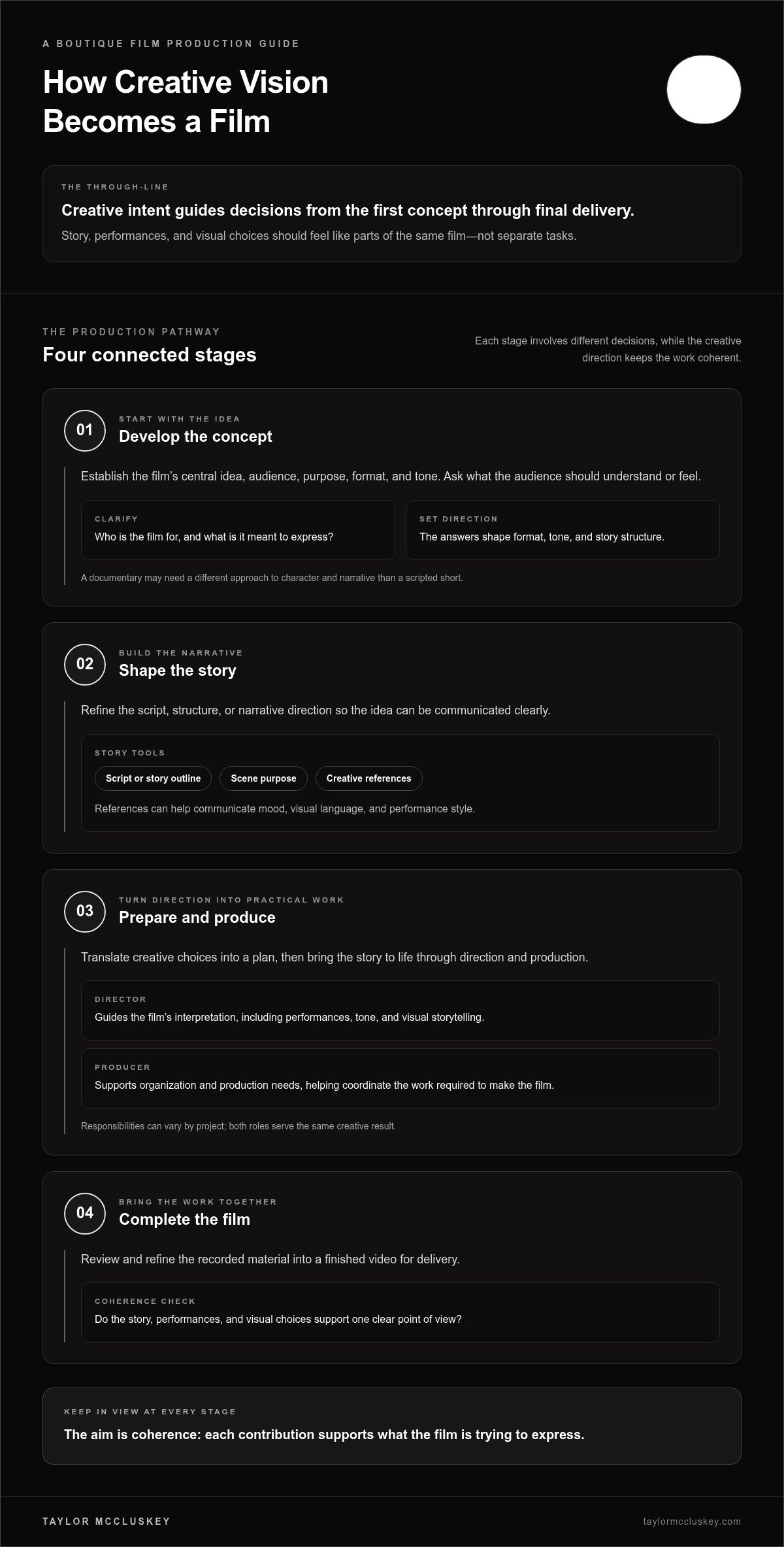
Film production services can carry a project from its first concept through story development, direction, production, and final video delivery. The stages are connected, but each involves different decisions. Creative intent acts as the through-line, helping the story, performances, and visual choices feel like parts of the same film rather than separate tasks.
From concept to a production-ready story
An initial idea becomes workable when its central subject, purpose, and point of view are clear. Who is the film for? What should the audience understand or feel? The answers influence its format, tone, and story structure. A documentary may need a different approach to character and narrative than a scripted short. Defining these choices early gives the project a direction that can guide the work ahead.
That direction informs writing and pre-production. A script or story outline can clarify what each scene contributes, while creative references help communicate mood, visual language, and performance style. Taylor McCluskey’s documented work offers examples across forms: he co-wrote and produced The Mirror, and co-wrote and produced the American Express-backed documentary Legends. The projects illustrate different kinds of storytelling, not a single approach that suits every film.
From direction and production to final delivery
Once the story and creative direction are established, planning translates them into practical work. The director guides the film’s interpretation, including performances, tone, and visual storytelling. The producer supports the project’s organization and production needs, helping coordinate the work required to make the film. Responsibilities can vary by project, but both roles serve the same creative result. Yale’s overview of the structure of a production team illustrates how roles such as director, producer, cinematographer, and editor contribute at different stages.
- Develop the concept. Establish the central idea, audience, purpose, format, and tone.
- Shape the story. Refine the script, structure, or narrative direction so the idea can be communicated clearly.
- Prepare and produce. Translate creative choices into a plan, then bring the story to life through direction and production.
- Complete the film. Review and refine the recorded material into a finished video for delivery.
At every stage, creative intent should inform the choices being made. A restrained story may call for subtle performances and composed images; a more kinetic concept may need a different rhythm and visual treatment. These are creative decisions, not fixed technical rules. The aim is coherence: each contribution supports what the film is trying to say.
A boutique film production house can connect these stages through focused attention to a project’s vision. TaylorMade Films provides filmmaking, directing, and production services from concept through final video delivery. Explore TaylorMade Films’ production work to see how creative direction and execution come together.
How to Evaluate a Boutique Film Production House
A portfolio is more than a highlight reel. It offers evidence of how a production house approaches stories, tone, and execution. To assess a boutique film production house, compare the work itself with the film you want to make. Credits can show creative range and experience, but they cannot guarantee how a future project will turn out.
| What to assess | What to look for |
|---|---|
| Creative fit | Does the work’s tone, visual language, and storytelling approach feel aligned with your idea? |
| Relevant credits | Which completed projects show experience with a similar format, subject, or creative challenge? |
| Project scope | Can the production services cover the stages your project needs, from concept through final video delivery? |
| Communication | Are creative decisions, responsibilities, and next steps discussed clearly? |
Match the portfolio to the story you want to tell
Compare individual projects, not just a showreel or promotional copy. A short film, documentary, and scripted drama call for different storytelling choices. Taylor McCluskey’s credits offer distinct reference points: Greenback$ is an award-winning short that earned him Best Actor at the 2017 Independent Filmmakers Showcase Film Festival; The Mirror is a project he co-wrote and produced; and Legends is an American Express-backed documentary he also co-wrote and produced.
Ask what each example demonstrates. Does its format match yours? Is the tone relevant? How does the work handle character, pacing, or visual storytelling? A credit can help you understand a filmmaker’s experience and range. It cannot promise that your project will follow the same path or receive the same recognition.
Assess creative collaboration and production scope
Strong fit involves both perspective and process. Identify the decisions that need alignment before production begins: the central message, intended audience, tone, format, and visual approach. Then consider whether the production scope connects the idea to the finished film, or whether key stages fall outside the work being discussed. A clear understanding of scope helps keep expectations grounded as the project develops.
Communication matters at every stage. Notice whether creative choices are explained in relation to your goals, and whether direction and production responsibilities are easy to distinguish. USC Online’s overview of how directors work with creative and production teams offers context on guiding the creative vision. For another perspective on how an artist’s point of view can shape a film, explore this guide to artist-led film production.
Project-fit checklist: choose a partner whose work aligns with your story, whose relevant credits demonstrate useful experience, whose scope fits your needs, and whose communication makes the creative process clear.
What to Prepare Before Starting a Film Project
A clear starting brief does not need to solve every creative question. It should give a production conversation something solid to build on: the story you want to tell, the people it is for, and the feeling or idea you want them to carry away. For a boutique film production house, these details help connect creative ambition to the project’s actual needs.
Shape the brief around the story
Begin with the central idea in a few direct sentences. Describe the intended audience and purpose, then note the format, tone, key message, and intended use of the finished film. A documentary, scripted short, and promotional film each ask different questions of the story. Clarity gives creative decisions a useful foundation without locking the project into every detail too early.
- Audience: Who should watch the film, and what do they already know about its subject?
- Purpose: What should the film communicate, explore, or invite viewers to consider?
- Format and use: What kind of film do you envision, and where or how do you expect people to encounter it?
- Tone: Should it feel intimate, energetic, reflective, humorous, or something else?
- Key message: If viewers remember one idea, what should it be?
Separate essentials from inspiration. Essentials are the elements the film must preserve, such as a central message, key subject, or particular point of view. Optional inspiration can include ideas you are open to changing as the story develops. This distinction helps protect what matters while leaving room for the creative process to reveal stronger choices.
Make creative references useful
References work best when they explain a quality you want to communicate, not when they prescribe a frame-by-frame imitation. Choose examples for specific reasons: one might convey pacing, another color or atmosphere, and a third the relationship between sound and image. Thinking about how sound and vision work together can help you describe how audio and imagery might support the narrative.
For each reference, write one note about what resonates and what does not. “I like the quiet pace and close perspective” gives a clearer creative signal than “make it like this.” Add practical questions to guide an initial project discussion:
- Which stages are included in the production scope, from concept development to final delivery?
- How will direction, production, and other creative responsibilities be handled?
- Which decisions about story, tone, performance, and visual approach should be settled before filming?
- What form will the finished video take, and how will delivery be defined?
- How will creative feedback be shared as the project develops?
Bring the essentials, references, and open questions together in a concise brief. It does not need to be polished. It needs to make your priorities visible and leave space for collaboration. Explore TaylorMade Films’ film production services as you shape your project conversation.
TaylorMade Films: A Multidisciplinary Creative Perspective
TaylorMade Films is the film label founded and led by Taylor McCluskey, who serves as its president. His work spans acting, writing, filmmaking, and music. That combination offers a distinct creative lens: stories can be considered through character, narrative, image, and sound, while each project retains its own form and direction. It is a perspective grounded in documented creative work, not a promise that every production will follow the same formula.
A documented body of film work
The credits offer concrete points of reference. Greenback$ is an award-winning short, and McCluskey received Best Actor at the 2017 Independent Filmmakers Showcase Film Festival for his work on it. He co-wrote and produced The Mirror, and also co-wrote and produced Legends, an American Express-backed documentary. These projects span different storytelling forms, giving prospective collaborators a basis for considering creative range and experience.
Youngblood adds another kind of recognition: its script was a semi-finalist at Flickers’ film festival. That distinction belongs to the script, not a claim that the film won an award. Taken together, the credits show several facets of McCluskey’s work. They can help a prospective collaborator think about tone, subject, and perspective, while leaving the creative possibilities of a new project open.
Film and music in one creative practice
McCluskey’s work as a musician sits alongside his filmmaking, connecting two disciplines shaped by rhythm, mood, and storytelling. The connection informs TaylorMade Films’ multidisciplinary perspective without implying that every film combines music and cinema in the same way. His EP Wild Ride was featured in Lifetime’s Don’t Look Back, a documented example of his music appearing in a screen project.
Music videos are a related format where visual storytelling and music meet, but their creative demands are distinct. A professional music video director guide can offer another lens on how a musical idea is shaped for the screen.
For anyone assessing a boutique film production house, TaylorMade Films brings a founder-led creative perspective supported by specific credits across short film, scripted work, documentary, and music. Those credits are useful context, not a forecast of a project’s results. Creative fit still comes down to the story you want to tell, the perspective you want to bring to it, and the production scope it requires.
Explore TaylorMade Films’ creative work to learn more about its filmmaking, directing, and production services.
Give Your Film Idea Its Next Step
A film begins to take shape when you move from imagining what it could be to expressing what it needs to become. Bring your central idea, the audience you hope to reach, and the creative choices that matter most. A focused conversation can turn those elements into a shared direction while leaving room for discovery.
Taylor McCluskey founded and leads TaylorMade Films. Its documented credits include Greenback$, The Mirror, and Legends; Greenback$ earned McCluskey Best Actor recognition at the 2017 Independent Filmmakers Showcase Film Festival. These works offer context for the creative perspective behind the label, not a promise of any future project’s outcome.
If you’re ready to explore how a boutique film production house can support your idea, explore TaylorMade Films and start a conversation about your film project. Bring the story you want to tell and the questions you want to resolve.
Frequently Asked Questions
Is a boutique film production house the same as a film distributor?
No. A boutique film production house is concerned with creating a film, while distribution focuses on bringing completed work to audiences through sales or release channels. These are separate functions, even when a company works across more than one. Films Boutique is a sales-focused outfit whose catalogue illustrates the distribution side. TaylorMade Films’ documented work is production; its film credits should not be read as evidence that it handles distribution.
How long does it take to produce a film?
There is no standard timeline for every film. A short, tightly defined concept may involve different development and production needs than a documentary or a scripted project with a more involved story. The scope also depends on what is required for filming and final delivery. A clear brief helps identify those needs and establish a realistic project timeline, without assuming a particular duration before the work is understood.
Can a film production house work on both documentary and scripted projects?
It can, depending on the production house’s portfolio and the scope of each project. Taylor McCluskey co-wrote and produced Legends, an American Express-backed documentary, and co-wrote and produced The Mirror, a comedy. Those credits show experience in distinct formats. They are useful context when considering creative fit, but they do not mean every production house works in both forms or that every project follows the same approach.
What is the difference between a film producer and a film director?
A director shapes how a story is interpreted on screen, guiding choices such as performances and the film’s creative approach. A producer guides the project’s overall realization, including the work needed to move it forward. Their responsibilities can overlap, depending on the production. On Greenback$, Taylor McCluskey is credited as writer, director, producer, and star, illustrating how one filmmaker can hold multiple roles.
Does a film production house help develop a story before filming?
Story development can be part of film production, helping clarify a concept and its creative direction before filming begins. The amount of development depends on the project and its starting point. TaylorMade Films’ production services cover filmmaking, directing, and production from concept through final video delivery. If you are still shaping an idea, begin by identifying its central subject and what you want the finished film to communicate.
What should I include in a film production brief?
Give a concise picture of the project’s core idea, audience, purpose, format, tone, key message, and any creative references that help convey your intent. For example, explain what a reference communicates to you, such as its mood or pacing, rather than asking for a direct copy. A short brief can also distinguish essential story elements from ideas you are open to developing together.


